Currently, the St. Louis Cardinals lead the National League Central by two games over the Pittsburgh Pirates and the Cincinnati Reds. Due to the latest turn in Uncle Bud’s Wildcard Ride, all three teams are guaranteed to make the playoffs, but only the division winner will automatically advance to the NLDS. The other two will play in a single Wildcard game to reach the division series. With the division coming down to the wire, everyone wants to talk about the worst-case scenario–or the best case scenario if you’re a Braves or Dodgers fan–a three-way tie that forces the NL Central teams into a brutal series of single game showdowns.
I have a better idea for resolving this potential problem. I think that everyone can agree that the Braves and the Dodgers are the real bad guys here, so how about we show some Central solidarity and solve this problem with some creativity.
One game. Three teams.
How is this possible? Well, to quote the classic 1997 film Air Bud, “Ain’t no rules say a dog can’t play basketball.” Each team will face both of their opponents in a single game. Each team will get a full nine innings on either side of the ball. It just won’t be at the same time.
Instead of halves, each inning will be divided into thirds. Home field and batting order will be determined by record against the other two teams. Best record plays at home, bats last. Second best record will bat in the middle third of the inning. Worst record will bat first.
Currently, the Cards have a .526 record against the Pirates and Reds, the Pirates have at .514 record against their opponents and the Reds have a .457 record. So the game would take place in St. Louis, Reds would bat first, then Pirates, then Cards. The Pirates pitchers would throw to the Reds batters in the first third of the inning, the Cardinals pitchers would throw to the Pirates batters in the middle of the inning, and finally the Reds pitchers would face the Cardinals batters. This way, each team faces one another. The team pitching would always bat in the following third of an inning, and then get a third of an inning to rest.
Winner of the three team game takes the division, then the team with the second most runs gets home field advantage for the play-in game. Given that each team has to outscore the other two to win the division, everyone will be equally motivated, even though each team’s batters are facing a different opponent than their pitchers. The only problem that could theoretically come up is if in the bottom of the ninth the Pirates are winning, the Cards are batting, and the Reds are pitching to preserve the Pirates lead with no interest in the outcome of the final third of the inning because they’ve already lost the division.
In this very unlikely situation, the Pirates will just have to hope that the Reds pitcher will be sufficiently motivated to become the first player to record a save for an opposing team because, hey, that’s pretty historic.
So let’s do it. Save some time. Three teams. One game. Twenty seven half innings. Baseball.
Legend has it that basketball was invented on a rainy day in the December of 1891. At the time, James Naismith, a physical education teacher and aspiring medical doctor, was teaching at a Massachusetts YMCA when the idea struck him. He had just attained the age of thirty, and being that life expectancy was far shorter at this time, he had begun to suffer a terrible midlife crisis. He’d taken up the opium pipe, he had spent the last of his cash on a sleek red soft-top horse, and now he was reconsidering future medical career. His mind was full of wistful thoughts of his childhood dream of becoming a great actor, dashed by Federal law preventing the exhibition of Canadians upon a stage.
It was this shattered dream, his professional training, and the need to make enough quick cash for his next horse payment that led to the development of the game that would be his legacy. Basketball, a sport played by actor-athletes, requiring both the skill to accurately lob a ball and the talent to pretend to be injured. Each match would appear to be decided by the players on the court, but the outcome would ultimately be controlled by the referees, allowing Naismith, who hand-picked the refs, to profit from the burgeoning sports betting industry without appearing suspicious.
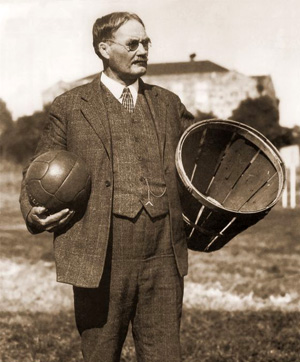
I can’t believe there is literally a picture of James Naismith with a ball in one hand and a basket in the other.
Basketball was a hit at the YMCA, where a number of boys had been seeking a socially acceptable outlet for their theatrical talents. The game spread to classical repertory companies, art schools, and even theatrical prep academies across the country. Professional squads, barnstorming and hustling from town to town, turned massive profits and soon consolidated, like the WWF, into a National Basketball Association. This brings me to this week’s game: NBA Jam.
NBA Jam, a 1993 release in arcades which was followed up by ports onto almost every conceivable home console, is one of the most successful sports games of all time. It didn’t just make it big across multiple platforms, but also helped spawn an entire genre: the ridiculously over the top arcade sports game. Sure, we had Base Wars before NBA Jam, and even NBA Jam owes a debt to its predecessor Arch Rivals, but the idea of taking a sport and distilling it down to the most simple actions, then cranking those actions up to Michael Bay levels originated here. Without NBA Jam, we would have never seen NFL: Blitz, The Bigs, NHL Hitz, or the only good argument I’ve ever seen for owning a Kinect, Diabolical Pitch.
In NBA Jam, the number of actors allowed on the court per team is lowered from five to two. This services multiple purposes. First, it is a function of NBA Jam’s origins as an arcade game. With only four actors on the court at any given time–two per team–each one can be controlled by a different person standing at the arcade cabinet. A four player arcade game can generate twice as much revenue as a two player game, and the idea of having every single participant in the basketball game controlled by a human was appealing. Second, it limited the number of sprites on screen, allowing a level of detail in the players that was fairly remarkable for 1993.
Wow, it really looks like a horribly monstrous version of Patrick Ewing.
Like all video games, NBA Jam was a product of its times. In 1993, the United States was still reeling from the hangover after the raucous party that was the 1980s. In my post about RBI Baseball, I referenced the singular focus on individuality that was mocked by the simplification of the game of baseball. NBA Jam does not subvert that fixation, but rather embraces it. Basketball ceases to become a team performance, and rather focuses on the acting skills of two players. But this isn’t about the way that media downplays collaborative effort in favor of individual performances. This is about something else.
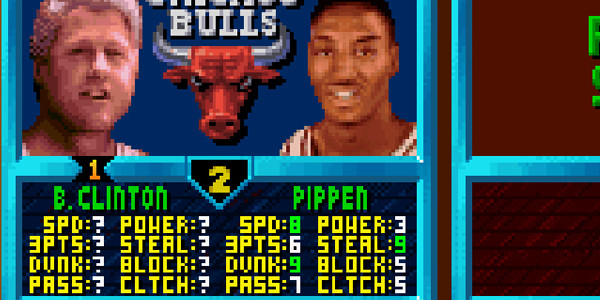
Known for signing the North American Three Point Agreement, President William Jefferson Clinton was fond of sinking the ball from downtown, if you know what I mean.
On February 28, 1993, the Bureau of Alcohol, Tobacco, and Firearms commenced a raid on the Mount Carmel Center compound, home of the Branch Davidians religious sect. The raid resulted in a siege of the compound that lasted almost two months, captivated the American public, and ended in a massive fire that killed the majority of the Branch Davidians, including their leader David Koresh. The Waco siege was a particularly unusual chapter in modern U.S. history, and set the stage for everything from the entrenchment of the survivalist ethos to the Oklahoma City bombing of 1995. It was also the unconscious inspiration for NBA Jam.
To understand the relationship between the Waco siege and an arcade basketball game, we have to start at the beginning. Specifically, with the Branch Davidian religion. Branch Davidianism is a sect of a sect of a sect of a sect. They broke off from the Davidian Seventh Day Adventists, which based their teachings off of a two book series (entitled Shepherd’s Rods) by the reformist Victor Houteff. The Davidian Seventh Day Adventists were, naturally, a sect of the Seventh Day Adventists, which themselves are the largest sect of the Adventist protestant movement.
This image of the siege is the very first google image search result for “Waco”, which really sucks for a town with a rich history like that other time it exploded just last April.
Adventism has its roots in the teachings of William Miller, a mid-19th century preacher who taught that the return of Jesus was just around the corner. Miller’s downfall was like that of so many similar men, in that he gave a precise date to the second coming–October 22, 1844–and when it didn’t happen most people rightfully stopped taking him so seriously. Some, however, decided to cut Miller a bit of slack and give him the benefit of the doubt. Jesus didn’t come back on October 22, 1844, but that didn’t mean he didn’t start getting ready. Essentially, the remaining Adventists decided that William Miller had the right date, but that it wasn’t the date of Jesus’s return but rather the day he started packing his bags to eventually return.
See, my son, I told you that satan does not have a kickin’ rad rear projection TV like I do. …what? He has a plasma?
Now, as we all know, Jesus doesn’t have to worry about having a variety of daywear and eveningwear on his journey back to Earth, so he isn’t packing his bags with clothes. Rather, he’s filling his luggage with souls. And the reason he is taking his time is because he wants to make sure he takes along the right souls. This process is known as “Investigative Judgment”. Seventh Day Adventists are big into Investigative Judgment, which has led to a conservative mindset among the movement. They also have returned to celebrating the Sabbath on a Saturday, but that makes perfect sense because it makes NCAA Football players heathens rather than NFL players.
Salvation up front, party in the back.
The Davidians shared the belief in the Investigative Judgment, but specifically diverted from the mainstream Seventh Day Adventist movement by embracing the importance of prophecy, vegetarianism, and, later, disclaiming Israel as the pre-Millennial kingdom. Meanwhile, the Branch Davidians differed from the Davidians by moving up the date of Jesus’s judgment to 1955 and, for a time, incorporating some unexpected feminist teachings into the religion. Unfortunately, all the good–or at least pleasantly radical–stuff was stricken from the religion and upon the death of Lois Roden, who was their leader throughout the late 70s and early 80s. The majority of the religion was taken over by David Koresh, who banned the feminist teachings of Roden and turned the Branch Davidians into a run-of-the-mill crazy survivalist sect led by a run-of-the-mill charismatic who wants to be Jesus except without all the Teaching Good Things and instead Molesting Underage Girls.
NBA Jam is basically to basketball what Branch Davidianism is to mainstream Christianity. The rules and customs of the sport have been filtered through a number of iterations. Basketball evolved into NBA Basketball, which was forced into the two-on-two format NES game Arch Rivals, which, like the splintering of the Davidians into the Branch Davidians, transformed into the madness of NBA Jam.
And then everyone caught on fire.
That’s it. That’s the punchline.
I was lazy with this one because I’m still playing too much Grand Theft Auto V and watching near-playoff baseball. Also fuck trying to get a Sega Saturn emulator working, that’s just a time sink. I’ll be back with a real post next week, I promise.
All sports games are divisive. Either you are a fan of the sport and its digital representation, or you find them utterly boring. And no sports game is quite as divisive along these lines as the golf video game. To most people, the idea of virtual golf is duller than than the pain of a lingering bruise. But to others it is a joy, if not an obsession. These players range from folks who enjoy a drunken game of Golden Tee at the bar, to the fans of EA’s Tiger Woods series, and finally to the madmen who still play Links. Capturing this audience is difficult, as there are only so many ways to distinguish a new golf game from those that came before. This brings me to this week’s game:
This is the only game I’ve played since Tuesday so this is the game you’re going to get.
In 2013, Rockstar Games released its first foray into the highly competitive golf market with Grand Theft Auto V for the Xbox 360 and Playstation 3. Rockstar was previously known for its work in revolutionizing the world of virtual ping pong with Rockstar Games Presents Table Tennis as well as the wildly successful bowling title, Episodes from Liberty City. However these were just warm-ups for the Scottish developer as they prepared to tackle the national sport of their homeland.
Thank God no one is sensitive about racism towards the Scottish because this picture. This picture.
The name Grand Theft Auto V originates from a phrase in the Doric dialect of Old Scots, “graend ‘heft otta V”, which refers to a very specific set of circumstances in the game of golf, when the ball is removed from play on the green (the “graend ‘heft”) by an otter or other woodland creature (the “otta”). This permits the golfer to take another swing from the “V”, which was the ancient equivalent to the golf tee–a v-shaped piece of wood used to hold the ball on the first drive that was in fashion before industrialization allowed for the mass production of proper tees. Up until the invention of otter traps, this phrase was common parlance on the Old Course at St. Andrews.
“Aye! Ye baill gyan missin’. Looken like a graend ‘heft otta V, taik ‘er back.”
Aye! Nah again!
As demonstrated by its choice of title, Grand Theft Auto V seeks to return the sport of golf to its Scottish roots. Unlike in the United States, where golf is considered s port of privilege, only open to the wealthy, in Scotland it is considered a far more egalitarian affair. Some of the most famous courses in the world, including the aforementioned St. Andrews, are open to the public. There are several government-owned courses with subsidized fees that are accessible to everyone.
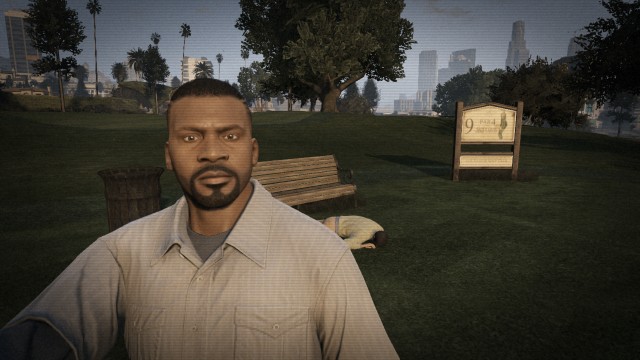
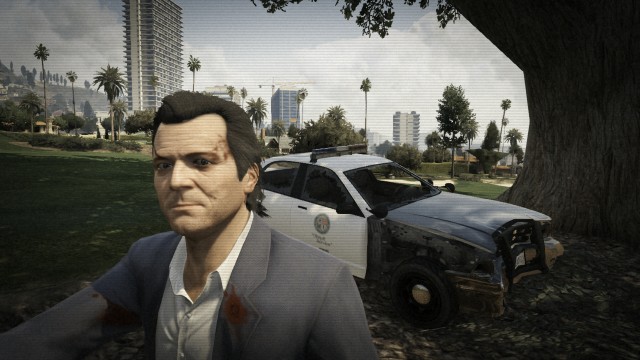
To further its goal of the democratization of golf, Grand Theft Auto V allows you to play as three characters from across the spectrum of social privilege. Rather than provide a selection of real golfers, these three golfers–Michael, Franklin, and Trevor–are fictional. Michael is a retired, wealthy man. The kind you would expect to see on the golf course. Franklin is an African-American of limited means, and Trevor is white trash incarnate. In St. Louis, we would call Trevor a hoosier but anywhere else that’s just going to sound like he’s from Indiana. St. Louis is weird about the word “hoosier”. I don’t think Trevor is from Indiana.
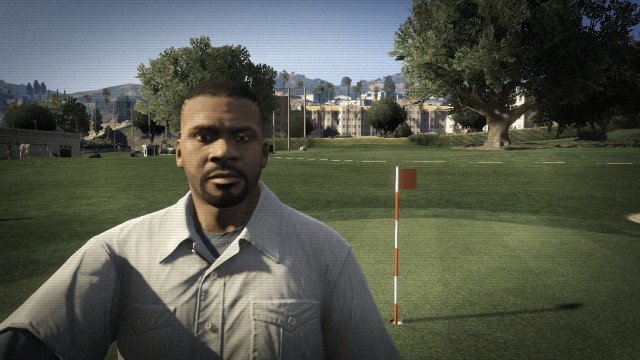
Franklin enjoys a day on the golf course.
Back in the Nintendo 64/Playstation 1 era, the days of games like Waialae Country Club: True Golf Classics, only including one golf course was acceptable. However, for a 2013 release, the inclusion of only a single 9 hole course was rather disappointing. This may be a reflection on Rockstar’s Scottish view of golf. Rather than offer a variety of locations, which would be available to a jet-setting celebrity or CEO, Grand Theft Auto V encourages a laser-like focus on a single local course.
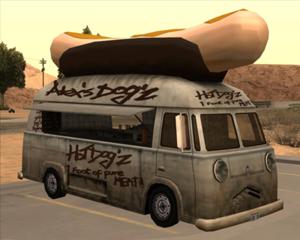
The location, in this case, is the fictional city of Los Santos. This is likely a licensing issue, as representing the existence of the course in any real city would pose a risk of brand confusion with any real course within that city. This may be disappointing to hardcore golf fanatics who have grown accustomed to the realism of the Tiger Woods series, but it’s not without reason. The specific layout of golf courses are protected from duplication or adaptation by the International Links Protection Agreement of 1998, which states that any recreation–physical or otherwise–of a protected property must be approved by a joint panel of judges selected from the U.S. judiciary, the Scottish Court of Session, and the International Court of Justice. EA, with its long-running series, has been willing to draft the necessary petitions and pay the necessary bribes, but Rockstar chose to forgo the hassle for its first attempt at a golf game. Incidentally, the poorly drafted definition of “links” in the 1998 ILPA is also the reason very few video games directly use the phrase “hot dog”, and instead use the generic “processed sausage”.
Two German diplomats had to die to make this possible. Don’t ask which ones.
The gameplay in Grand Theft Auto V is simple, and like Rockstar Games Presents Table Tennis easy for a beginner to jump into. The game automatically suggests the club, trajectory, and desired strength for each swing of the club. These suggestions aren’t perfect, and if you want to get under part, you’ll have to learn to tweak them, but they do just fine for the first time on the green. There’s also some light RPG elements, as each character levels up as you play. Swings can increase your strength, and running from hole to hole has a chance to increase stamina. Diving into the water hazards can also increase lung capacity, presumably allowing your golfer to yell “FORE!” with greater power.
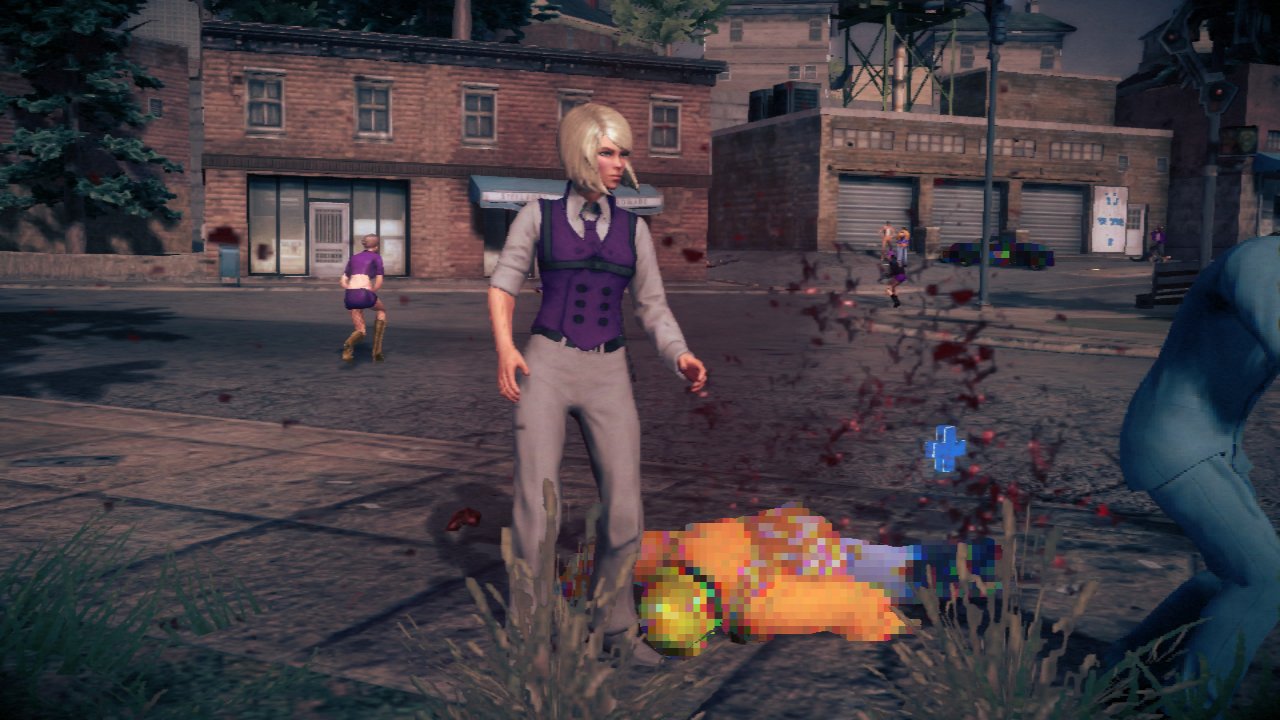
In Grand Theft Auto V, golf is a surprisingly brutal sport.
As you’ll note in the screenshot above, Grand Theft Auto V fills the background of the golf course with virtual buildings. Unlike most sports games, however, GTA V supplements its rather simple gameplay with the option to explore the area surrounding the course. You can walk your character off of the course and into the city. You can go through the streets on foot, in a car, or in a number of aerial vehicles.
The purpose of this side activity is twofold. First, it adds depth to a golf experience that can take less than thirty minutes to complete. Second, it gives context to egalitarian theme that persists throughout the game. In exploring the various neighborhoods within a short distance of the golf course, the lines between the wealthy and the poor become blurred. Within a few seconds, you can pass between mansions and slums, construction sites and beaches.
GTA V represents a message from the shores of Scotland to the heart of the United States: Golf is for everyone.
Franklin continues to enjoy golf, and doesn’t want you to look at what’s in the background of his picture.
Now that I have horribly shoe-horned GTA V into the theme of this blog, I’ll write quickly what I think of the real game, as I have been surprised by just how much I’m enjoying it. I didn’t come into this year, or even this month, with much excitement for GTA V. Games like the Saints Row series, Sleeping Dogs, Just Cause 2 and Infamous had all progressed the open world action genre so much that I wasn’t sure if I wanted another GTA. I didn’t even particularly like GTA IV, though I can’t say for sure how much of that was due to a sluggish opening act and a lack of mid-mission checkpoints. Then I watched a trailer for GTA V, found out Tangerine Dream was working on the soundtrack, and heard some of the boasts about the size and scope of the game. I realized I had to play it, if only to keep up with the zeitgeist and to see how in God’s name it ran on the current, outdated consoles.
Turns out, GTA V is a pretty great game. In a lot of ways, it is more of the same, the radio/TV attempts at humor are oddly dissonant with the themes of the rest of the game, a female protagonist would have been nice, and there are some undeniably problematic issues that shouldn’t be ignored. But the formula has been refined to a point. The city and the countryside are gorgeous. And maybe for the first time since Vice City the storyline missions are actually fun to play.
Something has gone incredibly wrong.
Most remarkable, though, is how GTA V feels like an attack on itself and the forces that created it. Five years ago, Rockstar Games tried to dramatically chang its formula, reeling in the silliness of San Andreas and focusing on a more personal storyline about the cyclical terror of violence with GTA IV. The game was a huge success, but complaints about nagging side characters and the dissonance between the story and the typical GTA player’s desire to rampage around the city abounded.
Like Michael in GTA V, Rockstar wanted to move on from a life of creating mayhem and do something different. But mayhem is what is expected of them, and it’s the one thing that the world thinks they are good at. So they are dragged back in. The silliness is back. Mini guns, blimps, gas cans, drug trips, and exploding smartphones. But GTA V doesn’t thank its fans for pulling it back in. Rather, it forces the player to think about how awful it all is. The world of GTA V is full of vile, unlikable people. None more than Trevor, and literal embodiment of what fans want Rockstar to make. His character lives like every GTA player acts outside of missions. He is violence for violence’s sake. But he is also a pathetic sociopath, and the commentary couldn’t be clearer. You don’t want to play as Niko Bellic or John Marston, whose characters make you question your desire for indiscriminate violence? Then you have to be Trevor, and Trevor ain’t pretty. He’ll drag you, and Michael, and Franklin, and Rockstar itself into the darkest of places, where you’ll wish your cousin could give you a call to go bowling.
So maybe you should just stick to the golf course.
I understand why some people don’t like baseball. For the most part, it’s a boring game. Most of your time at a baseball game is spent waiting for something interesting to happen. Most pitches don’t result in solid contact, and most contact results in an out. Watch baseball long enough and you understand. The game makes sense, and several minutes of nothing happening suddenly becomes exciting. In fact, it’s even better when one team makes nothing happen for the entire game. A perfect game. One of the most thrilling things to happen in the entire sport of baseball is for 27 consecutive batters to fail to make anything thrilling occur.
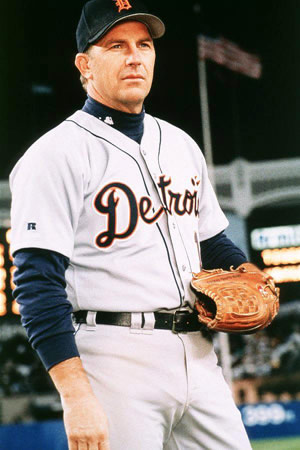
This film is actually about the New York Yankees repeatedly failing, making it the greatest film of all time.
In a way, baseball teaches us to expect disappointment. It makes us cynical, and lulls us into a sense of false security that the game will continue to disappoint. The crack of the bat is nothing but a loud strike, fouled down the line. The soaring fly ball will stay in the stadium. No amount of effort can push the runner to first base before the ball beats him on the throw. And then, once our expectations are ground into dust, baseball surprises us. It gives us the moment we stopped hoping for. All the excitement is condensed into a series of quick bursts. Suddenly there are runners on base. The pitcher is sweating. And now that hit–that unlikely hit–could actually put the run on the board.
This is why I’m writing about a baseball game again, less than two months into this project. Because while some people don’t like baseball, I love it. That doesn’t explain, however, why I’m writing about another NES baseball game developed in Japan and released in the late 80s.
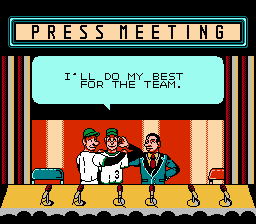
“Yes, I have a question for the man in the blue suit. Why do you need six microphones for three people?”
Baseball Stars came out over a year after RBI Baseball, in 1989. These two games, along with Bases Loaded, comprised the three major baseball games for the NES. I promise I won’t write about Bases Loaded, though the third installment does suddenly reinvent the game of baseball as a grueling saṃsāra, in which the player must play game after game until achieving the developer’s idea of perfection by following Ryne Sandberg’s Eightfold Path.
Karma Above Replacement Player.
The real reason I am writing about Baseball Stars has little to do with my love of baseball. Any sport could have been the one to implement the two features that really stood out in Baseball Stars. The first is a bare-bones GM mode, allowing players to create their own teams, organize their own league’s, hire, fire, and trade players. This is was critical to the success of Baseball Stars , since it didn’t feature MLB or MLBPA licenses. This level of customization was unprecedented in console gaming at the time and paved the way for similar features: roster editing, franchise modes, and the bizarre abomination that was NFL Head Coach.
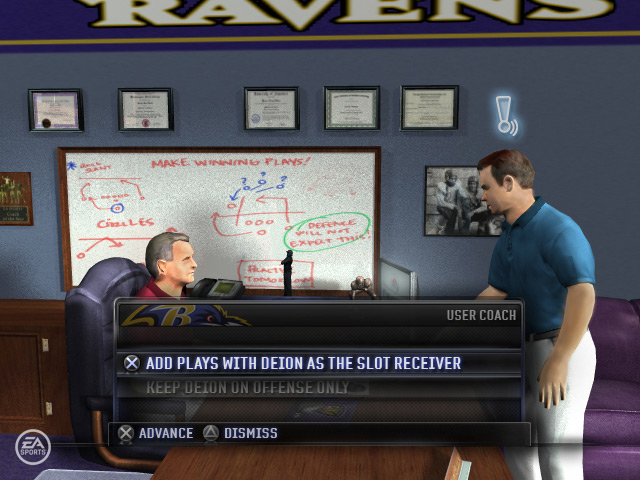
It’s a good thing he wrote down his cunning strategy of “make winning plays!” because he might have forgotten otherwise.
The second unique feature about Baseball Stars hasn’t become so ubiquitous. Unlike any mainstream team sports game of its time, and unlike almost every single one to come after, Baseball Stars allowed female characters. More specifically, the default set of teams featured an all-womens squad (the Lovely Ladies, which is an unfortunate name but it was 1989), created players could be women, and with a cheat code you could make an overpowered female team.
I sure hope RO Kelly pitches better than Joe Kelly last night.
Representation of women in gaming has been a hot topic recently, as the world is beginning to wake up and realize that the demographics have changed. For years, playing video games was perceived as “for boys”. It’s important to note that this isn’t just a sexist assumption, based in the dumb gender roles that have seen boys scolded for playing with dolls and girls steered away from the t-ball squad, but also fixated on youth. Video games were for kids, specifically male kids and no matter what Midway wanted everyone to believe, even so-called mature games like Mortal Kombat were marketed in that direction.
Video games, and specifically the phrase “rated M for Mature” have been singlehandedly responsible for the semantic drift of the word “mature”.
As consumers grow up, gaming is trying to grow up. Everyone involved is realizing that the market is–and always has been–much larger than just boys. People are starting to understand how the industry has been pandering to a very specific demographic for a long time, and how that pandering is excluding other groups. And the very boys who have spent the last twenty years being pandered to in video games are FURIOUS if anyone suggests this should change.
Can you imagine the internet death threats that would have been sent in 1989 over this picture?
Progress is slow. Call of Duty: Ghosts will be the first in the series to allow players to use a female avatar in multiplayer, but it took until 2013 for a series with a billion entries to finally make this addition. Assassin’s Creed only featured a woman in the lead role in a Vita spinoff, Assassin’s Creed: Liberation. Grand Theft Auto V, probably the biggest game of the year, has three main characters and they are all, for some reason, men. Granted, there are indications that you will be able to choose a female character in the online component, but Rockstar is so so secretive about everything that there is no telling what the options will be and you’ll probably have to pick which former U.S. President to play as in an homage to Point Break.
Baseball Stars was an extreme outlier, to the point where sequels to Baseball Stars removed the ability to make women’s teams and female players. Granted, it was a cosmetic change and the implementation of it was rather weak–the brief animated cutaways and even the fielding didn’t feature female player models–but removing it was still a shitty thing to do.
Female players looked identical to male players in the field, which is to say that they looked like chubby men in skin tight jumpsuits.
At least in sports games, the inclusion of female characters has been dire since the first Baseball Stars. Tennis games and the occasional golf game have featured women, but the major U.S. team sports have been devoid of the option. Arguably, the reason is because women don’t play these sports in the leagues that are being portrayed within the game. There are no female MLB, NFL, or NBA players. Baseball Stars proved in 1989 that this is not a good excuse. Understandably, developers will not stick women on a roster where there aren’t any female players. However, there’s no reason to disallow created players to be female. And don’t say it’s player models. Most modern create-a-player modes allow for a wide variety of height, weight, and body shape.
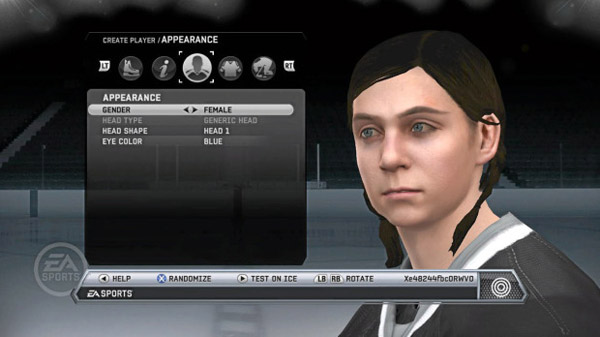
The absurdity of this was made evident when EA decided (much to their credit) to add female created characters to their NHL series in NHL 12. After receiving a letter from a fan, who wondered why she couldn’t create herself in the game, EA received permission from the league and…they added few female faces and a wider range of create-a-player sizes when switching gender to “female”. That was it. that was all it took.
And all the sudden the other half of the population can see itself represented in your game, at barely any cost to anybody.
I feel like I should throw out some credit to another sports franchise, an old favorite Baseball Mogul, which for as long as it’s been around has had a feature in which you can determine the year women enter baseball. When setting up a league, you can determine the year in which female rookies can be drafted/show up in minor league systems. Again, this is an incredibly tinything, since Baseball Mogul is only a step above an interactive spreadsheet and adding female players only means changing the pool of first names that the spreadsheet pulls from for generating rookies. But the fact that it’s such a small thing is an indictment on other developers who don’t put in the same functionality.
Yep.
I will concede that sports games have the best excuse of any for the minimal representation of women. There may be licensing issues related to the league, or other similar hurdles to be cleared. I believe that EA had to seek approval of the NHL to add female characters, and there’s no telling what the offices of Bud Selig or Roger Goodell would do with such a request. I would hope they would realize that it was a gesture that didn’t hurt them, didn’t hurt their league, and potentially create a whole new vector for a larger audience. But the world of professional sports can be just as pig-headed and pandering as the world of video games, so who knows.
That doesn’t mean there shouldn’t be a change. And because of games like Baseball Stars and NHL 12, it seems like maybe some of that change can happen in sports games. As far as I’m concerned, it’s not happening fast enough elsewhere. Arguably the two biggest games so far of 2013, Bioshock Infinite and The Last of Us were extended escort missions in which the main character was an older, world-weary man protecting a young, naive girl. And they actually represent progress because the female characters in them aren’t helpless and develop as characters. Saints Row IV, the fourth installment of a series in which your character is repeatedly turned into a walking toilet, unfortunately represents a high water mark for equal opportunity representation in big budget, big release games this year. And that’s because it lets your character be anything from a young skinny black man to an old, fat white woman to Nolan North and doesn’t change the story or script one bit based on your choice.
With the exception of MAYBE the cockney guy the female voices in Saints Row 4 are the only way to go. Russian spy, southern belle, or Laura Bailey? What the hell are you doing playing a male character?
Gamer culture needs to change. Any culture that produces exampleslikethese should be taken out behind the woodshed and shot like a rabid dog. Unfortunately, it takes more than one bullet to take down a monstrous, societal behemoth like toxic gaming culture. It needs to be attacked on every end, from every angle, and that includes sports games, as unlikely as they might be.
Baseball Stars had the right idea. Maybe there are reasons that a women couldn’t make it in professional baseball. It may be decades before we know, because a whole lot of old men are going to have to die before it’s even considered. But why can’t a woman make it in video game baseball? Why can’t video games let us play in a better world?
In 1989, the owner of Titan Sports, Inc., admitted that professional wrestling was staged. This wouldn’t have been a big deal, except for the fact that the owner of Titan Sports, Inc. was named Vince McMahon and that his company was better known as the World Wrestling Federation, or the WWF. At the time, the WWF was arguably the biggest it would ever be. McMahon had built it from a loose conglomeration of regional competitions into something resembling a nationwide league. Millions of people watched Wrestlemania every year. The steroid scandal of the early 90s hadn’t reared its head yet, Hulk Hogan was a household name, and the USA was in the brief period when people with disposable income unironically wore mullets.
Pete Sampras’s rival Andre Agassi proudly demonstrating just about everything you need to know about 1989.
McMahon didn’t reveal the secret of professional wrestling because it was the honorable thing to do, or because he wanted to prevent young fans from emulating the stunts of their WWF heroes. No, he did it because he wanted to make a little bit more money. New Jersey, the site of Wrestlemania IV and V, taxed the broadcast and exhibition of sporting competitions. McMahon was willing to swear that there was nothing competitive about professional wrestling to get around the tax. It didn’t work (you can read a court decision discussing these matters, and more, here) meaning that the WWF stayed clear of New Jersey until the tax was lifted in 1997. When they came back, they were absolutely puzzled that they still couldn’t pump their own gas.
Of course, the fact that professional wrestling was not a sport was not a complete revelation. In 1957, Roland Barthes wrote of the spectacle of professional wrestling. He noted how the rules, the costumes, and even the very physiques of wrestlers were just a series of signs, pitted against one another in a performance that was far more drama than sport. But, let’s face it, the typical WWF fan in 1989 didn’t read Barthes, and at the time the shows were almost plausible enough that they could be real. This was pre-Undertaker, folks, and while the storylines were obviously scripted perhaps–just perhaps–the matches were not.
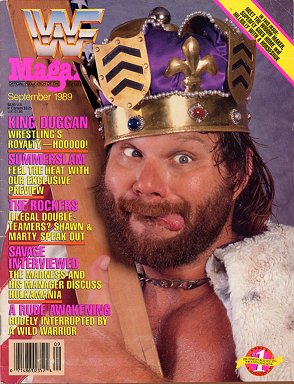
The September 1989 issue of WWF Magazine. Okay, no one could possibly have believed that this was real.
I won’t talk too much about professional wrestling itself, if only because Barthes did it a whole lot better 60+ years ago and nothing has really changed. Check out The World of Wrestling, which I am only linking here because I assume that if MIT put it online then it’s probably okay to read without buying a copy of Mythologies. Go check it out. The important point I wanted to make was that, as early as 1989, the WWF was officially fake. There were no pretensions to reality, except to the kids I went to grade school with but I suppose they can be forgiven for being unaware of New Jersey Tax Court filings.
The Ultimate Warrior reacts to reaching the limitations of structuralism and realizing, as Barthes did before him, that no matter how much rocket fuel he loads the spaceship with, his powerslam will never produce a transcendental signifier.
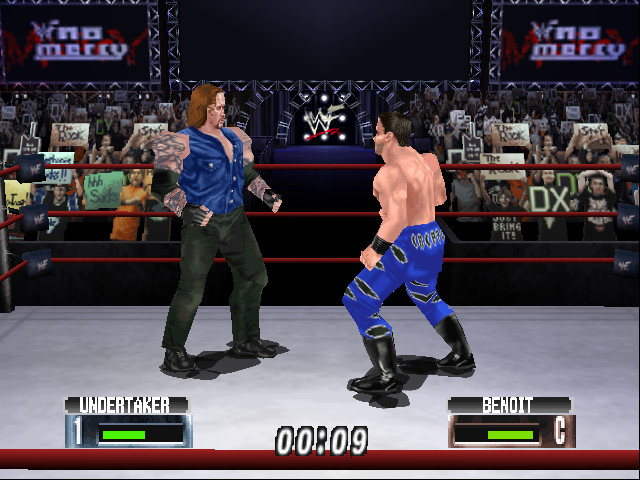
The real subject this week is the WWF: No Mercy for the N64. No Mercy was the sequel to the previous THQ WWF joint, Wrestlemania 2000, released in 1999 because everyone was going by Madden years at that point. THQ, via developer AKI, had previously worked on games for the WCW/nWo wrestling license. Many people consider No Mercy the last truly great professional wrestling game, as THQ afterward moved primary development from AKI to Yuke’s, who worked on the contemporaneously released Playstation wrestling titles. God help me, I also played a bit of a recent Yuke’s title, WWE ’13, and it seems perfectly acceptable, if a bit workmanlike, but some people stand by the AKI N64 titles. AKI continued to ply their trade, though, and went on to develop the Def Jam: Fight for New York, a fighting game featuring Snoop Dogg and Ludacris, so I think the world won out in the end.
What’s most interesting about WWF: No Mercy, and honestly all WWF/WWE games as a whole, is their utter, slavish devotion to kayfabe. Kayfabe, for those who are unaware, is the official, unofficial term used to refer to the illusion of professional wrestling as reality. Kayfabe is the believe that the rivalries are real, the matches are not pre-determined, and everything that that happens in the ring is a true, competitive sporting event. In WWF: No Mercy there is no acknowledgment of what people have known since 1989 (and before), which is that wrestling is a staged performance that is more about telling a story than athletic competition. WWF: No Mercy presents wrestling as nothing other than any other sport. It features a campaign not terribly different from Pete Sampras Tennis, pitting the player’s chosen wrestler against a series of opponents in a quest for a championship.
Too soon?
The player controls only the performer, and wrestles only against other performers. The AI similarly does not act as an actual WWF wrestler, working off a script and struggling to portray an inevitable victory or defeat as the result of a competitive match. In the WWF and WWE video games, the wrestlers do face off in a competitive match. Either side can win or lose. There is no script, no bible… Not even Faces or Heels. The player can inhabit any wrestler, whether good or evil, and bring them victory. The player can even create wrestlers to challenge the existing WWF superstars.
Getting ready to introduce the nWo to the power of the BwO.
The closest that WWF: No Mercy comes to an awareness of wrestling’s true nature is the bizarre Guest Referee mode, in which the player takes control of a wrestler who, for some reason, has been given the job of referee. In this mode, the player can observe and referee a match, calling both submissions and disqualifications for remaining outside of the ring during a match. The goal appears to be to arrange a situation in which both wrestlers lose simultaneously, giving the referee the win. Of course, your ref can play dirty, smacking the two wrestlers around to create this situation. At least in this single mode, the game acknowledges that the matches are not controlled by the skills of the participants, though it chooses to do so in a roundabout fashion.
#1reasonwhy
Why is this? Throughout almost the entire history of WWF/WWE video games, none has portrayed professional wrestling for what it really is. Yukes’ later Smackdown v. Raw and WWE games on the current console generation come close, allowing players to script out story lines in a (rather impressive) comprehensive mode that includes scripted cutscenes and dialog. However, the matches are still won and lost by the skill of the player. And the WWE Universe mode, implemented in recent versions of the game, buys into kayfabe to the point where roughing up an opponent during a match can lead to legitimate, non-accidental injury. In the real WWE, both wrestlers are doing everything they can to prevent injury, which given the stunts they are performing is the real, impressive measure of their athletic talent.
It’s not necessarily easy to imagine how a game would successfully break kayfabe, acknowledge that matches are staged, and incorporate this into gameplay. But it’s also not impossible. Losing a match as a professional wrestler takes as much–if not more–skill than winning a match. Selling a loss isn’t easy. The player would still be required to wrestle “better” than her opponent to a certain point in the match, but also take enough hits to make a throwing the match at the last second believable. Prior to 2010, wrestling games could have incorporated the application of fake blood as a gameplay mechanic. There could be storyline penalties for no-selling a loss and winning anyway. Hell, losses could be forced on the player in a dusty finish. The goal might be to win a championship, but it also might rather be to get over on the fans, and earn their adoration or hatred as a face or heel. It would be more interesting gameplay than what WWF: No Mercy has to offer in the ring, which is really just a slow, grapple heavy fighting game, and especially more interesting than Yukes’ system. So Why Not?
Being able to turn off “attitude” undermines everything that the WWF was attempting to do in the late 90s.
In The World of Wrestling, Barthes describes a professional wrestling match as a display that “takes up the ancient myths of Suffering and Humiliation”. The act of one man putting another in a hold, immobilizing him while his face contorts in agony, symbolizes an agony that goes beyond defeat. It represents torture and submission in a way that no touchdown, homerun, or even bloody hockey fight can convey. There is duration and struggle to these moments, and they are used to multiple effects. These moments of submission can be a great injustice, like when a heel breaks the rules and catches his opponent off guard with a well-placed folding chair. But they can also signify redemption when the heel gets what’s coming to him in the end.
The blocky figures of the wrestlers represents how boys are forced into rigid stereotypes of masculinity from a young age.
When professional wrestling is treated as a voyeuristic morality play, the idea of putting the player in the position of the actor suddenly becomes problematic. No one wants to suffer, but suffering is part of life. Whether it’s a hard day at work, or breaking up with a girlfriend, or being pinned to a soft mat in front of thousands of people by a man covered in gold paint, everyone accepts that they have to deal with a little pain. But there’s nothing worse than faking pain. Getting hurt is bad, but it happens. Accepting that you are hurt is worse, but it is just an acknowledgment of an obstacle to overcome. Pretending to be hurt, though, is inexcusable. And, for the most part, professional wrestling is built on the backs of men who pretended to be hurt.
Losing a fixed fight isn’t the most awful part, though. The real reason that a wrestling game will never subvert kayfabe and present the sport accurately is that no one wants to win a fixed fight. Throwing a match realistically is an interesting gameplay idea, and fixed fights resulting in losses are a storyline staple of RPGs. But players simply would not accept, under any circumstances, a game in which the victories were staged. No one wants to believe that the hard work put in to achieving success was in any way pre-determined by a larger, powerful system that they will never have control over. Wrestling video games are ultimately built on the same deception as the myth of the American dream.
More than that, victory in professional wrestling is supposed to be an act of justice. The heel is brought before the crowd and humiliated. Eventually, the face always wins (or the heel becomes a face, but that’s a whole different recipe that the Rock is cooking). A video game that forces the player to actively participate in the forgery of righteousness hits too close to home for the intended audience. It would serve as a reminder that retribution is often more symbolic than meaningful. Whether it is the trial of a murderer, the bombing of a country that used chemical weapons, or a cringe-inducing hold that leaves the Iron Sheik pretending to be crippled, violence does not create justice. We like to believe that it does, but at best an act of violence is a deterrent and at worst it is an accelerant towards greater strife.
These acts of violence are inflicted upon a target, but they are directed at the audience who watches from afar. And that audience–the people who play games like WWF: No Mercy–are not interested in participating in the kabuki. They want to watch. They want to believe that it’s real, or at least that it means something. That is why they cannot be allowed to participate. As soon as you let them participate–as soon as you let people in on the portrayal of the act and make them the perpetrators of fake or meaningless violence–they are turned off by the idea. No one would buy that video game. No one bought Spec Ops: The Line, after all.
Simply, a WWE game that broke kayfabe would be too subversive. It would reveal too much about why we inflict violence and perceive victory . And that’s why it needs to be made.














 The Redbird Menace