
On the Career of Rick Ankiel

On August 9, 2007, in the bottom of the first inning against the San Diego Padres, the starting right fielder for the St. Louis Cardinals took an awkward swing at a Chris Young fastball and popped it straight up, not even out of the infield.

Geoff Blum, who at this point in his career shouldn’t have been playing shortstop for a team with playoff aspirations, settled under the ball and retired the right fielder.

All in all, it was an unremarkable at bat in an unremarkable game from a season that felt like the lengthy hangover after the 2006 championship celebration. Except for one thing: the starting right fielder for the St. Louis Cardinals was a 28 year-old Rick Ankiel, making his second Major League debut.

Rick Ankiel’s first Major League debut happened eight years earlier.  Adam Kennedy would start at second base for the Cardinals in both of Rick Ankiel’s debuts, but was traded for Jim Edmonds in between. The St. Louis Cardinals faced the Montreal Expos, a team that would no longer even exist when Ankiel stepped to the plate in 2007.  Mark McGwire was at first base.  Alberto Castillo was behind the plate.  The outfield featured Ray Lankford, the legendary Craig Paquette, J.D. Drew and even Willie McGee for the last few innings.

Most importantly, Rick Ankiel made his first debut as a pitcher.

Most people remember the sweeping curveball. It wasn’t a 12-6 hammer like Adam Wainwright’s signature pitch, or a diving air-to-ground missile like Shelby Miller’s hook.  Ankiel’s curve started up and away and tumbled through the strike zone to the catcher’s mitt low and in.
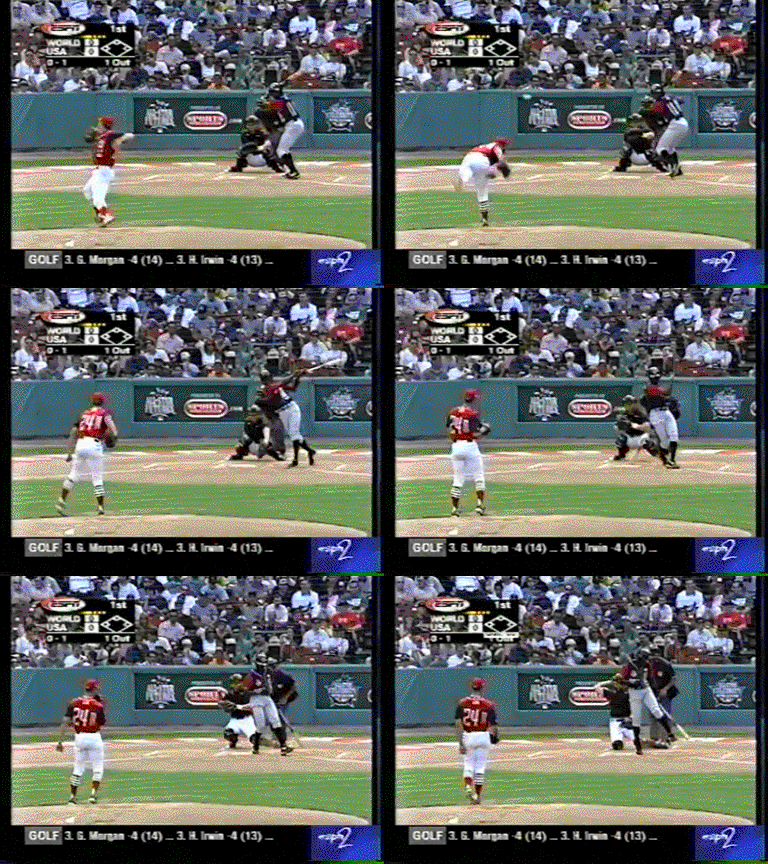
It was a thing to behold, but it wasn’t what really made Ankiel special.  He combined this curve with two fastballs.  One, a straight pitch, effortlessly touched the mid-90s and could blow away any hitter who wasn’t expecting such velocity from a lefthander.  The other fastball, a sinker/two-seamer, came in almost as fast but danced downward, just out of the hitter’s reach.
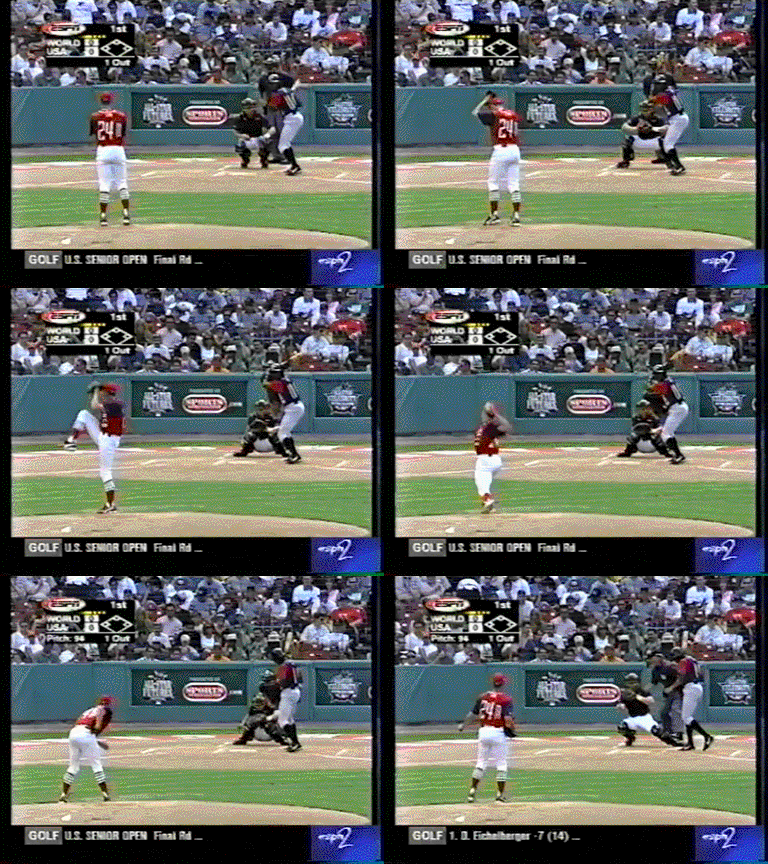
In 1999, Baseball America listed Rick Ankiel as the #2 prospect in all of baseball.  A year later, he was upgraded to #1.

Everyone knows what happened next.  Ankiel made good on his promise as a starting pitcher in 2000, having one of the best rookie years of any pitcher in club history.  His weakness, as it had always been, was his command.  But it had never been bad enough to become his undoing.  Randy Johnson had only recently mastered command of the force of nature residing in his left arm, so a 4.6 BB/9 in Ankiel’s rookie year didn’t seem like a cause for concern.  Then Ankiel was called upon to start Game 1 of the NLDS.

I was at Game 1 of the NLDS.  I skipped school to go see it.  After all, when you have playoff tickets, sophomore pre-calculus doesn’t seem so important.

A number of oddities surrounded Ankiel’s Game 1 appearance.  Cardinals catcher Mike Matheny, injured in a freak accident unwrapping a hunting knife, was on the DL and replaced by Carlos Hernandez, who had an injured back and get up to block a wild pitch. Dave Duncan had been tinkering with Ankiel’s set position on the rubber, though the results of those experiments had been very positive for his control in September.  Tony La Russa had pulled an interesting stunt, using Darryl Kile as a decoy Game 1 starter up until game day.

And that’s all without mentioning the pressure that had followed Ankiel his entire career.  His father made Tony Rasmus look like a reasonable fellow with reasonable expectations for his son.  If Rick Sr. hadn’t been in jail during his son’s first stint on the Cardinals, I expect he would have spent hours trolling Dave Duncan on usenet.

Did any of these things contribute to Ankiel’s meltdown?  There is no way to know.  It could have been a simple trick of the brain.  Steve Blass disease.  The yips.  Chuck Knoblauch block.  But after that game he was never the same pitcher.  Within a few years, he wasn’t a pitcher at all.

Back to August 9, 2007.  It’s the seventh inning of a 2-0 game.  The Cardinals lead over the Padres.  Chris Young has just left the game, after a walk and a wild pitch (of all things).  The Padres make the call to the bullpen for Doug Brocail, who originally broke in with San Diego back when George H.W. Bush was president and Sir Mix-a-lot’s “Baby Got Back” was popular for the first time.

Brocail had never been a power pitcher, and the combined forces of age and repeated arm injury hadn’t done him any favors.  On 2-1, he tried to sneak a backdoor breaking ball past Ankiel.  The result:

Suddenly a meaningless game in an increasingly meaningless season became something bigger.  For a few moments, the 2007 St. Louis Cardinals transcended the team that followed a stunning World Series victory with a Kip Wells/Braden Looper rotation.

Very few people thought that Rick Ankiel would ever see the Major Leagues after deciding to become an outfielder.  In his one full season as a Major League pitcher, Ankiel hit only .250/.292/.382.  He was 24 years old when he made his conversion official, and he was generally seen as a finished player.  The idea that he could turn his entire career around in his mid-20s, improve his batting skills in the minors, and fight his way back to MLB was wishful thinking at best.

When he hit that home run, he proved something.  He could have never taken another Major League at bat, and he would have done more than anything ever expected of him after he decided to end his pitching career.  Everything else was just gravy.

A few days ago, Rick Ankiel was released by the Houston Astros.  I’m not sure it was a good move, and I suspect there are several teams that could use an outfielder with an excellent arm capable of slugging .484.  Nevertheless, being released by the worst team in the Major Leagues is a damning fate.  This may be the end to Rick Ankiel’s career.  He never became a star.  He never even became a full-time starter.  It’s easy to say that his career was a failure, but that would be incredibly short-sighted.

In 2000, Rick Ankiel pitched 175 innings with a 134 ERA+.  In 2008, he had 463 plate appearances with a 120 OPS+.  No one in the modern era has accomplished anything like that.  Two separate seasons, two significantly above average stat lines, on both sides of the plate.

I don’t think Rick Ankiel should retire.  He can still hit the ball a long way, which is a lot more than can be said for a number of players who still somehow inhabit a MLB roster.  But if this is the end for Ankiel, it is not an ignoble end.  His career is not one to be mourned, but rather celebrated.  He didn’t fail.  He didn’t falter.  He persevered   On August 9, 2007, he beat the odds.  And he continued to beat the odds for over five years, seventy home runs, four hundred hits, and a few blistering outfield assists.

We will all be lucky to see another player like him.

UCB Roundtable Discussion: Prince Fielder

At the  beginning of every offseason, the United Cardinals Bloggers participate in a roundtable discussion about the past year and the future of the team.  Thanks to the pleasant surprise of an extra month of Cardinals baseball, this discussion has continued into the winter.  Last Friday was my turn to pose a question and in the wake of Albert Pujols’s defection to the Angels, I asked the following:

Should the Cardinals pursue Prince Fielder?  Why or why not?

The answers:

Continue reading

254

Albert Pujols is gone.   Starting next season, he will no longer be a Cardinal.

Outside of a few hours yesterday, when the Marlins bowed out and the rumors were swirling that the Cardinals actually had the highest offer on the table, I was expecting this.  We all should have expected this.  Baseball players follow the money.  Hell, people in general follow the money.  Beyond family and (sometimes) country, loyalty is a fleeting and transient sentiment.  Albert Pujols does not owe St. Louis anything.  He does not owe Cardinals fans anything.  He certainly does not owe Bill Dewitt Jr. anything.  The Los Angeles Angels of Anaheim offered 254 million dollars.  If reported figures are to be believed, that is at least 30 million more than what the Cardinals were willing to give him.  It’s no surprise that he took it.  It’s no surprise that anyone would take it.

I feel like anyone who is genuinely surprised by Pujols’s decision hasn’t been paying attention.  When he demanded an extension rivaling Alex Rodriguez’s record-setting free agent contracts, he wasn’t doing it so he could reinvest the money in the city of St. Louis.  When he refused to negotiate after spring training started, it wasn’t so that John Mozeliak had more time to worry about the amateur draft.  And when he continued to retain Dan Lozano despite the controversy that emerged over the last two months, it wasn’t so that he could work out a deal favorable to the St. Louis Cardinals organization.  This has been a long time coming.  Pujols wanted to get paid.

That said, I don’t blame the Cardinals either.  Matching the Angels’ offer would have been insane.  The offer that the Cardinals made was probably insane.  Emotionally, I wanted to see Pujols stay with the Cardinals and I would have been happy with any deal that made it possible.  But logically, a ten year deal at 20MM+ is a huge risk for any player.  Albert Pujols is going to be 32 when the deal begins.  He will be 41 when it ends.  Not many players–even elite players–age well into their late 30s and early 40s.  There are freaks of nature and/or science like Barry Bonds, Hank Aaron, Mariano Rivera, and Roger Clemens that play well into their twilight years.  But there are many players like Ken Griffey Jr., Alex Rodriguez, Miguel Tejada, Larry Walker, Mark McGwire, Pedro Martinez, and others who see their incredible talent ravaged by injury and time.  There is no way to know what will happen to Pujols, but we all saw proof of his mortality in 2011.  I don’t begrudge the Cardinals for not going higher.

I do, however, wish that the Cardinals had negotiated better.  There’s no way to know the full story behind their plans and machinations.  I can only see what the media shows me.  But I saw a front office that, for whatever reason, was deceived by the same expectations as the fans who now lash out at Pujols.  It looked like they expected him to sign, they expected him to be polite, and they expected him to want to return above all else.  Pujols came into free agency looking for a battle.  Mozeliak arrived looking for a handshake.

From the beginning of the offseason, the Cardinals gladly handed over every bit of leverage to Pujols and Lozano.  They didn’t change their offer until late in the game.  They never gave any deadlines.  They outright denied any interest in free agents who could have competed with Pujols for the Cardinals money.  Pujols knew that the Cardinals weren’t going anywhere.  They weren’t going to snap up Jose Reyes or Prince Fielder and leave him with one less suitor.  He could take his time and wait for some team to finally snap and offer him the mind-boggling sum he thought he could get.  And if he didn’t get it?  Unlike the Marlins offer, the Cards ~9/200MM wasn’t going anywhere.

Do I think anything would have happened differently if the Cardinals were aggressive?  If they made a competitive offer to Fielder, or at least pretended that they were considering it?  If they told Pujols that they needed a decision Tuesday night then pulled their offer?  Probably not.  Almost certainly not.  But it would have been nice to see the Cardinals front office approach the negotiations with an attitude and tenacity that matched Pujols and Lozano.  Like I said before, Pujols didn’t owe the Cardinals a hometown discount.  But the Cardinals didn’t owe Pujols anything either.  They didn’t have to announce to the world that they were not pursuing Fielder or Reyes before negotiations even began.

Now it’s over.  The Cardinals will move on.  Pujols will move on.  I’ll probably cheer for the Angels in the AL now because Albert is still one of my favorite players.  I hope he has a great career in Anaheim that proves all the doubters wrong.  I hope he retires the home run champion and sails into the Hall of Fame with a Cardinal on his cap.

I also hope the Cardinals sign Prince Fielder or Carlos Beltran and crush the Angels in the World Series in 2012.

The Strange Case of Mike Matheny

I don’t know if anyone noticed, but something’s been going on over in the sports section of STLtoday.  It began a week ago, with reports that former Cardinals catcher Mike Matheny would be interviewed as a possible replacement for Tony La Russa.

Perhaps this didn’t come as a huge surprise to a lot of people.  Matheny was a well-respected leader on the team many years ago. He was hard-nosed and competitive.   Even then, there was talk that he would make a good coach or manager some day.  But on closer examination, it was a little unusual.

Matheny hasn’t been a manager in the minors, like Ryne Sandberg, Chris Maloney, or even Joe McEwing.  He hasn’t been a coach with the current Cards club like Jose Oquendo or Joe Pettini.  And he certainly doesn’t have the big league pedigree of Terry Francona or Joe Maddon.

Matheny’s coaching experience, as far as I know, is limited to a few years as a spring training instructor and a series of videos for Protege Sports.  Does that mean he’d be a bad manager?  Of course not.  I’m actually an advocate of signing an inexperienced manager because someone without a history is going to cost less.  And I don’t think that the manager is terribly important.  As long as he gets along with his players and doesn’t make too many horrible mistakes, he probably has less effect on the success of the team than the backup catcher or mopup reliever.  There’s no reason to break the bank on a manager.

I’m in a pretty small minority with that viewpoint, however.  So it was a bit unusual to me that the Cardinals, fresh off a WS victory, would consider replacing a high profile manager like La Russa with a complete rookie.  I didn’t think too much about it, though.  I honestly thought that they were interviewing Matheny as a courtesy or a curiosity.  At that point, I assumed that Oquendo, Sandberg, and Francona were the real candidates.

Then STLtoday featured an article which detailed Matheny’s interview with the Cards.  This piece highlighted his positive attributes, addressed his lack of experience, and was quick to point out Matheny’s bonds with Dave Duncan, Yadier Molina, and of course Albert Pujols.

Once again, this was only slightly unusual at the time.  But now, almost a week later, there haven’t been any similar articles about the other candidates.  There have, however, been stories considering the merit of hiring an inexperienced manager as well as a Bernie Miklasz article contemplating Matheny as a potential choice.

If you’re as cynical as me, you realize that STLtoday might be floating a trial balloon.  They might be preparing Cardinals fans for what they already know or suspect: Mike Matheny is the frontrunner to replace Tony La Russa.  We’ve certainly seen it before.  Rasmus’s departure came on the heels of various stories about his difficulty with the Cardinals coaching staff.  McGwire was floated as a potential hitting coach in the news before he was hired.  Are we seeing that same thing now?  And why?

Why Matheny?  Why would the Cardinals–who have spent the last 16 years demonstrating that they value the position of manager far too much–hire a completely inexperienced skipper?

Two possibilities come to mind:

1. This may be an unfortunate response to a crisis of leadership.  The Cardinals have been Tony La Russa’s team for so long that they might not know how to live without him.  Perhaps they hope to keep his reign alive as long as possible by hiring a figurehead manager, and allowing Duncan and McGwire to make the real calls.  This isn’t a particularly flattering analysis for Matheny, but it is something that should be considered.  Matheny is a blank slate, and perhaps the Cardinals want to shape his future with the help of La Russa’s old coaches.

Of course, if this was the goal, why not hire Joe Pettini?  He’s filled in for La Russa numerous times.  He probably knows La Russa’s style better than anyone but Duncan.  He’d be the natural fit if you wanted to ensure maximum continuity.  Which leaves me with…

2. This is Mozeliak’s power play.  And it’s really goddamn interesting.  When Walt Jocketty was dismissed following the 2007 season and replaced with Jon Mozeliak, I assumed the new GM was nothing but a puppet for Tony La Russa.  Jocketty left over disputes with management.  Mozeliak was an org team player.  Throughout his time with the Cardinals, he’s been at La Russa’s beck and call.  He traded Brendan Ryan and Colby Rasmus.  He acquired Matt Holliday, Ryan Theriot and Lance Berkman.  The media made no attempts to conceal where these moves truly originated.  La Russa wanted these players (or he wanted them gone) and Mozeliak made it happen.

Now La Russa’s gone.  There’s a power vacuum.  And I think this is a surprising move from Mozeliak to come out of the shadows and establish that he’s no longer just an apparatus of a larger-than-life manager.

How do I figure this?  A little tidbit that has come out into the public  eye since this search began.  Mike Matheny has been working for Mozeliak, in the GM’s office, for the last year or so.  Think about this quote from the above-mentioned Miklasz article:

“He’s also served as an adviser to Mozeliak. An unofficial assistant GM, if you will.”

Interesting, right?  Pettini and Oquendo are acolytes of La Russa.  They worked on the field with him.  McEwing and Sandberg are managerial prospects from the White Sox and Phillies, respectively.  Terry Francona would bring his own people in.  But Mike Matheny?  He’s been working with Mozeliak.

There is still no predicting who will be the Cards’ manager in a few days.  But I think that Matheny’s sudden ascension to front-runner shows that Mozeliak is ready to make the Cardinals his team.  For better or worse.


The End of the Tony La Russa Era

Tony La Russa retired today.  He decided to leave baseball on a high note, stepping down as the manager of the Cardinals after leading the team on a thrilling, improbable streak to a world championship.

This move leaves me with a lot of mixed feelings.  Sometimes I like La Russa.  Sometimes I hate him.  Even when he’s winning, he can be infuriating.  Even when he’s losing, he can be fascinating.  No other manager sticks Skip Schumaker at second base, then leaves him there even after he’s proven he can’t play the position.  But, then again, no other manager is willing to try batting the pitcher eighth.  I still think that’s a good idea.

No matter how I feel about La Russa at the moment, there is no denying that he shaped the face of the St. Louis Cardinals.  For better and for worse.

He took over as manager in 1996.  That was back when Bill Clinton was campaigning for a second term, the Macarena was a hit song, and Hailee Steinfeld–the actress who played Mattie in 2010’s “True Grit”–wasn’t even born.

La Russa took the team from the fading embers of the contact-and-speed Ozzie Smith era to the electrifying tape-measure Mark McGwire era.  It wasn’t a graceful transition, and ended up alienating Smith as well as a legion of Cardinals fans.  There are still those who, to this day, yearn for the slaps and steals of Whiteyball.

La Russa guided the team through the days of the MV3: Pujols, Edmonds, and Rolen.  But he also broke up the band.  His bizarre feud with Scott Rolen cast a dark shadow over what should have been a pleasant run at a title repeat in 2007.

The next few years were rough, but La Russa remained as the Cardinals built a new sort of team.  Pujols remained, but instead of being surrounded with elite hitters, he was paired with a couple of aces.  Chris Carpenter and Adam Wainwright were not always healthy at the same time.  But when they were, they made the Cardinals a team to be feared.

And now the Pujols years may be coming to an end.  It’s too soon to be sure, but there’s a fair chance that next season is an entirely new beginning.  If so, Tony La Russa took us all the way from the end of Whiteyball to the end of the Pujolsball.  That’s sixteen years.

It’s almost impossible to judge the skill of a manager.  There are too many factors.  If we want to be traditional–look to wins, postseason appearances, and titles–La Russa may be the best manager the Cardinals have ever had.  In his sixteen years, the Cardinals made the postseason nine times.  They went to three World Series.  They won two of them.  Only a Yankees fan could find those results unacceptable.

Of course, La Russa was gifted with incredibly talented players during his time with the Cardinals.  Lankford, McGwire, Drew, Edmonds, Pujols, Kile, Rolen, Carpenter, Wainwright, Holliday, Berkman…  Just to name the standouts.   La Russa also had the benefit of the best pitching coach in baseball.  I’m not sure Dave Duncan isn’t the one really responsible for La Russa’s success in St. Louis.  There is no one like him and I suspect he will be missed even more than Tony in 2012.

Considering the folks surrounding La Russa, it’s damn near impossible to give him full credit for everything he did for the Cardinals.  But he shouldn’t be overlooked.  Chances are, La Russa had a finger in acquiring many of the players I listed above.  He was more than just a manager.  He exerted control over the team far beyond the confines of the dugout.

That was part of the reason Walt Jocketty–another talented person who lent his skill to La Russa’s legacy–left in 2007.  The Cardinals weren’t his team.  They were Tony’s team.  And they were handed over to John Mozeliak.  Outside of the surprising Chris Duncan trade, Mozeliak has largely been seen as an apparatus of La Russa’s influence.

When La Russa wanted Matt Holliday, Mozeliak got Matt Holliday.  When La Russa wanted Brendan Ryan gone, Brendan Ryan was gone.  After Tony expressed a desire to improve the “character” of the clubhouse, Mozeliak brought in Ryan Theriot, Lance Berkman, and Nick Punto.  When Colby Rasmus wore out his welcome, he was shipped off for veteran pitching depth.

Things are going to change now.  Tony La Russa is no longer in charge.  What does that mean?  Is that good?  Is it bad?  I don’t have the answer for that.  When you look at the decisions La Russa made–and the fact that he was being paid millions to make them–it’s hard not to think the team is better off without him.  But when you look at his tenure in St. Louis–the years between 1996 and today– it was, overall, an amazing time to be a Cardinals fan.

I often disagreed with Tony La Russa.  I often hated his decisions. I often wanted him gone. But the Tony La Russa era was far more than the sum of its parts.  It’s very possible that I will never see a more prosperous stretch of Cardinal baseball.

So I want to thank Tony La Russa for the last sixteen years.  I don’t know if he’s responsible for any of it.  But I also don’t know if that matters anymore.

Carpenter Syndrome

The St. Louis Cardinals are world champions.  Even a couple hours after the fact, it still doesn’t feel real.  This team has been on the brink of elimination for two months.  They fought tooth and nail to keep their season alive since the end of August.  I almost feel like the only thing to do is write yet another recitation of their struggles, their comebacks and improbably successes.  But that’s fairly well covered.  I’ve already seen several other bloggers handle this better than I could, and I already tried when they slipped into the postseason four weeks ago.

Instead, I want to talk about a specific player.  I’m not sure I’ve ever spent much time on this blog discussing Chris Carpenter and that’s a damn shame.  David Freese might be getting all the headlines.  He was rightfully the NLCS and WS MVP.  His incredible and improbable postseason cannot be ignored.  But Chris Carpenter is the reason the St. Louis Cardinals are World Champs.

Before tonight, the Cardinals had already faced three must-win games.  Game 162 of the regular season.  Game 5 of the NLDS.  Game 6 of the World Series.  Chris Carpenter threw complete game shutouts in two of these games.  That’s why no sane Cardinal fan questioned who would pitch Game 7 of the World Series.  Carpenter wasn’t sharp on three days rest before, but that didn’t matter.  You don’t fall behind in Game 7 with Chris Carpenter sitting in the bullpen.

I’ll admit, there were several times I thought Carpenter should have been pulled.  I wanted Lohse to warm up in the first inning after the Rangers jumped on Carpenter’s flagging fastball and hanging curves.  I thought he should have been pulled for a pinch hitter in the fourth inning when the Cardinals had two runners in scoring position.  I wasn’t sure he should have started the top of the sixth.  I certainly threw a fit when he batted for himself to lead off the bottom of the sixth.  He looked gassed the entire game.  He looked sore and broken; I was just waiting for the Rangers potent lineup to get to him.

They didn’t.

After the NLCS, we learned that Carpenter was beginning to feel elbow soreness and there were questions about his availability for game 1 of the World Series.  Carpenter denied that anything was wrong.  But anyone who pays close attention knew the truth.  Chris Carpenter is 36 years old.  He’s had so many arm surgeries that the next one is free.  He threw for more innings than anyone in the National League.  The speed and movement on his pitches were down from his shutout against Philadelphia.  He was laboring.

Even then, he started game 1.  He started game 5.  And thanks to a postponement, he started game 7.  He pitched nineteen innings in ten days.  It didn’t matter that his arm was hurting.  It didn’t matter that he was aging or that his arm was held together with various ligaments from various other parts of his body.  He kept going.  He kept pitching.

I would not be surprised to find out that Chris Carpenter was playing through a serious injury. But this isn’t supposed to be a pessimistic post.  Right now is no time to worry about what might be revealed by some MRI in the future.  That’s not the point of this.  The point is that we should all appreciate what Chris Carpenter did.

At age 36
After shoulder surgery,  Tommy John surgery, and a tear in his oblique
After throwing the most innings in the NL
After throwing the most innings in his career
After starting two games in the World Series already
On three days rest
With a sore arm
With sketchy command and a weak curveball…

Chris Carpenter held the potent Texas Rangers to two runs in six innings and won game seven of the World Series.

This should not be forgotten, no matter how compelling David Freese’s RBIs and Albert Pujols’s impending free agency might be.


Elaboration on an Abomination

I wish that I could convince myself that what I am about to write is simply hyperbole.  I don’t want to feel this way.  I don’t want to be this reactionary and short-sighted.  But it’s impossible.  I can’t stop thinking it.  Tonight may have been the worst-managed baseball game I’ve ever watched.  Feel free to correct me.  Tell me about a game that was managed worse. It would make me feel better.

Tonight I watched the St. Louis Cardinals make a series of awful decisions that cost them the lead in the World Series.  And it sucked.

Earlier this evening, I made a very quick post about Mike Napoli’s stats versus righthanded and lefthanded pitchers.  It was brief, and I only made it because I couldn’t fit my point into a single tweet.  Basically, Napoli’s had a strong platoon split for his entire career.  He hits righthanders fine, but he crushes lefties.  This season especially, he’s been one of the best hitters in baseball against lefthanded pitching.  Leaving in noted lefty Marc Rzepczynski to face Napoli with the bases loaded was painfully foolish.  It’s reminiscent of allowing Lohse to face Howard in game 1 against the Phillies.  La Russa loves matchups, and he’s been manipulating them like crazy throughout the playoffs.  Here, he sat in the dugout and watched as a mediocre lefty faced a batter who eats lefties for breakfast.  The result was predictable.  4-2 Rangers.

If only that was all we saw tonight.  Instead, we also witnessed Ryan Theriot pinch-bunt.  Bunting isn’t a great move in general.  There are few situations where it improves the chances of scoring a run.  Most of those situations involve a pitcher at the plate.  There’s no reason to insert a player into the lineup specifically to bunt.  That’s insane.  I thought about citing statistics to prove how insane that is.  I don’t think that’s necessary.  The insanity is self-evident.  And I wish it was the most insane thing we saw.

No, the most insane move of the night was bringing Lance Lynn into the game to intentionally walk Ian Kinsler.  This was the calling card of the catastrophe.  It was how we all know that something was truly wrong.  There’s no explaining it.  Bringing in a pitcher, issuing an intentional walk, then pulling that pitcher should never happen.  Never.  I can contrive an elaborate situation to justify almost any managerial move–even the pinch bunt.  Not this one.  Clearly, the Cardinals management was lost in one of the most important games of the year.

Then to top it all off, in the top of the ninth the Cardinals send Allen Craig while Pujols (who can hit the ball a long way) is batting and Neftali Feliz (who can barely find the strike zone) is pitching.  It wasn’t just predictable that Albert would swing at a ball out of the zone and Craig, slow as his tortoise, would be thrown out at 2b.  It was damn near fated.  Craig can’t run.  Feliz is probably one of half a dozen pitchers in baseball  that Pujols can’t be trusted to make contact with.  Why?  Why hit and run there?  Craig crossing the plate doesn’t win the game for the Cards.  It doesn’t even tie the game.  The only reason to hit and run is to prevent the double play.  DPs have been a problem for the Cards, but consider this:

Albert Pujols has struck out 704 times in his career.  He’s only hit into 232 double plays.  That’s actually a lot of double plays and not that many strikeouts.  But the K is STILL far more likely than the GIDP.

Neftali Feliz has struck out 164 batters in his career.  He’s allowed 150 ground balls.  That’s right, Feliz is more likely to strike out a hitter than allow him to make contact and produce a ground ball.

There’s no reason to just expect a DP.  There’s no reason AT ALL to hit and run.

After the game, the excuses came fast and furious.  There was something wrong with the bullpen phone.  Albert himself put on the hit-and-run.  The speed at which this team covers for Tony La Russa is phenomenal.  If Allen Craig could run as fast as the Cards spin their failures, the team would be coming home up 3-2.

I really don’t know what else to say about what we saw in game 5.  It was atrocious.  It was like watching a car accident, except car accidents are usually over much quicker.

One week ago, the entirety of sports media was fawning over La Russa’s brilliance.  I wonder how many of those same writers dare question him after tonight?

Welcome to October

This wasn’t supposed to happen.

Before the season even began, Adam Wainwright heard the three words that every pitcher fears: Tommy John Surgery.  The Cardinals best pitcher was out for the season.  He would be replaced in the rotation with middle reliever Kyle McClellan.  An aging Chris Carpenter and a still-green Jaime Garcia would become the anchors in an increasingly unstable rotation.

Brendan Ryan, perhaps the best defensive shortstop the Cardinals have seen since Ozzie Smith, was shipped out due to issues with management.  He was replaced by Ryan Theriot, who could only theoretically still play the position.  For the first month of the season, the team clung to washed-up closer Ryan Franklin, who did his best to hasten his own retirement.

Everything seemed lost.

This wasn’t supposed to happen.

One month ago, the Cardinals were 10.5 games out of first place.  Fans and columnists wondered if the team should start thinking about the wildcard.    Even that seemed silly.  Atlanta and San Francisco were in the way. The bullpen was unstable as ever.  Matt Holliday and Lance Berkman were out so often they barely played in the same game.   Jaime Garcia was faltering and barely looked like the same pitcher who carried the team early in the season.

Four days ago, we were supposed to watch Albert Pujols’s last home game as a Cardinal.  Maybe he would re-sign but with the numbers being floated around, there was no reason to hope.  Maybe they’d pull it out and catch up to the Braves, but it wasn’t likely.  The fans at Busch gave him a proper send off, letting him know how much they appreciated the decade he spent wearing the birds on the bat.  It was over.  We all knew it, one way or another.  Even if we were hopeful, we feared the worst.  We suspected the worst.  The Cardinals were done.  Pujols was done.  This was the end of an era.  Right?

This wasn’t supposed to happen.

But it did.

Tie Me Up, Tie Me Down

After 161 games, the St. Louis Cardinals and the Atlanta Braves are tied in the NL Wild Card race at 89-72.

I haven’t posted in over two months.  There are reasons for that.

Some of my reasons are good: I was in the process of studying for, then taking, and finally agonizing over the bar exam.  I was also writing a novel.  Posting my thoughts about baseball on the internet took a back seat to other things.  It’s really too bad, as there have been so much drama and intrigue over the last few months.  The Colby Rasmus trade alone, along with the performance of the involved players after the move, would have given me plenty to write about.

Some of my reasons are bad: I haven’t been following the team as much as I did earlier in the season.  It’s been forever since I’ve paid this little attention to a Cardinals team.  I’ve been distracted, but it’s been more than that.  Up until this month, the Cardinals have been a frustrating mess that I simply couldn’t deal with.  Because of this, I felt rather unqualified to make any intelligent observations about them.

I’ve been watching over the last few weeks, however, and I’ve seen a Cardinals team with a new lease on life.  Over the season, they have turned victory into defeat.  Tonight, they turned defeat into victory.  That’s been this year in a nutshell.

No matter what happens, the comeback to tie for the wild card was amazing.  But, at the same time, it is something of a disappointment.

The fact that the Cardinals managed to get this far only underscores everything that went wrong.  Where would this team be with a healthy Adam Wainwright?  Where would they be if not for the persistent, random injuries to Matt Holliday?

And where would they be if not for some atrocious management early in the season?  One game is one game, and the Cardinals gave away several games this season.  If not for Tony La Russa’s fanatical devotion to Ryan Franklin, game 162 might just be a tune-up for the playoffs.  If not for a mind-boggling infield of Ryan Theriot and Skip Schumaker behind a groundball pitching staff for half the season, many of us Cardinals fans would already have our NLDS tickets in hand.

I don’t know what will happen tomorrow.  The Cardinals deserve to be in the playoffs.  The Cardinals front office and management staff…maybe not so much.  But it doesn’t matter.  It’s almost like a whole new season.  One day, two games, and everything will be decided.

Or not.  If the Cardinals and Braves both win or lose, we’ll see game 163.  Wouldn’t that be something?