Experiences in Old Sports Games: Blades of Steel

From 1994 to 1999, the St. Louis Blues employed a man named Anthony Twist for the purpose, at least in theory, of playing hockey as a winger. Tony Twist, as he was known to friends, fans, and foes, was not a particularly skilled hockey player. He was better than me, and probably better than most people, but compared to other people who were similarly employed for the purpose of playing hockey, he was pretty terrible. That was because his job wasn’t really to play hockey. Hockey was a front, like a New Jersey waste management company or the NBA, for more nefarious business.
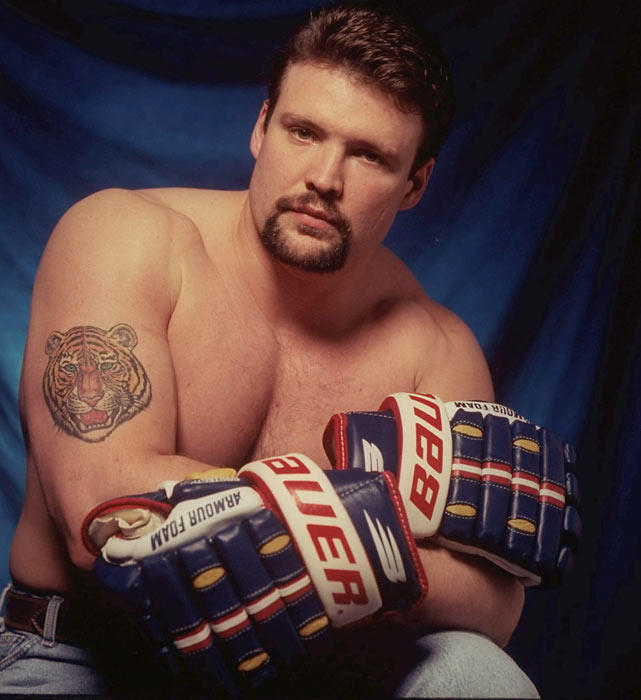
This man is named Tony and he has a tattoo of a tiger.  Surely this is a man with good judgment.

This man is named Tony and he has a tattoo of a tiger. Surely this is a man with good judgment.

Tony Twist was an enforcer. His job wasn’t puck control, or scoring goals, or blocking the net. His job was to beat the living shit out of someone on the other team. Everyone knew it. During games, the crowd would go wild when Twist took the ice because they knew he was out there to throw down his gloves and throw up his fists. And he wasn’t alone. Almost every team had an enforcer like Twist, and they usually ended up fighting each other

To people that know hockey, this is all perfectly normal. To those that don’t, I probably sound like I’m making all of this up. I’m not. Fighting in hockey is accepted as a part of the sport in North America. It is like the seventh inning stretch in baseball, except that it’s actually appropriate to sing “God Bless America” during a hockey fight. 

This brings me to the topic of this week’s games, Blades of Steel for the NES and its erstwhile descendant, Blades of Steel ’99 for the N64.
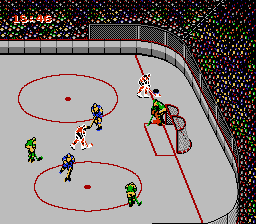
I think these two players are about to go SSJ3 in order to defeat the Edmunton goalie, Majin Buu.

I think these two players are about to go SSJ3 in order to defeat the Edmunton goalie, Majin Buu.

The very name Blades of Steel invokes violence. Back in the dark days of the late 80s and early 90s, I can picture a kid going to the local video rental store and leafing through the NES games. The box art is missing from most, and an original manual is even harder to find.  She leafs through the generic clear plastic cases until she sees a title that intrigues her: Blades of Steel. Now, this kid loved the original Ninja Gaiden for the NES just like any sane person, so she gets excited. Surely this is another ninja game, or maybe a samurai brawler. At least she can be sure it contains swords and action, right?  She rents the game, runs home, and finds out that she was wrong.  It’s a fucking hockey game. The weekend is either ruined, or another poor soul is halfway on her way to becoming a hockey fan.

This title isn’t accidental. It is meant to invoke the violence of hockey, which ran rampant when it was released. It was intended to telegraph the fact that Blades of Steel was the first hockey game to include fighting as a game play mechanic. And this wasn’t just a gimmick.  Ask anyone what they remember about Blades of Steel. Most people will give you a strange look, and perhaps try to figure out if you are lost or somehow mentally disabled, because you are asking them about a goddamn NES game, you weirdo.  But pester them long enough to convince them to pity you and they will tell you that the most memorable part of the game was the fighting.

Finally Canada gets what has been coming to it ever since the seventy-two resolutions.

Finally Canada gets what has been coming to it ever since the Seventy Two Resolutions.

Despite its name, Blades of Steel is not Base Wars or Mutant League or even Blitz. It isn’t licensed, but otherwise it holds itself out as an accurate representation of North American ice hockey.  Yet straight-up getting into a fight–which is against the rules–is a game play mechanic that can help you win. Only in hockey.

Unlike the massive annualized franchises of the day, Blades of Steel never received a proper sequel, but its impact on the landscape of hockey games was felt harder than the impact of Colton Orr’s fists on Todd Fedrouk’s already fractured skull. NHL Hockey, the predecessor to EA Sports’ legendary NHL series, released for the Mega Drive two and a half years later and featured a fighting system. It was removed for NHL 94 and 95, but returned in 96. From then on out, it was a focal point of upgrades to the game, and now uses a modified version of EA’s Fight Night engine. The NHL 2k series always had fighting, and the short lived Wayne Gretzky 3d was rumored to have Mortal Kombat-style fatalities (it didn’t).

FINISH HIM!!

FINISH HIM!!

Konami didn’t revisit the Blades of Steel name until a decade later, releasing the following for the Nintendo 64:

Blades of Steel 99  was a bad game.  There’s no getting around this.  It played terribly, the graphics were muddy, and just…  Everything that was wrong with gaming in the late 90s was distilled down into a toxic sludge, then poured into this game.  Clumsy models, awkward colored lighting, terrible rock “music”.  Just look at that video above.  My god.  It’s like Trent from MTV’s Daria moved to Canada and suffered a grand mal seizure.

Unlike the first Blades of Steel, which was released in the early days of sports games when licenses were hard to come by, Blades of Steel 99 features full NHL and NHLPA licenses.  This means that you can play as awful, blocky representations of all your favorite players from your favorite team, with correctly colored uniforms and logos that looked accurate if you squint and tilt your head.

This is actually a technically amazing feat, as there are only five polygons on screen.

This is actually a technically amazing feat, as there are only five polygons on screen.

Being as this game was released in 1999, and featured the rosters of the 98-99 season, This means that my favorite enforcer is right there on the St. Louis Blues roster, ready to smash faces into boards, then smash fists into faces, then probably smash old beer cans into his fists to toughen them up, because he’s crazy and crazy people do shit like that.

No one at Konami must have watched the St. Louis Blues because that "fight" rating is WAY too low.

No one at Konami must have watched the St. Louis Blues because that “fight” rating is WAY too low.

Even though Sir Anthony of Twist’s renowned pugilistic skills are poorly represented in Blades of Steel 99, fighting is still part of the game.  As seen above, it’s even one of the six skills players are graded on.  This is no surprise, as hockey games–and especially the original Blades of Steel–were known for their brawling as much as their hockey.

But why? In almost any other sport, the fight is forbidden. There are occasional scraps in baseball, but they are few and far between. Football, which might as well be a heaping serving of violence placed into a spoon and heated into liquid for the American public to shoot into their veins, strictly forbids fighting.  More to the point, the NFL has been incredibly strict as to how football is portrayed in video games. Midway had to repeatedly tone down the late hits and even celebrations in NFL Blitz to keep its license, and only went full crazy with Blitz: The League after losing it.  Why is hockey so different, to the point where the NHL is perfectly fine with playable brawls, “fight” ratings, and even the incorporation of a boxing game engine later EA NHL titles?
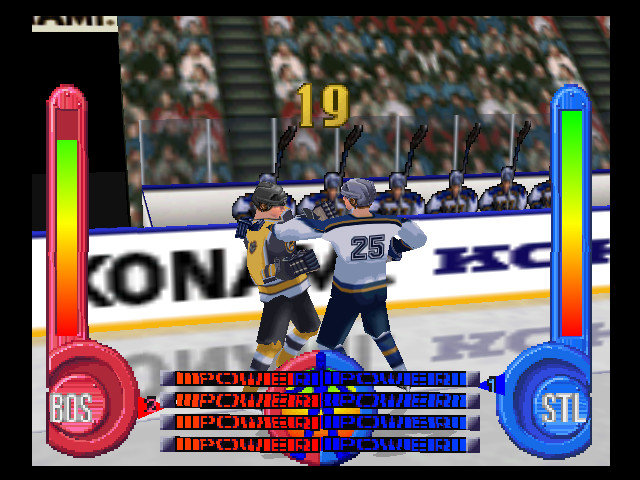
POWER POWER POWER

POWER POWER POWER

To understand the meaning of hockey fights, we have to understand desire.  In Violence and the Sacred, philosopher René Girard explains that desire is mimetic.  Now, if you’re like me, when you see the word “mimetic” you assume that it has something to do with treasure chests that sprout teeth and attack when you get near them.  Fortunately, that’s a useful framework to discuss Girard’s ideas.  When we desire something–whether it is a physical object like the copy of Saints Row IV sitting in a warehouse until Tuesday or an abstract concept like love or acceptance–our desire is not innate.  Rather, it is learned.  That is to say that when you approach the treasure chest, it is because you have learned that a treasure chest symbolizes something to be sought and desired, rather than feared.  This is why it is so surprising when it suddenly attacks you.

Girard posits that we don’t learn to desire the treasure chest from experience (at least not at first) but through imitation.  We see that other people seek out treasure chests, and we learn that treasure chests are good and that we will be happy and that, most importantly, those treasure chests will not suddenly attack us.  Unfortunately, this leads us to desire things that other people already want, because we are imitating those people, and puts us in conflict with them.  Girard loved the Oedipus complex because it could be read as an allegory of this process.  Also René Girard, like most French philosophers, is really kinky.
Holy shit, this bird statue actually represents MY MOTHER

Holy shit, this bird statue actually represents MY MOTHER

Hockey is all about the puck.  If your team has the puck, you are on top of the world.  You’re in position to get a goal.  If the other team has the puck, well, you better do everything short of killing your father and sleeping with your mother to get a hold of it.  In Hockey, the puck is the object of desire.  But that puts players in conflict with players on the other team and conflict leads to violence.  This is the novelistic truth of hockey.

Now, of course, you’re asking how this differs from any other sport.  Plenty of sports have something like the hockey puck–a Desired Object–over which the teams struggle to maintain control.  Soccer is damn near hockey with a large, kickable ball and you don’t have boxing matches break out in every other game of FIFA.  We’re still stuck with the same damn question: why is hockey different?

There are a couple ways in which hockey differs from every other major sport that involves chasing a Desired Object around the field of play.  First, hockey is played on ice with skates–blades of steel–attached to the players’ feet. Second, everyone has a giant goddamn stick.  Most hockey sticks are about as tall as I am, which means that players are armed with a dangerous weapon should they want to use it.

Two minute penalty for attempting fellatio on a member of the opposing team.

Two minute penalty for attempting fellatio on a member of the opposing team.

Returning to Violence and the Sacred, Girard hypothesizes that as the rivalry over a desired object increases, eventually the object actually drops from view.  The rivalry becomes more important than the object, leading to violence.  Now, instead of imitating desire of the object, people imitate the desire for violence.  This can lead to a terrible downward spiral in which everyone dies and no one gets the object, so basically the end of every dark heist film ever.

Fortunately, or unfortunately depending on who you are in this process, there is a braking mechanism to prevent this.  Imitating desire for conflict rather than the desire for an object eventually leads people to coalesce and fight against a single enemy.  This enemy, or victim, or scapegoat depending on which work of Girard’s you are reading, is then destroyed and peace returns to humanity.  It’s kind of fucked up for the scapegoat, but humanity gets to move on through the cycle.  New desires are inflamed.  Violence rises again, and a new scapegoat is created.

Girard believed that this cycle was the origin of ritualistic sacrifice.  From the Greeks to the Aztecs to the allegory of Christ, religion and culture throughout human history is full of the idea that one person can take the weight of humanity’s horrible tendencies upon their back, and appease the Gods with their sacrifice.  Believe it or not, hockey fights can work the same way.

Hockey enforcers will tell you that they protect the team’s star players.  By engaging in fights, and taking the hits and the penalties, they prevent violence from being enacted upon their teammates.  Normally, if you put a bunch of men in their 20s and 30s in a highly competitive situation, then give them sticks, people are going to get hurt.  Enforcers act as a braking mechanism on this violence.  Hockey fights between these enforcers are the kind of ritual sacrifices described by Girard. Enforcers put on their own version of a passion play. Their job is to fight.  Their job is to get hurt.  And then their job is to sit in the penalty booth so that everyone else can play the game.

I wish I was color blind.

I wish I was color blind.

In adding fights to video game hockey, Blades of Steel recognized the role of fights in North American ice hockey. It is ritual violence, meant to symbolize the open hostilities that the two teams have come to feel for one another. Unfortunately, unlike the surrogate rituals provided by religion, hockey fights are also real violence, and the enforcers who participate an end up hurt or worse. And violence that is meant to prevent greater injury ends up glorifying violence itself. No one gasped in horror every time Tony Twist took the ice, though that would be the proper response to the appearance of a man about to perform a brutal, bloody ritual to maintain the relative peace.

I wonder how many kids in St. Louis grew up wanting to be like Tony Twist, absorbing the mimetic desire for violence without the context. To a young boy, who doesn’t understand that beating up people and getting realistic tiger tattoos isn’t cool, Twist is a dangerous figure to imitate. Maybe this explains the popularity of UFC, which explains a rise in brain damage, which even further explains the existence of Smurfs 2. Or maybe we’re lucky, and they all played enough Blades of Steel to know that fighting doesn’t lead to success, it leads to a terrible future where everyone steals your ideas and you turn into a terrible Nintendo 64 game.

Experiences in Old Sports Games: RBI Baseball

We all know about the 1980s.  Even if we’re too young to remember them, there are countless Cracked and Buzzfeed lists flooding the periphery of our daily internet consumption to remind us of hair metal, Top Gun, and men wearing acid washed jeans.  Like every semi-recent era of human history throughout human history, the 1980s are simultaneously reviled and embraced throughout pop culture.

The first game I have chosen to examine for my ambitiously dumb project of reviewing old sports games is R.B.I. Baseball, released in early 1988 on the Nintendo Entertainment System. R.B.I. Baseball, which was essentially a re-worked and Americanized version of the Japanese Pro Yakyuu Family Stadium, was a revelation in baseball video games. It was the first console game to feature the names of real MLB players. And unlike the prior effort on the NES, titled simply Baseball, R.B.I. was actually playable and enjoyable. I don’t intend to focus on games as well-known as R.B.I. Baseball in the future, but I wanted to start with something familiar.

Just like we all know the 1980s, we have all heard or read Percy Bysshe Shelley’s 1818 sonnet “Ozymandias.” Perhaps it was forced upon you in high school English class, as your first introduction to romantic poetry beyond the creepy-in-retrospect couplet you passed to your freshman lab partner on the day you dissected a frog. Perhaps you clicked on the wrong link of the Watchmen wikia and accidentally read something that wasn’t illustrated. Or maybe you’re just really hyped about the last season of Breaking Bad.

“Ozymandias” tells of a fallen statue in a ruined land, erected by a tyrant who boasted that his material power would last forever. It didn’t, and the monument to his reign ended up as broken as his kingdom. Some believe that Ozymandias is based off of Ramesses II, who had no way of knowing any better, since he ruled a thousand years before the discovery of irony by Qin Shi Huang in 210 B.C.

While the kingdom of Ozymandias does not survive, the intent of the sculptor who created the statue lives on.  The tyrant is remembered by the artist who portrayed him, with “wrinkled lip, and sneer of cold command.”  What was commissioned as a monument was, in fact, a mockery of the tyrant.  He could not see it, because the flaws it portrayed were the truth.  Now, only the critique live on, while the statue has fallen to ruin along with the kingdom.

R.B.I. Baseball is, on the surface, a monument to the conservative movement that swept the United States in the 1980s.  But like the statute of Ozymandias, it speaks truth to power and reveals the flaws of an ideology that were beginning to emerge in the late years of the decade when the game was released.

The conservative victory in America during the 80s didn’t originate in America (or in the 80s, for that matter).  It was adapted from a successful product released overseas in the prior year.  Margaret Thatcher, who rose to power leading to her election to Prime Minister in 1979, was the Pro Yakyuu Family Stadium to the R.B.I. Baseball that was Ronald Reagan.  Reagan was elected in 1980, promising a new start for a country stuck in economic and geopolitical turmoil.  A former actor, Reagan was charismatic and charming.  He endeared himself to America, and in the process ushered in an era of deregulation, increased hostility to the Soviet Union, and the rollback of social programs that continues to this day.  He was known as The Gipper, probably because during his later years he was known to interject in cabinet meetings with a frantic yelp that sounded like “Gip!” to the untrained ear.

GIP GIP, MR. WEINBERGER

GIP GIP, MR. WEINBERGER

The dream of Reagan’s reforms can be seen at every level in R.B.I. Baseball, starting with the very circumstances of its release.  Reagan loved deregulation more than Jack Zduriencik loves baseball players who can nominally play a position but are probably career DHs.  Nintendo, however, was a different story.  Nintendo tightly regulated releases on its NES system.  Using a lockout chip, which required all NES games to go through an approval process it limited the number of games any publisher could release in a given year, and forced them into restrictive licenses.

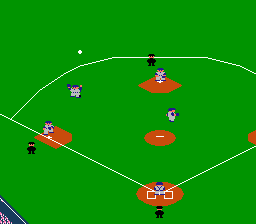
Tengen, the manufacturer of R.B.I. Baseball, opted, Reagan-like, to pursue deregulation of the NES.  It acquiesced at first, licensing a number of games (including the first run of R.B.I. Baseball) through proper channels.  But once they had their hands on the NES lockout chip, they reverse engineered it and began releasing unlicensed games.  That’s why, if you owned a copy of R.B.I. Baseball, it probably looked like this:

It looks wrong. It's like walking in on your brother when he's nude and discovering that he is actually not a person but a well-coordinated pack of gray squirrels hiding in a trench coat.

It looks wrong. It’s like walking in on your brother when he’s nude and learning that he is actually not a person but a well-coordinated pack of gray squirrels hiding in a trench coat.

But the release history of R.B.I. Baseball wasn’t the only way in which the game reveled in the reforms of the Reagan era.  It strove to exemplify everything that the conservative movement achieved.  Baseball has always been a particularly individualistic sport–which is why player stats are so important.  But R.B.I. Baseball, like Ronald Reagan during his early years as a Cold War crusader, sought out all collectivism in baseball and stripped it from the batter vs. pitcher bones.

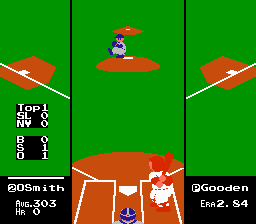
Fielding wasn’t rated, and was stripped down to a matter of only controlling the player closest to the ball.  It was by far the least important part of the game, which focused intently on the batter/pitcher matchup.  This was only exaggerated by the simplification of the pitching mechanics.  Since the NES controller had only two buttons–and one of them had to be used for pick-offs–the game “simulated” pitch movement by allowing the player to control the ball once it left the hand of the pitcher.

As such, it turned pitchers into ubermenschen, capable of abnormal and divine feats, violating the laws of physics.  It tore them down as human beings and recreated them as demigods with talents that could not be earned, only given from on high. As such, R.B.I. Baseball portrays baseball as less of a team sport and more of a clash of idols.

The pitcher looking away from the developing play represents the conservative fixation on restoring the glory of the past.

The pitcher looking away from the developing play represents the conservative fixation on restoring the glory of the past.

On top of this, R.B.I. Baseball doesn’t feature every team in the league. Only Boston, California, Detroit, Houston, New York (NL), St. Louis, Minnesota, and San Francisco are available, along with AL and NL All-Star teams. The eight teams represented in the game are the playoff teams from 1986-1987, an example of the social darwinism endemic to the title. Only winners are allowed to exist.  Everyone else was just the crud Michael Douglas scraped off the bottom of his shoe and fed to Charlie Sheen in my Wall Street follow-up that was apparently “too weird” for fanfiction.net.

Speaking of Wall Street, every single player in R.B.I. Baseball is white.  Color has been purged from the league.  Baseball is restored to an era in which anyone who didn’t pass a paper bag test was relegated to a different league that was much more awesome because it had Satchel Paige and Josh Gibson.  Sure, African-American players are in the game, but they’ve been whitewashed more than the cast of a high budget Hollywood adaptation.

Are you kidding me with this?

Are you kidding me with this?

So at this point, R.B.I. Baseball must seem like just another product of the conservative zeitgeist, like Red Dawn, Dallas, and the McRib.  As I alluded before, it’s not that simple.  As described in “Ozymandias” a work can both immortalize and critique the same subject matter.  R.B.I. Baseball was such a work.

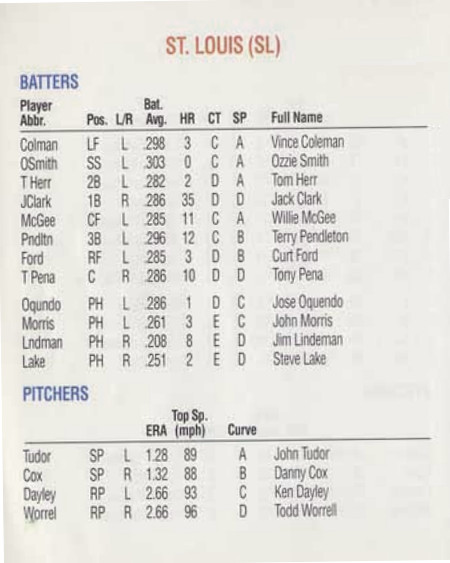
To understand how R.B.I. Baseball is subversive of its subject material, one must understand that R.B.I. is a remarkably prescient game.  It was released in 1988, at the tail end of an era of baseball in which speed and contact ruled the day, and yet HR was clearly the most important rating given to players within the game and listed in the manual.

Manualsample

Making switch hitters into lefties is unsurprising. The view that one must either fully support the RIght or be a “lefty” is a remnant of Benito Mussolini’s “O con noi o contro di noi.”

Power rules all.  Speed merely functions on the basepaths, and has little to do with success at the plate.  Contact rating, oddly enough, only modifies power in certain circumstances (See here for the best explanation I could find).

With this in mind, everything about R.B.I. Baseball falls into place.  It is not meant to be viewed by its contemporaries, but by those who come later and understand the chaos wrought by the values it satirically promotes.

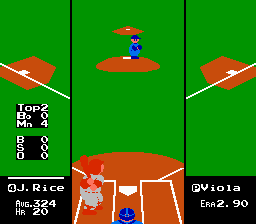
RBIs are now known to be a terrible stat for measuring individual players.  They are incredibly team dependent, which runs counter to everything R.B.I. Baseball stands for.  RBIs are known to be basically useless, outside of a needless desire to conform to tradition.  The use of RBI in the title is a signpost to intelligent fans–remember, Bill James had been publishing his Baseball Abstract over ten years in 1988–that while the game might be fun, its philosophy is not to be taken seriously.

White Jim Rice is not amused by what I have to say about RBIs.

White Jim Rice is not amused by what I have to say about RBIs.

The strange Tengen cartridges pictured earlier are another example of how R.B.I. Baseball speaks out of both sides of its mouth.  On one hand, it is emblematic of the deregulation of the era.  Nintendo’s centralized licensing economy was bested by the invisible hand of the free market.  But the truth is far darker than such Randian fantasies.  Tengen agreed to work under Nintendo’s license, then used that opportunity to steal the design for the lock-out chip.  R.B.I., published both under the original licensing deal and later with Tengen’s illegitimate chip, stands for the proposition that deregulation is accomplished through theft.

Every element of R.B.I. Baseball is laced with such subtle irony.  The criteria for inclusion as a team–making the playoffs in 1986 or 1987–excludes the New York Yankees.  Can you imagine a game released today that didn’t feature the New York Yankees?  Granted, the 1980s were hardly the pinnacle of the  Yankee era, but they were still the team of Babe Ruth, Lou Gehrig, Yogi Berra, and so many championships that people occasionally had to take George Steinbrenner seriously.

As I noted before, the hitting ratings rely heavily on power, and far less on speed or contact.   In the years since the game’s release, and the advent of ROM hacking, people have broken open the RBI rating system to reveal the full picture of the ratings system.  All credit to the excellent Nightwulf R.B.I. Editor on this one:

Still a Cardinals fan, even if I'm blogging about "video" "games".

Still a Cardinals fan, even if I’m blogging about “video” “games”.

As you see, contact is represented by a two digit number in the late teens or early twenties.  Speed numbers are three digits, and there is only apparently a difference of 122-148 between Jack Clark, who once lost a foot race to the Stan Musial Statue in front of Busch, and Vince Coleman, who shot a man in Reno just to see if he could sprint to Vegas before he hit the ground.  Power, on the other hand, is rated in the 700s and 800s.  Baseball’s traditional scouting scale, from 20-80, is strange enough.  This is just madness.  Like the voodoo economics of the 80s, it seemed make everything work at the time but once we had some perspective, it was just throwing increasingly large numbers at a television screen and yelling loud enough that no one noticed when they didn’t add up.

R.B.I. Baseball is ultimately a paper tiger, and not the good kind like the life-sized cardboard cutout of Miguel Cabrera I use to scare away burglars and people who want to talk to me about advanced fielding statistics.  This is not a criticism of the game.  It was designed to be shallow, simple, and propped up by math that not only fails to check out but can’t even make it to the express lane without having a seizure.  It is a monument to the policies of its era, and yet also a scathing critique of their values.

My name is the Tax Reform Act of 1986, quoin of coins.
Look upon my works, ye Mighty, and default.

Take that, late stage capitalism.

Take that, late stage capitalism.

The Meaning of Madden

No one gives a shit about sports video games. Granted, they sell extremely well. The top franchises-Madden, FIFA, MLB The Show-all bring in plenty of money. Even games based on staged sports do well, as evidenced by the success of the yearly WWE entries and NBA 2K series.  But no one cares about sports video games. They occupy a space long-derided by serious sports fans and serious video game fans alike.

To the sports fan, a video game is a dilution of the experience. It may technically reproduce every aspect of a football or baseball game, but ultimately the simulation rings hollow. Besides, why don’t you just go outside and play the game for real, loser?

Alex Rodriguez

This image basically sums up baseball right now.

To the video game fan, sports games represent everything wrong with the medium.  They were the unoriginal, uninspired, mass-market, annualized plague on gaming even before the was a new Call of Duty and Assassin’s Creed on the shelf every November.  They are regurgitated every year, with little more than a roster update and a few new features to slap on the box. Besides, why don’t you just play a real game, like Shadow of the Colossus, mouthbreather?

So despite the fact that sports games are some of the most successful titles, and have kept Electronic Arts afloat after a coke-fueled bender in which the board decided to bet the future of the company on BioWare’s writing staff, they don’t get much attention from either of their core audiences.  No matter how entertaining or technically proficient, they are not placed alongside the classics in any evaluation of video games as a medium.  Instead, they live in the ghetto of casual gaming, in a sketchy-looking apartment complex just down the street from the Candy Crush Payday Loan.

But I care about sports games. Here’s why: sports games are some of the few video games not completely lost to the hyperreal.  If Umberto Eco ever sat down with a Xbox for a few hours, he’d probably update Faith in Fakes with a new final essay that just read “Fuck you, I’m out” and run screaming into the woods never to be seen again.

To become a Model Reader of this text we must first choose no items, Fox only, Final Destination.

To become a Model Reader of this text we must first choose no items, Fox only, Final Destination.

An example: the most recent two releases in the Medal of Honor series purported to be based upon the actual details of modern military operations. The questionable ethics of this aside, these games were nothing of the sort.  They were imitations with no original, copies of copies of copies, so removed from any representation of reality that they became grotesque parody. The new MoH aped almost everything from the Call of Duty single player campaigns, which as linear parades of over-the-top set pieces, do nothing but try and continually reproduce the Invasion of Normandy sequence from, naturally, Medal of Honor: Allied Assault.  As if this wasn’t bad enough, Allied Assault was just a pastiche of the battle as portrayed in the film Saving Private Ryan.

That is just an example, and while there is plenty more to say about how modern military shooters affect our view of war, that’s another story. This is about sports video games, which is clearly more important on both a personal and global scale.

Actual screenshot from The Walking Dead: Survival Instinct

Most video games are basically power fantasies, and sports games are no exception. Even if your arm topped out at 70 mph in high school, you can rack up strikeouts in MLB The Show. No matter your concussion history, you can make tackle after tackle in Madden 13. And while the most you accomplished in theatre was getting cast as the understudy of a chorus member in your high school musical, you can still lead your team to the Finals in NBA 2K13.

However, unlike most games, the fantasy that the sports game is attempting to provide is, theoretically, achievable in real life.  No one has killed a dragon, or saved a princess from a horde of sentient lizards and fungi, or single-handedly defeated Russia in a global war.  None of those things have ever happened.  Despite what the Heritage Foundation would like you to believe about Ronald Reagan, those lizards were not sentient.

But the events depicted in sports games are real.  Someone has thrown a touchdown pass, hit a home run, or done whatever it is that’s supposed to be cool in soccer. All those things are possible, but exceedingly difficult. The challenge in accomplishing those goals is in overcoming real world obstacles, and a big part of a sports video game is reproducing those obstacles.

And this is where sports games get interesting. Unlike Medal of Honor, in which developers are trying to make the experience more like Call of Duty’s take on two decades of the shooter genre, the creators of Madden are trying to make their games more reflective of reality. The closer the game gets to the actual sport, in theory, the more fans will enjoy it. But the physical inputs they are working with-the timing (sometimes intensity) of button presses and the movement of two control sticks-simply don’t have the margin for error associated with the corresponding physical activity triggered by those inputs. It’s way easier to press a button and aim a stick than it is to throw a ball. So they rely on tricks to increase the difficulty.

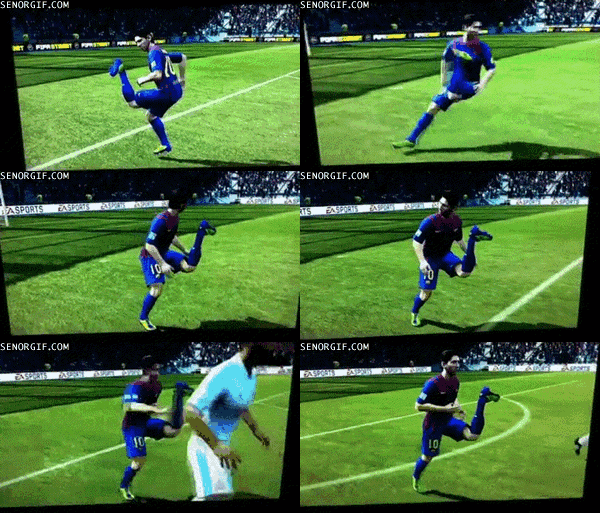
This is the reason MLB The Show added pressure sensitive throwing buttons to the fielding controls and pulse pitching. It’s the reason Madden implemented the ill-advised “vision cone” for quarterbacks. It’s why FIFA debuted a physics engine that led to some rather shocking images and video.

WHY DID WE PLAY AT BEING GODS?

WHY DID WE PLAY AT BEING GODS?

Not all of these developments work.  Some, like the vision cone, end up adding a layer of ugly, cumbersome game bullshit that put an additional barrier between the player and the desired results.  Some people still swear by the cone as a way to engage player skill and differentiate quarterbacks, but for the most part it was a failure.  Other developments, like the analog pitching in the otherwise properly-maligned MLB 2K series, have fared better.

This is also why sports games have ever more elaborate systems of evaluating players, and applying those evaluations to gameplay.  How do you give the user full control of the game, while also making it easier to play as Miguel Cabrera than it is to play as Rob Johnson?  This is a huge challenge that largely goes unappreciated.

Because the goal is to recreate reality, or at least provide the player with an experience that feels true to the sport, the decisions and care that go into a sports game is actually far more interesting than what goes into the next Halo or Elder Scrolls or whatever near-future third person shooter Ubisoft wants to make into the next big franchise this year.

So because I can’t think of any better ideas for this blog, I’m going to go back and play some old sports video games. And write about them.  It may be the dumbest idea ever, but at the very least it will set a nice baseline for other dumb ideas I might have in the future, like cat-sized Cardinals jerseys stitched with the name “Meowjica” or cheering for the St. Louis Rams.