
I Watched Atlas Shrugged Part III So You Don’t Have To

prev

jamestripsRead Part I

Read Part II

proIf there was anything that Ayn Rand loved more than her friends’ husbands, it was the free market. This was not a view shared by the producers of Atlas Shrugged Part III.

Very few people asked for Atlas Shrugged to be adapted into a film, let alone three films. The first installment earned less than five million dollars at the box office, and only a few million more on DVD. It failed to recoup even half its budget and was critically panned across the board. Nevertheless, the producers pushed forward with their plan, even if they couldn’t bring back the director, most of the crew, and all of the cast. The second film was financed through a debt sale and filmed over a single month, the dying gasp of a dream that should have never been brought into reality. Part II debuted on three times as many screens as Part I, likely due to its release near the 2012 election and the hope that money could be made off of the politically charged subject matter. Nope. Part II bombed even harder than the first installment, barely squeaking out over three million dollars.

The promotional materials for Far Cry 3 have taught us that the definition of insanity is doing the same thing over and over again, expecting different results. So, naturally, the producers of the first two Atlas Shrugged films made a third one.

“How?” you ask, and I don’t have a good answer. No one with any sense would invest in a project like this–the third film of a trilogy that twice failed to earn a profit and consists, notoriously, of the worst parts of the book it is based on. Atlas Shrugged isn’t a masterpiece from the start, but it falls apart spectacularly in the last third, mostly because of a 70 page speech by one of the worst Mary Sue characters to ever be realized outside of fanfiction.net.

Part III reportedly cost 10 million dollars to produce, which is considerably cheaper than the first two films but still 10 million dollars more than anyone should have been willing to pay. To top that off, a kickstarter campaign was drawn into the mix. Allegedly, none of the money was used to actually produce the film, which begs an important question: where did it go? The page is really vague on that–“expanding the production and marketing” is the official wording. The producers elaborate on this in their video and FAQ, stating that the main purpose is to allow fans to be “part of Atlas Shrugged history.”

In other words, the kickstarter was a way to take money from people who were willing to give it. And can you really blame the producers when there were six people who paid $7,500 to have their name written on John Galt’s wall in the film?

rewards The idea of paying a bunch of money to get your name associated with the prime mover capitalist heroes of Atlas Shrugged is maybe the most amazing thing to come out of this whole series of terrible movies. It’s so dumb and it’s even vaguely even predatory, though I can’t feel sorry for the prey of this particular scam. And maybe, in the end, they’re onto something. Anyone who had their name put up on that wall has something in common with Ellis Wyatt: they basically set a bunch of money on fire.

In keeping with the fine tradition of continuity, the entire film has been recast once again. Gone is Samantha Mathis as Dagny Taggart, replaced by Laura Regan who you might recognize as (a) Harry’s wife on Mad Men or (b) the actress who portrays Robin Wright’s character in Unbreakable during flashbacks. That’s how little there is to say about her. Hank Rearden is no longer a mob boss, but played by Rob Morrow (in theory; we’ll get to that later). And the standout of Part II, Patrick Fabian, is sadly missing in action as James Taggart, but gleefully replaced by yet another in the revolving door of unsettling expressive actors, Greg Germann. Or, as you probably know him, Fish from Ally McBeal.

NewTaggart

Everyone else has been recast as well, including Ray Wise as President Thompson. Which is a hell of a disappointment because President Thompson is actually in this film for more than a minute and Wise is sorely missed.


Continue reading

I Watched Atlas Shrugged Part 2 So You Don’t Have To

Previouslylasttime

Atlas Shrugged Part I: Full Post

proIt shouldn’t surprise anyone that Atlas Shrugged Part I was box office poison. It was a dry adaptation of the first third of an unfilmable book, starring Taylor Schilling pre-Orange Is The New Black. The studio presumed that it would find success because it courted a conservative market that is largely ignored by Hollywood. This was a huge miscalculation, because nakedly conservative films have (typically) been driven to profitability by church groups and Rand isn’t exactly a fan of religion. Also, while plenty of Republican politicians cite Atlas Shrugged as an influence, I’d wager that most either (1) haven’t read it or (2) didn’t understand it because otherwise they’d have to realize modern American political conservatism has way more in common with the regulatory capture and obstructionism of the villains than the ambitious drive of the protagonists. Socialism wasn’t the only windmill Rand tilted at with Atlas Shrugged, after all.

The misguided quest to film a book that didn’t need to be filmed should have ended with the failure of Part I. The free market spoke. But the producers didn’t listen. They still had a vision to complete, even if it would have to be reduced in scope and, hilariously, funded by selling debt. The entire cast was replaced. Jason Beghe took over for Grant Bowler as Hank Reardon. And Taylor Schilling was swapped out for Samantha Mathis, who is probably best known by readers of this blog as Daisy from the Super Mario Brothers Movie.

Sorry, Sam, but it looks like talking to a puppet dinosaur won't be the career low point you assumed.

Sorry, Sam, but it looks like talking to a puppet dinosaur won’t be the career low point you assumed.

When we last saw our heroes, Hank Rearden was fuming over yet another set of governmental regulations that would make it illegal to produce his “Rearden Metal”, which may or may not just be a type of steel. And Dagny Taggart was screaming at a burning oil field after tycoon Ellis Wyatt decided to torch all his product rather than let the government tax the state of Colorado. Wyatt then disappeared with a mysterious fedora-wearing dude, John Galt, whose very name has become a rhetorical question that no one has an answer for, because this world is very much like our own but does not have Google.

Continue reading

And Now Suddenly I Play MOBAs

There’s some not-very-different alternate reality where I’m obsessed with MOBA (Multiplay Online Battle Arena) games. I’m not just talking about being one of the folks who picked up League of Legends early on and got way into it; I’m talking about playing these damn games from the beginning. The real weird folks.

I played a lot of Starcraft back during the heyday of the original game. More importantly, I played and created a whole bunch of Starcraft custom maps. Including a map called Aeon of Strife. The Aeon of Strife Starcraft map is sometimes considered the very beginning of  MOBAs, though that discounts how many MOBA-like elements were present in the 1989 Megadrive title, Herzog Zwei (which is the progenitor of the entire Real Time Strategy genre). Aeon of Strife featured many of the elements that are now central to the MOBA–hero characters, RPG elements, three lanes, towers, creeps, and so on. But it wasn’t the highly competitive game we know today. Instead, it was purely cooperative–four humans against the AI.

Hey, you try and find a part of Herzog Zwei that makes sense in a gif

Hey, you try and find a part of Herzog Zwei that makes sense in a gif

Aeon of Strife gets the credit, but it was hardly the only map of its type. There were single-player RPG maps with similar objectives. Others had jungles and bosses, but lacked the typical three-lane structure. Some were simplified to make them easy to win. And a few were insanely difficult. I think I probably posted an RPG map of some sort to battle.net, which shouldn’t be a surprise. And it was probably terrible.

Continue reading

I Watched Atlas Shrugged Part I So You Don’t Have To

proA disclaimer: I don’t hate Ayn Rand. Or, at least, I don’t hate her in the performative way that someone who falls on the left of social/political lines is supposed to hate her. Rand’s prose is mediocre, her characters hollow, her futurism half-baked, and the way that Objectivism has been twisted and weaponized in modern politics is horrific. However, at the core of everything Rand wrote was a brutal honesty that I just can’t bring myself to hate. Rand offers a window into the selfish, greedy part of humanity that is usually hidden, rejected, or couched in relentless apology. And very rarely she makes a good point, like a squirrel with a bad haircut finding single acorn after gathering a dozen rusty nails. Her unflinching acceptance of the human id causes her to stumble into some useful insights into the futility and self-absorption of guilt.

That said, engaging with most of Ayn Rand’s ideas is like smacking around an empty pinata. Sure, it’s fun to swing a bat, but ultimately by hitting the pinata you’re admitting that you think there’s something of worth inside it. So this post isn’t going to be about Objectivism, it’s going to be about a bad movie.

A really bad movie.

logo
Continue reading

Elite: Dangerous – Like 400 Billion Stars When All You Need is a Knife

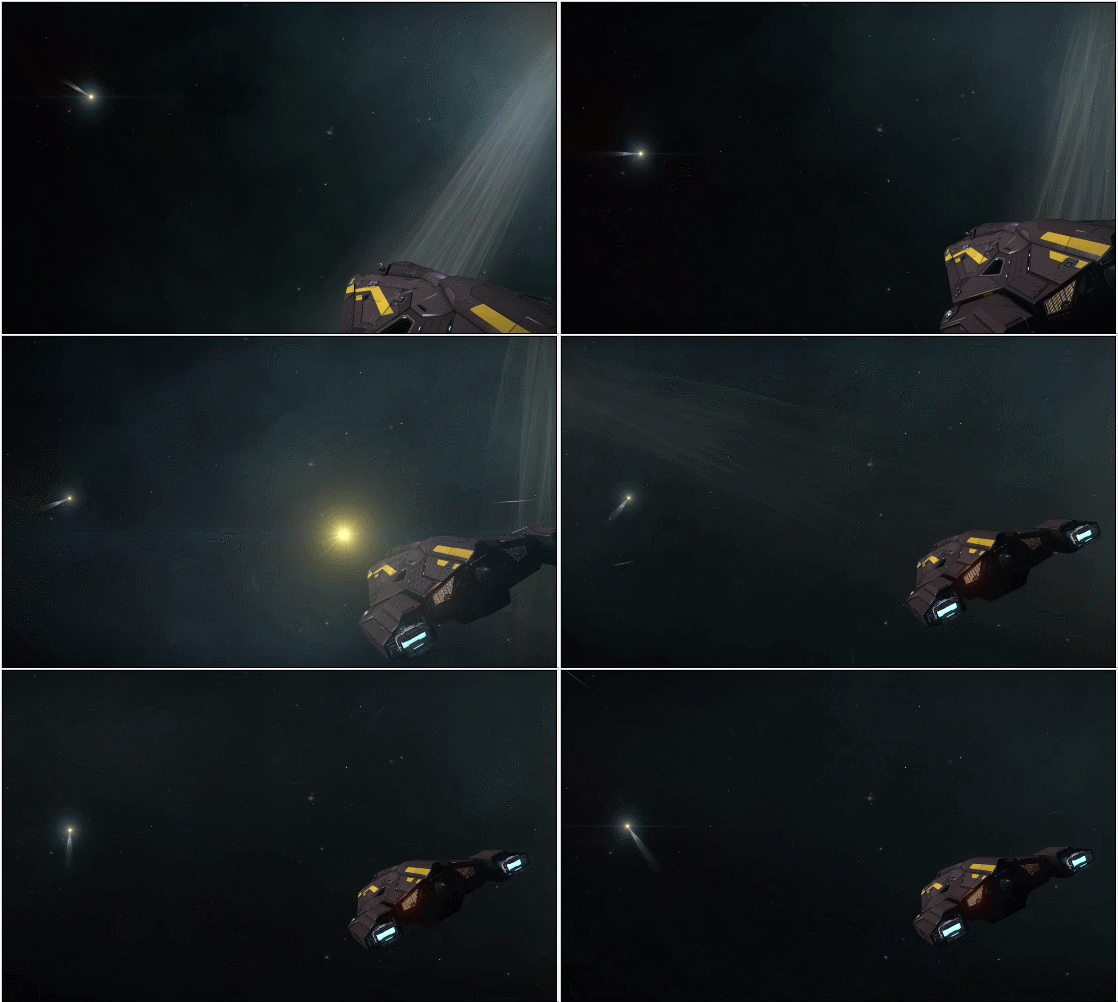
When I last logged out of Elite: Dangerous, I had just finished my lengthy pilgrimage to Empire-controlled space. The trip took well over an hour, thanks to the need to re-fuel at space stations every few jumps. I’d left on this mission (foolishly) without equipping a fuel scoop and there weren’t many larger starports in the area, which meant I couldn’t modify my ship to make it better suited for long trips between uninhabited stars. If I wasn’t careful, and didn’t stop whenever I got the chance at the smaller outposts to top off the fuel tank, I knew I could end up trapped in a dead-end system with no way out. And I didn’t want to start over, even if that would let me plan the trip better in the first place.

Elite: Dangerous is a space sim, by the way. You pilot a ship, visit the stars, shoot other people visiting those same stars, and smuggle weapons parts. It’s the sort of game that should require a keyboard and crazy flight stick, but the developers managed to port it to the Xbox One. That’s where I’m playing it because of my PC gaming aversion that I’ve long chronicled on this blog.

comet

There was one particular space station between Federation and Empire space that stands out to me.  I don’t remember the name, of course, because the places in Elite: Dangerous are all procedurally generated. Most of them don’t stick in your memory. They have generic-ass names like “Hoffman Enterprises” and “Cleve Hub.” The name of this station doesn’t matter. What matters is that it was the only populated place within jump distance as my fuel reserves dipped into the lower 1/4 of the gauge. I needed to stop somewhere–anywhere–and this place would have to do.

Continue reading

I Watched “United Passions” So You Don’t Have To

Last week saw the timely U.S. release of “United Passions,” a film about errant soccer association FIFA, funded by errant soccer association FIFA. This was a vanity project to top all vanity projects, an attempt to rehabilitate the image of an organization now best known for its corruption and destructive nature. And, in the United States, it came exactly one week too late, following the arrest of several top FIFA officials and resignation of FIFA President Sepp Blatter.

“United Passions” reportedly made $607 dollars in the United States over the weekend. There’s no missing digit, no missing “thousand” which would make that number less embarrassing. Six Hundred and Seven Dollars, so little that someone probably had to make a call on whether to report how many cents it made over $607. Even given the recent controversy–which probably made more Americans think about FIFA than ever before–no one wanted to see FIFA’s movie about FIFA. And it’s really no wonder, since it has 0% on Rotten Tomatoes and (as of this writing) a legit 1 on Metacritic (again no digits missing there).

But, c’mon, you’re curious, right? That’s where I come in.

roth Continue reading

Hey, This Is A Video Game: The Escapists

The Escapists is a game for people who like the early parts of Hitman levels: the careful planning, the testing of systems to see how far you can push them, and the way everything can go south in an instant if the wrong person sees you in the wrong part of the building at the wrong time. Unlike Hitman, however, there’s no second part of the level; when you fuck up and the guards turn hostile against you, it doesn’t turn into an action game. There’s no shootout because there are no guns (at least not in the first level) and there’s really no good way to fight the guards. You can get a drop on a guard with a weapon and knock him out, steal his keys. But once you’ve gone down that path you’re just a few minutes away from having all your items taken away and being stuck in solitary.

Each level of The Escapists drops you in a different clockwork prison. Your day is divided up between meals, work periods, exercise periods, and free time in which (depending on the prison) you can explore or improve your character. There are dozens of items to collect and combine into makeshift devices that can help you escape. Because escape is the only goal. You just have to get out, and the catch is that the game gives you no idea how you’re supposed to do that. Dig a hole? Cut through the fence? Hide in a box? Copy the right keys? For the most part, The Escapists doesn’t even tell you what’s possible, let alone the easiest path. The tutorial leads you through an escape where all the pieces are laid out for you (and one that is, I believe, impossible to put together yourself) and then throws you back in prison to figure out your own way to freedom.

If you go along with the other moving pieces of the clockwork world, you’ll never get anywhere. The items in your own cell aren’t enough to plot your escape, so you have to deviate from the path the game sets out for you–raid other inmates’ cells during exercise time, steal plastic utensils from the lunch room, use your job in the laundry room to nab a guard’s uniform. All while keeping your head down, because getting caught or beat up by another inmate takes away all your contraband items. And contraband items are the best items.

I escaped the first prison on my sixth day. I don’t want to say what I did, because figuring out how exactly I was going to get out without any preconceived notions was the best part of the game. But if you want to see me stumble around on the first day (which doesn’t spoil anything but a couple item combos) and get an idea of what the game looks like, I’ve done the 21st century thing and uploaded a video.

Ed Easley’s Wonderful Day: A Browser-Based Visual Novel

screenshot

Today the Cardinals called up career minor-leaguer Ed Easley for what is sure to be a single-game appearance with Jon Jay returning this weekend. Rather than write a blog post about it, I made a short visual novel. You can play it in your browser or on your phone at this link: Ed Easley’s Wonderful Day

While you’re at it, if you like visual novels, go check out Serafina’s Crown on Steam Greenlight. I wrote about 1/3 of the dialog (the creator of SC is doing the music and portrait art for The Closer). It’s not my usual style, but if you like my video game/sports writing, give it an up-vote to speed up the greenlight process. Thanks!

MLB The Show: The Proselytism of Matt Holliday

If you’re a Cardinals fan, you know that there are a ton of Cardinals fans who want to turn Matt Holliday into a first baseman. Their goals are noble and fully understood. Holliday didn’t come to the Cardinals as the best of left fielders and he hasn’t gotten any better. Despite putting up consistently great offensive numbers for half of a decade, some people seem to remember him best for a defensive miscue back in 2009. Matt Adams has started 2015 with an uninspiring performance, and the Cardinals have a glut of intriguing outfielders. Moving Holliday to first, giving both at-bats and defensive opportunities to Grichuk, Bourjos, Piscotty, etc. sure sounds nice. There’s only one problem.

Matt Holliday has never played first base as a professional. In fact, he has over 200+ games at third base in the minor leagues but not a single professional inning at first. But is that a problem? First base requires the least mobility of any position on the field. It’s poorly-sourced common knowledge that anyone can play first base. It doesn’t require range. It doesn’t require much of an arm. A first baseman needs to be able to catch the ball and react quickly. But those are skills generally required of all positions. So, surely, Matt Holliday can play first base?

If you’ve been following this blog at all, you know that there is only one way to answer any question about players out of position. It needs to be simulated in MLB: The Show.

MLB® 15 The Show™_20150524133703

Continue reading

MLB The Show: 15 — The Reformation of Tom Brady

Yesterday, the National Football League announced that New England Patriots quarterback Tom Brady would be suspended four games as a result of his role in the Great Football Deflation Scandal of 2015. This was a big deal, not just to the Patriots or the entire league, but to Tom Brady himself. You see, Tom Brady is an intensely competitive man. You might even call him a “competitor”, if you were an NFL announcer and had to fill several hours of airtime with the sound of your voice without saying anything meaningful. Tom Brady isn’t the sort of guy who will take to sitting on the sideline. Instead, he’s going to do something drastic. He’s going to join the professional sports league where tampering with the ball is a storied and celebrated act.

Tom Brady is going to play Major League Baseball.

MLB® 15 The Show™_20150511213254
Continue reading