Explaining My New Venture, BAD GAMES PLAYED BADLY

Everyone knows the tale of E.T. for the Atari 2600. The film took the world by storm and Atari rushed to develop a licensed game to ride the coattails of its success. Atari spent millions acquiring the rights, churning out a game in under six months, and printing out as many copies as possible. It was supposed to be a smash hit but the game was bad and poorly tested, so instead it was an expensive failure that became the figurehead of an industry-wide crash.

Mulder, it's a bomb!

Mulder, it’s a bomb!

While E.T. was a disaster, video game companies kept coming back to the same idea: strap a successful license onto a bad game and the bad game will sell tons. They were probably right, at least up to a point, because the history of video games is littered with mediocre-to-awful licensed brawlers, shooters, adventure games, and action/platformers. There are games based on The Sopranos, CSI, Prison Break, Rocky, Jaws, The Godfather, Deadliest Catch, The History Channel, and Reservoir Fucking Dogs. Among others.

And X-Files.

And X-Files.

So I’m going to be streaming them. And writing about them.

I’m doing this for a lot of reasons: to promote my own upcoming game, to learn from the mistakes made by sloppy or bad games, to make gifs to post to twitter, to indulge in masochism, and because a lot of these games are dirt cheap these days. After all, like E.T. they were probably produced well in excess of demand.

I’ve already started up with X-Files: Resist or Serve as you might guess from the gifs I’ve interspersed throughout. And I already have a few more games lined up after that. It will be mostly a mixture of PS2/PS3 titles, but I have all sorts of systems available if I stumble upon the right game. If you’re interested in following me live, my efforts can be found at twitch.tv/RedbirdMenace but there will be gifs posted on twitter after each session, and write-ups here (probably with video) as I go along.

I do not remember this episode

I do not remember this episode

I don’t have a microphone yet, so for the moment the streams won’t have commentary. But I’m looking to maybe expand into doing commentary as well, and for now it’s all the easier to hear the bad voice acting. Generally, I will be playing blind but, in full disclosure, I will not stop myself from using in-game cheats to complete games with restrictive save points if they’re available. No one wants to watch me beat my head against a wall forever, and I’m more interested in seeing all the terrible content rather than the challenge. I’ll

Games up ahead will (probably) include The Sopranos: Road to Respect, Star Trek (starring Zachary Quinto), 24, and others! If you have any requests, feel free to let me know.

And God help me.

Brian Williams, Lies, and Memory

I don’t often write about being a lawyer. There are good reasons for that: pesky things like attorney-client privilege, ethical duties, and–perhaps most importantly–there’ls nothing interesting about what I do. Now, I’m not one of the really boring lawyers: transactional attorneys who draft contracts and wills and… Well, I’m not even sure what they do to fill their days. I work in litigation, which means I actually am in the courtroom a fair amount, and I do get to argue at hearings and take testimony. But it’s still completely boring 99 percent of the time. I don’t want to write about boring things.

Today, though, I thought I’d further dilute my brand by discussing a few things I’ve learned at the cost of wearing a tie every day.

Earlier this week, Brian Williams, who is best known for his cameos on the hit sitcom 30 Rock, recanted an oft-repeated story of his: that he was in a helicopter that was shot down in Iraq. Turns out that some other folks who were in that helicopter got sick of hearing the story and finally decided to call him out on it. Williams was actually in a different helicopter nearby. That helicopter did have to land when the other one was shot down, but that’s a little less dramatic than the story Williams was telling.

In admitting his fault, Williams claimed that the stress and confusion of the moment, compounded by watching footage later, caused him to remember the events differently than they actually occurred. On its face, that sounds ridiculous. But it seems very familiar.

People tell me things that aren’t true all the time. It’s a pretty common theme of my job. Often times these untruths merely aren’t believable. Other times, they are verifiably false. Witnesses, clients, opponents… Everyone does it. I don’t believe anyone tells the truth. I don’t think I would tell the truth if asked enough questions. And it isn’t because I’m a liar. Notice, I’m not saying these people are telling me lies. They’re just telling me things that aren’t true.

They do this because they trust their memory. And I don’t blame them for it. For the most part, I trust my memory too, if only because the other option is existential terror. But while our memories are good at a lot of things, especially with the help of repetition, they are terrible storytellers.

Most of the cases I work on deal with very traumatic events that happened over a year ago. These are events that no one will ever forget–certain images, thoughts, feelings will be seared in their mind forever–but that isn’t a guarantee of how well they will be remembered. Certain details will recede, others will come to the forefront. The order of events may get jumbled up. If the event happened while they were in the middle of doing something they do every day–like crossing the street to get to work–details from other days may get mixed into the pile. But that’s not where the real damage happens.

The real damage happens when they begin to tell the story. They tell their families, they tell their doctors. And their story gets repeated back to them. Sometimes the people repeating it back tell it wrong and the person assimilates those wrong details into their own memories, then repeats it back to another person. The story grows and as it does, the story changes. But more importantly, the memory changes.

The power of suggestion is a hell of a thing and our memories aren’t nearly strong enough to resist it. The worst thing, perhaps, is that this even happens to actual liars. They start out telling something that isn’t true because it helps their case. But then they repeat it enough times, defend it and build a context around it, and pretty soon they believe it. Their memory adjusts to include the falsehood, and then they doubt that they ever intended to lie about it in the first place.
Now, the story that Brian Williams told is a pretty tall tale. He didn’t recount the events out of order, or replace a detail. He put himself on a completely different helicopter. I’m not going to say for sure whether he lied the first time he told the story, but I would be willing to bet he wasn’t lying a few years later. By that point his brain, in its neverending quest to turn observations into narratives, took the footage he watched of the other helicopter and married itself to his story.

When you think about it, this makes a lot more sense than to believe that Williams, who can’t be a total idiot, continued to tell a story he knew was a lie, that could easily be disproven by a number of people, and could destroy his career. By now, he’s really got nothing to gain from repeating the tale and everything to lose. If he knew it was a lie, why didn’t he bury it–never speak of it again. Even in the terrifying ever-connected world of the internet, the story might have mostly disappeared. No, the reason he kept repeating it was because I think it became the truth to him.

I can’t go into details, but I’ve seen this before. It can be both frustrating and terrifying, because there is no one harder to defend than someone who truthfully believes something that is plainly not true.

This is not (necessarily) a defense of Brian Williams. I have no idea why he told the story the first time. But this story is important because it is a high profile example of how shitty our memories can be, and how it’s not always our fault. It’s why an eyewitness account is often a terrible piece of evidence, especially if the person has been discussing the event with someone who might be biased. It’s why we should take come claims with a grain of salt, but also why we shouldn’t demonize people when parts of their story turn out to be untrue. They might not be lying. They might be telling their truth, and it just doesn’t line up with what actually happened.

The Closer: The Official Trailer

Do you like trailers? Are you the kind of person who doesn’t believe something is real until you see it on YouTube? Has the magic worn off between you and still pictures, and now you need something more exciting, like video, to really get you excited?

Well, I have good news for all of you! Presenting the first official trailer for 2015’s most anticipated free RPG Maker adventure game about baseball for Windows PCs, The Closer: Game of the Year Edition.

Stay tuned for more information and probably some kind of website in the near future.

(Music by Jenny Gibbons )

Remakes: Anger and Fear

Yesterday, the cast for Paul Feig’s Ghostbusters remake was announced and, predictably, some folks on the internet exploded. There are a lot of moving parts to consider when examining what, exactly, makes this project so odious to certain people–from a fatigue with Feig’s recent output to the perpetual backlash against Saturday Night Live to the general minefield of women making in-roads into genre/sci-fi culture–but I wan to focus on a much broader point: why do remakes get people so angry?

On the surface, a remake of a film seems like the dumbest thing in the world to get angry about. Unless George Lucas is involved, the original film is completely untouched by the process.  At worst, the new movie comes out and it’s godawful. So you don’t see it and you pretend it never existed.  At best, the new movie adds to the original and explores some new angle of the concept. And that’s great. The world is better off for having a billion versions of Dracula, for example.

But it’s not that simple.  It’s not just remakes people get mad about, but adaptations.  When Hollywood makes a shitty movie out of a good book, fans of the book are furious.  But why?  The book is still there.  You can ignore the film.  Nothing changes.  Right?  RIGHT?

The problem is that these books and original films are important to people. They aren’t just pieces of media or art that are consumed, enjoyed, and cast away once finished. They are more powerful than that. Each film, each book, each video game is a point on the vast field of popular culture which we use to assist in identifying ourselves.

For as long as I’ve been alive, “culture” has been defined in terms of the media and products that I consume.  If you don’t believe me, consider Facebook.  Or at least the early days of Facebook–I don’t know that much about modern facebook to be honest. But back when I used it, one of the first things you were prompted to indicate on your profile were your favorite films, bands, books, and television shows. Facebook asked us to use popular media to craft our public image–and most of us did it!

Who am I? Going back to the facebook profile I haven’t updated in years, I’m Cat’s Cradle. I’m LOST.  I’m Steven King’s The Stand. I’m Kill Bill. I’m I’m Luo Guanzhong‘s Three Kingdoms, but only because ten years ago I got way into the Koei Romance of the Three Kingdoms strategy series to the point where I started reading Chinese historical novels. Which is maybe the most embarrassing thing.

This sounds like a horrible corporatist nightmare in which we all form our identities around products sold to us, but I try to look on the bright side of things. For most of human history, culture has been bounded by geography and ethnicity.  And culture wars were actual wars, with folks taking knives to the throats of their neighbors.  Being a consumer is bad, but it’s not the worst manifestation of culture we have seen as a species. So I’m not going to rage against consumer culture entirely, at least not in this post.

The problem is that culture changes and recycles itself, even though it is part of our identity.  When the culture we have assumed  as part of how we position ourselves in the world comes under assault, we take it as an attack on our self.  We cannot ignore it. We cannot shrug it off and tell ourselves that it is meaningless.  When we use films as  coordinates to determine our own identities, those films becomes quasi-sacred.

So, sure,  when the remake comes out, the old film is still there. The remake didn’t change it. But the very existence of the remake suggests that the old film–something that we incorporated into our own identity–was examined by our culture and found deficient.  It has been forced to change to remain relevant and that is troubling because it says something about our selves, and the terms we have come to use to define our selves.

The anger that people express against these remakes is existential anger.

This sounds overdramatic. Or maybe it sounds like I’m looking down upon the common folks, seething over pop culture, for being dumb sheeple who buy into the idea that they can find meaning in corporate brands which pander to them as members of a certain demographic audience. But I’m not.  Far from it. I’m right there in the brands with the rest of them.

There’s one particular movie I left out from the paragraph about my old facebook profile and it’s probably easy to guess since I withheld it for dramatic purposes: Ghostbusters. When I was a little kid, Ghostbusters was my favorite movie in the world. I watched it all the time, and even watched its mediocre sequel and forgettable cartoons. I owned a ton of Ghostbusters toys and dressed up in a jumpsuit and proton pack for at least one Halloween.

Of course, by now my passion for the franchise has waned.  But it still has stuck with me, both as a part of my past and as a building block of my writing style and sense of humor.  If you go back and read any of my early comedy scripts,  it’s almost embarrassing how apparent the influence of Ghostbusters is on what I think is funny.

I like to consider myself an even-keeled person who doesn’t get angry or upset about something as dumb as Hollywood films. But months ago when Feig’s reboot was announced, I felt that tiny voice in the back of my head whispering “How dare they fuck up Ghostbusters.” And maybe for the first time I understood what made people so angry.

Granted, it took maybe an hour to get over myself and accept that remaking a film didn’t affect me in any meaningful way. And when I found out that the main cast would be women this time, I was relieved because it signaled that the new movie wasn’t meant to replace the old movie and instead riff on the idea.

I still understood the anger.

I suspect that we all have books, movies, sports teams, albums, and video games that are somehow sacred to us.  Because as much as we might want to act like we’re somehow outside of society, we aren’t. Pop culture is ubiquitous.  Brands and franchises are relentless, bombarding us with idealized images that we can only pretend to forget.  They worm their way into our heads and placate us by reinforcing or changing how we see ourselves.  And then, when they are done and move on to a more lucrative audience, they remind us that they were products all along.

Ghostbusters is a product and now that I’m 30 and I bought the DVD, it doesn’t have any more use for me. It sees a whole new group of kids and teens who have a different sense of humor and a different set of interests, who think that capturing ghosts is just a new way to follow each other on Snapchat.  Those people will spend more money, buy more action figures, play the mobile game, and build the new electric-powered ECTO-1 in Minecraft. My Ghostbusters won’t reach those kids.

I have come to accept this, so why am I writing this? Because I also understand why others haven’t come to accept this. There are a ton of people in my generation, stuck in shitty situations,  who haven’t moved on from the things that made them happy as a child. They haven’t found new coordinates with which to plot their identities.  And the reasons they haven’t moved on aren’t entirely their fault.

The people you see shouting into the void about remaking a film aren’t just angry. They are afraid. They see their identity being stripped away and re-packaged to a new audience. And while we might want to mock them for being so pathetic that their identity is, even in part, reliant on a Bill Murray movie about trapping spirits in mechanical backpacks, let’s not forget that we’re all exposed to the same cultural pressures and seductive media.

There but for the grace of ghosts, go I.

 

One Weird Trick to Writing Too Many Words About Duke Nukem 3d

Duke Nukem 3d was released for the Playstation 3 and Vita last week–free for PS+ members–and it caught me totally off guard. I’d forgotten that anyone really cared about Duke Nukem anymore.  I certainly didn’t think that, in the wake of the abysmal Duke Nukem Forever, there would be enough fond memories of the franchise to port even the best-regarded installment to the goddamned Vita.

I don’t have a ton of great memories from Duke Nukem 3d.  I’ve always been more of a console gamer, which means that I missed the Duke zeitgeist.  It also means that I first played the game on the N64. Feel free to write off all my opinions for this reason. I don’t really care; I played the PC version a year later and nothing of value was really lost in the port.

Less important than the platform was the timing. Since my first experience with Duke Nukem 3d was the N64 port, I came to the game a year and a half after it was released. And that was a year too late. Duke Nukem 3d was a product of a very specific time in pop culture and video game development and there was really no going back.

Duke Nukem 3d was released in January of 1996.  At the time, it was the zenith of FPS development. It was the natural progression from Wolfenstein 3d to Doom to Hexen and all sorts of other similarly-designed titles. Duke specifically used the Build Engine, which improved upon Doom Engine/id tech 1 to allow for better “faking” of three dimensional space.  The Build Engine was a hell of an achievement for its day.  The only problem? Quake released five months later.

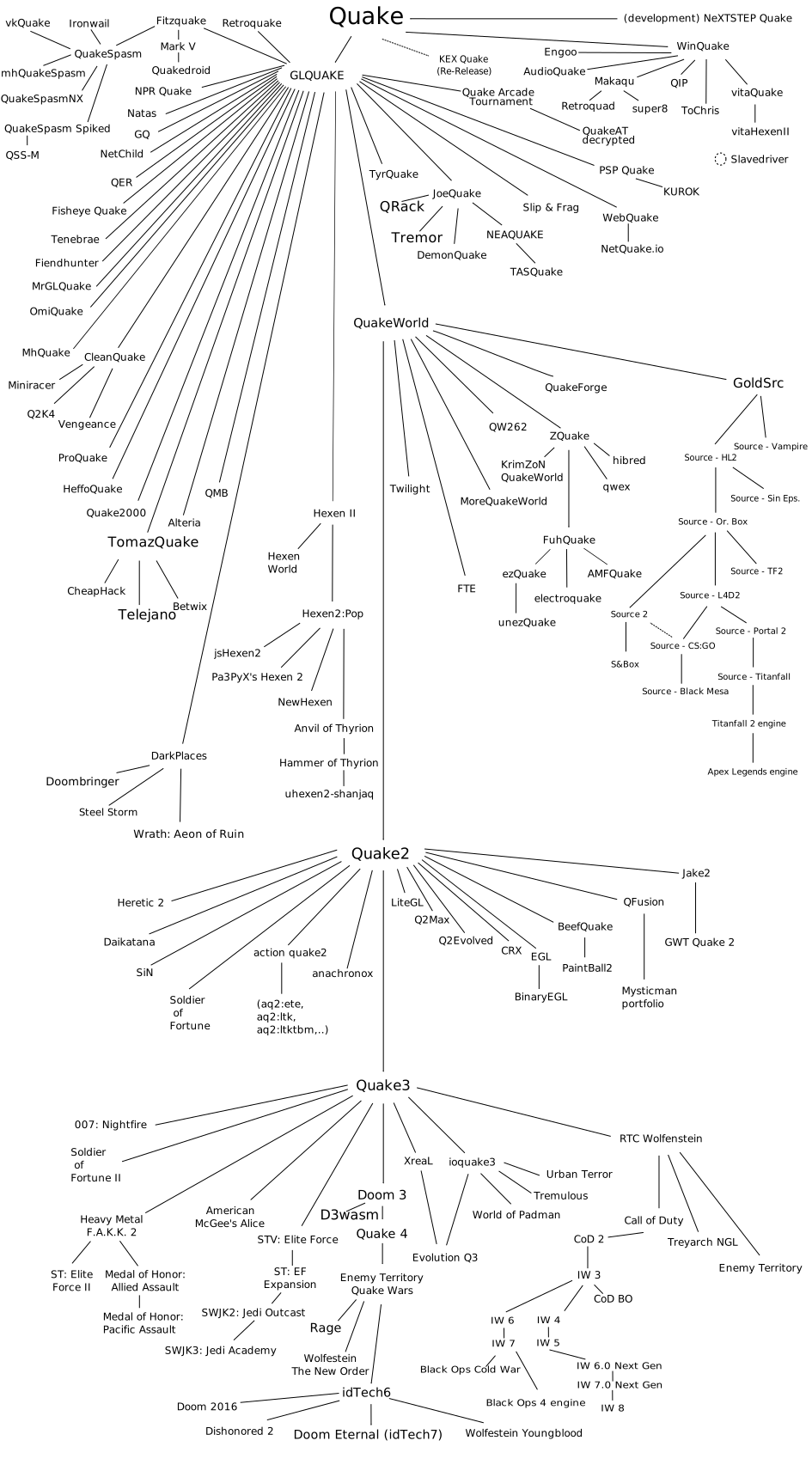
Quake, unlike Duke Nukem and other Build Engine games, featured actual 3d rendering and processing. I can’t overstate how much of an effect Quake had on everything that came afterwards. If you want to know how important the Quake Engine was, just look at this chart.

In a lot of ways, Duke Nukem was made obsolete less than six months after it was released.  Sure, more Build Engine games were released (Blood, Shadow Warrior) but the 2.5d shooter was dying.  If you didn’t catch Duke before you tried Quake, you were in for a bit of a disappointment.

Continue reading

I Can’t Support John Smoltz For The Hall Of Fame Because We Don’t Know He Didn’t Kill A Drifter In An Applebees Bathroom in 1997

It’s that time again, when the BBWAA announces its annual inductions into baseball’s hallowed Hall of Fame. This year’s ballot is packed with talented players, with more than a little controversy surrounding many of its potential inductees. But there is one name that won’t be on my ballot. And, yes, it’s for the reason everyone won’t stop talking about but no one wants to hear.

My conscience won’t allow me to support John Smoltz when it is possible that he murdered a drifter at an Applebees on February 3, 1997.

Yes, I know that Smoltz was never convicted–or even charged–with the brutal killing of a teenage hitchhiker in the bathroom of a Georgia casual dining establishment. But here’s the thing: Because Major League Baseball did such a terrible job of policing the behavior of its players during Smoltz’s career, we are left with questions that can never be answered. We are left to speculate whether the hard-throwing right-hander attacked an innocent young man in the bathroom of the Smyrna Applebees Bar & Grill just to know what it felt like to end a life.

What are we supposed to think? Just take a look at pictures of Smoltz before and after the 1997 offseason. You can see a confidence in his posture that could only come from using his bare hands to snuff out the existence of another human being, as well as a weariness in his eyes that looks, perhaps not without cause, like the weathered gaze of a young Charles Manson. His supporters are already rolling their eyes, and muttering to themselves that a thousand-yard stare means nothing. Maybe he just wasn’t getting enough sleep. But in the context of the era, when illegal activity was running rampant, signs like these can’t be ignored.

Maybe his supporters are right. Maybe Smoltz was doing something on February 3, 1997 other than brutally choking another human being to death mere yards from oblivious diners enjoying a generous serving of mozzarella sticks. Maybe, as over 18,000 murders occurred in the United States in 1997, Smoltz merely looked the other way and relieved his curiosity about the fragility of the human condition in other ways. But where was he, one of the most prominent pitchers in baseball, in protesting these thousands of killings. Smoltz never did a thing to stop a single murder in 1997, even if we suspend credulity and agree that he may not have been involved in one?

To date, Smoltz has not even addressed the accusations that he carefully placed an “Out of Order” sign on the mens restroom at the Smyrna Applebees so that he would not be interrupted as he strangled a complete stranger until he could no longer breathe. Like most of the other murderers of the era, he has chosen to stay silent on the matter. Where is the accountability from a professional athlete who says that these suspicions are “baseless” and “silly?”

I don’t care how many times you tell me that no one saw John Smoltz at the Smyrna Applebees on February 3, 1997, or that fibers from the floor of the bathroom matched clothing found in the home of an area serial killer. This isn’t a court of law, this is a Hall of Fame ballot, and my standard of evidence is a bit lighter than the burden of the state to convict.

Sure, Smoltz has a good case if you just look at the stats. But voters have a right–no, a responsibility–to consider the possibility that he used his greater size and physical ability to commit the most brutal of crimes.

Did John Smoltz murder a drifter in the bathroom of an Applebees on Feburary 3, 1997? I don’t know. But can I ignore the suspicion? Can I fail to weigh it against his MLB career? No, that would be a disservice to the Hall of Fame and I will have no part in that.

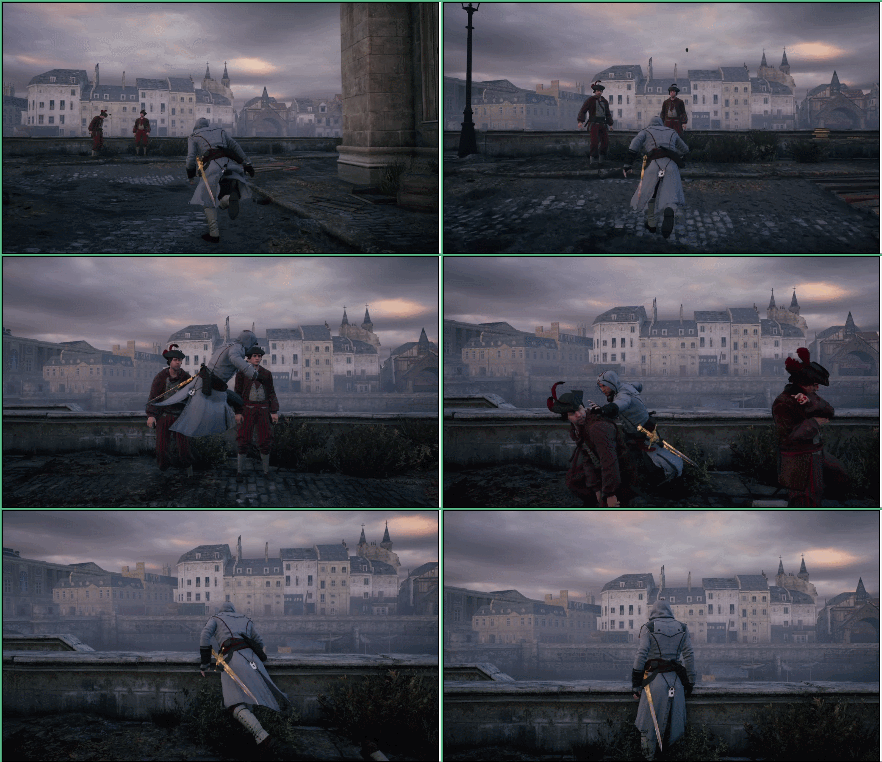
A Defense of Assassin’s Creed: Unity

Last week, horror legend John Carpenter called Assassin’s Creed: Unity his #1 game of the year over on GiantBomb. He didn’t give an explanation and the guys at Giant Bomb didn’t ask for one because, c’mon, he’s John Carpenter.  If John Carpenter is even willing to entertain the idea of doing a top video game list, you don’t question the dude.

At the time, I commented that it would be excellent support if I ever decided to write a defense of AC: Unity. After all, between The Thing, They Live, Escape From New York, and Big Trouble in Little China, John Carpenter has (indirectly) been more of an influence on video game narratives and tropes than…well…anyone in film. He wrote, directed, and even did the music for the films that influenced games the most, so the guy is owed at least some deference.

I didn’t actually think I would write a defense of AC: Unity, but here I am. The idea stewed in my head long enough that I convinced myself that it was something I should do. So here it goes.

twokills2

Continue reading

Once Upon A Time In The Projections

I’ve been thinking a lot about baseball player projection system lately, which is just a fancy way of saying I’ve been sick and unable to play 3d video games without feeling nauseous or write creatively so my brain had to go off and do something dumb. A few days ago, Fangraphs published Dan Szymborski’s 2015 ZiPS projections for the St. Louis Cardinals. If you follow enough of Cardinals/sabermetric twitter you know that Szymborski took issue with a particular Cardinal blogger who questioned the necessity of these projections and made some fundamental mistakes regarding the ZiPS process. Piling on Cardinals fans is a national pastime for some reasons we don’t bring on ourselves (the media’s terrible Best Fans in Baseball Narrative) and some reasons we do bring on ourselves (I can’t even look at Cincinnati on the map without muttering “kiss the rings”) so the blog post was passed around, ridiculed, and pulled.

Social media drama is the last thing I ever want to care about, but the argument got me thinking. First off, I respect all the hard-as-hell mathematical work that goes into developing projections. I couldn’t do it. I wouldn’t even know where to start learning how to do it. Second, there is clearly an audience for projections–as demonstrated by the anticipation leading up to the ZiPS reveal. So it’s cool someone is putting in the hard work.

But what do good projections really tell us?  I haven’t been able to answer that question and it has stuck with me through a haze of cold medicine.  This isn’t just about ZiPS, or STEAMER, or PECOTA, or any projection system in particular but about the concept of projection systems in general.  What information are they providing?

“They give us a better idea of how players will perform!” you are shouting at your screen while you add my name to a list that includes Murray Chass.  And you’re right, that’s exactly what they do. Maybe.

Bear with me on a thought experiment (groan, I know) while I consider two hypothetical projection systems: the PERFECT system and the BEST system.

The PERFECT system: The PERFECT system correctly and accurately projects player performance. As indicated by its name, it gets nothing wrong. In December of 2013, the PERFECT system projected Matt Carpenter to get 709 plate appearances and a .272/.375/.375 triple slash. How does it do this?  I dunno. Let’s say that, to borrow heavily from the film Interstellar, it tracks batted balls in the future by the minute changes in gravitational fields as they travel backwards through space-time.

Now, the PERFECT system trivializes baseball in lot of ways and calls into question important concepts like free will and predestination.  But it also does one thing really well: it’s the only projection system in the goddamn universe that predicts Allen Craig will have a .266 BAbip in 2014. It’s also the only one that sees Pat Neshek coming.  The really weird stuff–the stuff that has a lot of value to predict–is only truly caught by the PERFECT system.

“That’s not fair!” you reply and move my name above that of noted blogger Murray Chass. “You can’t compare projection systems to literally seeing into the future!” Well I can because this is the internet and on the internet you can advocate for things as crazy as seceding New Hampshire from the Union or SEGA producing Shenmue 3. Also, I need something to compare with the next system.

The BEST system: The BEST system is a bit more realistic. This projection model is top-of-the-line.  Using all that math I don’t understand, it provides the most precise predictions possible without any knowledge of the future. I think we can all admit that (Interstellar notwithstanding) there is no way to measure all the random shit that happens in a baseball season.  And as someone who watched the Cardinals bat .330 for an entire season with RISP, I know for a fact that the sample size of an entire season isn’t enough to weed out all that random shit.

What the BEST system does, however, is successfully weed out all the random shit in the past stats, and uses that to provide an exquisite shit-free stat line for every player in the upcoming season. The BEST system is so good, its creators boast, that if the 2015 season were to be played 1000 times and the results averaged together, the numbers would be exactly what the BEST system projected for them.  This seems like a crazy boast, but the cast of the television series Sliders (which is still running in at least one universe) confirms that it is true.  The BEST system is just that good.

Every year, when you run the numbers, the BEST system is going to be named the most accurate projection system. In aggregate, that will be true. But what about each individual player?  Sure, the BEST system will be the system most likely to come the closest to the real numbers. But, by design, it will staunchly be unable to identify an outlier.  That’s not a bug. It’s a feature of a good projection system.

Remember how I said that playing the season 1000 times would result in averages that equal the BEST system projections?  And how great that was?  The problem is that 1 of those seasons is going to give you the PERFECT system projections.  And then the other 999 seasons are going to drag that pin-point accurate projection straight to the average.

What I’m saying is this: the problem with the BEST system is that it’s incredibly conservative. It will predict a decline from Allen Craig, yes, but not because it knows he will turn into a pumpkin  It is because his 2013 was also an outlier. The BEST system will never predict a collapse.  Similarly, it will look at everything about Pat Neshek and spit out some mediocre numbers, because of course it will.  No one could have seen that coming (and no one should be expected to).

This conservative nature is the problem with any good projection system, because conservative predictions aren’t terribly interesting. With the exception of minor leaguers, the BEST system as described above isn’t going to tell you a lot you couldn’t glean from a glance at the player’s age and MLB stat history. Which is a shame, because developing something like the BEST system that is so (on aggregate) accurate would be an incredible mathematical achievement. It just wouldn’t tell us anything about current MLB players.

This is why the really fascinating stuff in the ZiPS projections for the Cardinals isn’t, say, Matt Holliday’s numbers or Adam Wainwright’s numbers. Someone taking a wild guess or simming the year in MLB: The Show could come up with a triple slash of .275/.348/.456 slash line for Holliday. I don’t mean this a an insult to ZiPS, which of course is way more work than that, and will be more accurate for more players.  But a conservative prediction that Matt Holliday will continue a gradual decline is, well, not exactly a revelation.  And any good projection system will likely come to a similar, conservative result.

The interesting stuff in the ZiPS are projections from guys like Ty Kelly (.254/.333/.358) or Samuel Tuivailala (3.29 ERA, 28.3 K%). Kelly is a journeyman utility infielder with no MLB time projected to be about as good as Kolten Wong.  Tuivailala is a converted position player who rocketed through the system in two years on the strength of a  99 mph fastball. Obviously, a system that identifies guys like these who can be immediately productive at the MLB level would be very valuable. Maybe the BEST system as described above would do that, but the problem is that these projections–which are truly interesting, and the reason I like looking at ZiPS–are the most difficult to verify as reliable. Kelly’s numbers are based on the idea he receives 550+ PAs and god help the St. Louis Cardinals if injuries force the team into that situation.

While I like to look at projections and I respect the hell out of the work that goes into them, I’m sympathetic to the argument baseball old-timers put forward that they are meaningless.  The more accurate a projection system gets, the less it tells us that we didn’t already know.

Of course, projection systems published on the internet are mostly created to give us something to talk about in the off-season and I just wrote 1000+ words about them. So maybe I’ve already lost any argument I was trying to put forth.


One Way or the Highway: MMOs, Dota, and Metagames

I played my first MMO this year. I don’t know what came over me. This was shortly after finishing Lightning Returns and I wanted to play a good Final Fantasy game (as opposed to a good Valkyrie Profile game). Lots of people were saying that FF-XIV: A Realm Reborn wasn’t just a good MMO, but accessible to beginners.  The PS3 version was cheap on PSN and could be flipped into a PS4 account with little effort. So I went for it.

There are a few reasons I had never played an MMO before 2014.  As I’ve written before, I’m not much of a PC gamer. I don’t like mouse/keyboard as a control scheme for anything other than strategy games and I prefer to work on a laptop. Socializing is the last thing I want to do when playing games, so I didn’t have any interest in the chat room aspects of MMOs.  And I don’t like paying subscriptions.

Abyss

Continue reading

A Top 10 List of 2014 Games, Because The World Totally Needs Another One of Those

I already know what my 2015 Game of the Year will be, because I put it in the title. But what about 2014? I feel silly doing a top 10 list, because the idea is so overplayed and the internet is so full of lists that I might as well be throwing a stone into a giant pile of similarly-sized and otherwise unremarkable stones.  However, now that I’m trying to make a game and half-heartedly market it, I thought it might be a good idea to give everyone an idea of what I like.  And the more I thought about it, the more I realized that my top 10 list would be scattershot enough that I doubt there is another exactly like it.

For a lot of folks, 2014 was a disappointing year.  Some games were delayed. Others should have been.  Buggy and underwhelming releases abound.  I’ve seen several people comment that it was hard to even come up with 10 games to put on a top 10 list.  I didn’t have that problem, but I guess I’m not picky.  Or maybe I’m just weird.  Sure, AC Unity had a shitty framerate.  Driveclub and Master Chief Collection were broken.  Watch_Dogs fell so short of the hype that I almost forgot it existed while I was coming up with this list. But for the most part, those weren’t games I cared about that much anyway.  But in the end, I thought 2014 wasn’t too bad.  So here are my top 10 games of the year.

Disclaimers:

There are a lot of games I simply didn’t play this year that might have made it onto the list, based on what I know about them.  I haven’t even touched Tropico 5, The Evil Within, Alien Isolation, Civilization: Beyond Earth, Titanfall, Sunset Overdrive, Divinity: Original Sin, and D4 because either I didn’t have time or didn’t have the proper platform (a better PC or Xbox One).

Of special note here is Far Cry 4, which I am now a few hours into.    The opening missions were fun and I’ve heard it’s mostly just more Far Cry 3, which sounds great me. If you disagree with any of my picks, just replace it with Far Cry 4.

Beware, large gifs ahead.

Continue reading