The St. Louis Cardinals era is over for Ty Wigginton. Today, the veteran announced that he had given the team its unconditional release.
Wigginton, 35 and only nominally capable of playing the field, had signed the Cardinals in the offseason to provide him with a roster spot and occasional playing time. He appeared in only 47 games for the team and had a cumulative OPS of .431. Unfortunately, the Cardinals didn’t meet his expectations.
“This was really a miscalculation on our part,” Wigginton’s agent said. “We thought that we were signing the Cardinals of the early and mid 90s. You know, a mediocre team without any real playoff hopes, where my client would fit in. But the Cards kept winning, and they kept putting my guy in to bat in critical spots, and we realized that it just wasn’t working out.”
Signs of trouble appeared early on in the deal, when on April 7 the Cardinals gave Wigginton a start at third base. Wigginton’s fans levelled heavy criticism at the team over the misuse of their player, noting that even with David Freese injured, he should have at least been behind Matt Carpenter, Daniel Descalso, Ryan Jackson, Allen Craig, and Joe Kelly on the 3b depth chart.
The rift between the veteran hitter, who hit .156 as a pinch hitter in 2013, and the team, which currently holds a .609 winning percentage, only intensified as the Cardinals emerged as a contender. Wigginton was reportedly unhappy with GM John Mozeliak’s decision to send down embattled reliever Mitchell Boggs, and voiced his displeasure by spending more time on the bench and less time in the lineup. He’d hoped that the organization received his message, but when the Cardinals began decreasing the playing time for shortstop Pete Kozma, it only emphasized how different their goals were.
With the Cardinals retaking the NL Central lead over the weekend, Wigginton knew what had to be done. “I respect the months of service the Cardinals organization has given me,” Wigginton explained in a prepared statement. “But it’s time I let them go. It’s just not fair to my fans, who don’t want to see me bat in important situations.”
While the Cardinals are now free to sign or promote any bench player they wish, Wigginton is still on the hook to receive the remainder of the five million dollars he agreed to take when he joined the team.
This Wednesday, Ecuadoran Foreign Minister Ricardo Patiño held a press conference to confirm that his country had received a request for asylum from Memphis Redbirds shortstop Ryan Jackson. He then read portions of what he said was Jackson’s letter to Ecuador’s president:
“I, Ryan Jackson, member of the St. Louis Cardinals organisation, write to you to request asylum from the Republic of Ecuador because of my continued confinement to the minor leagues and/or bench despite sustained success and a clear need at the major league level.”
“Having exhausted all other possibilities, I have determined that I am being held as a political prisoner. During spring training, Mike Matheny overheard me telling Matt Adams that bunting a runner to second base actually decreases run expectancy. Since then, I believe the organization has issued a secret kangaroo court order for my indefinite detention and prominent members of the team have called me a traitor or worse: the next Tyler Greene.”
“I am not a Tyler Greene. I made a conscious decision to expose grave misconceptions about the value of sacrificing an out to get someone into so-called ‘scoring position’. As a result of my political opinions and exercising my rights of free expression through which I showed a fellow rookie that position players should never be asked to lay down a bunt, this organization has turned against me. They are the true Tyler Greenes.”
Patiño stated that Jackson compared his case to that of Colby Rasmus, another member of the Cardinals organisation who successfully sought refugue in Canada two years ago. Like Rasmus, Jackson believes that he has been given every opportunity to fail. Unlike Rasmus, Jackson notes that he hasn’t even been given a single opportunity to succeed.
Jackson’s letter made several references to current Cardinals shortstop Pete Kozma, who is currently hitting .252/.296/.319 in 274 plate appearances. “Kozma’s OPS is the eighth worst among qualified batters in the NL,” Jackson told the Ecuadoran President in his plea for asylum. “Meanwhile I have an on-base percentage near .400 in AAA. I’m out-hitting Oscar Tavares.”
The Foreign Minister then addressed reporters himself, telling them that Ecuador would decide how to proceed based upon the values enumerated in the Ecuadoran Constitution, the Universal Declaration of Human Rights, and the 1988 edition of the Bill James Historical Baseball Abstract.
“We will examine domestic law, international law, and Runs Created,” Patiño said. “But not Win Shares. Never Win Shares.”
In recent years, Ecuador itself has come under fire for suppression of free speech and government control of the media. Opponents of President Rafael Correa have suggested that his administration has no place criticizing the personnel decisions of United States baseball organizations.
Patiño, however, sees it differently. “In Ecuador, we respect the privacy and values of our citizens. Government-run media allows us to protect our people from offensive content such as American propaganda, violent protests, and Ty Wigginton at-bats.”
For the moment, the Ecuadoran government has made no decision on whether to grant Jackson’s request for asylum. “While the injustice is great, we do not really need a shortstop at this time,” Patiño explained. “We are primarily looking for outfield help, and his bat doesn’t profile well to a corner.”
Currently, Ryan Jackson’s whereabouts are unknown, but reports have surfaced that he has already fled Memphis and may be hiding out in Moscow after a hasty plane flight from the United States.
When reached for comment on Jackson’s status, Russian President Vladimir Putin was tight lipped. “I cannot state anything specifically about Mr. Jackson,” he said in a statement Tuesday. “But hiding in Russia without my permission is like baseball: you only get to go home after you have been sufficiently hit around.”
This week, Jake Westbrook rejoined the St. Louis Cardinals in New York and was stunned to discover that the pitching staff was now full of what the veteran righthander called “small children”.
“I don’t know what to think anymore,” Westbrook told reporters. “When I left the team, it was a seasoned squad of hard-nosed ballplayers. These were guys who had been places, seen things, and had a history of taking the ball every five days and giving 110%. But when I got back, everything was upside down. I told them it looked like the set of Captain Kangaroo. They didn’t even know who that was. They thought I was talking about the Jerry O’Connell/Anthony Anderson buddy film. Why the hell would I ever talk about that?”
The experienced sinkerballer, who had been on a rehabilitation assignment in the minor leagues, spent the afternoon trying to understand his new teammates. “They are all listening to this thing called ‘dub step’,” he said. “I don’t think you can even call this music. It sounds like a VHS tape being rewound.”
Rookie Keith Butler overheard this comment and spent the afternoon trying to find an active torrent for A VHS Tape Being Rewound, which he believed to be the name of a band.
Westbrook almost missed out on his first day with the team. Upon arriving at Shea Stadium, he turned around and headed back to the airport, believing that he had accidentally stumbled onto a little league field. He only realized his mistake when he saw the area surrounding Shea, and came to the conclusion that no sane person would build a little league field there.
“Do these kids’ parents know that they are here?” Westbrook wondered aloud as he drove around Queens. “This can’t be right.” He then returned to Shea and reportedly forced reliever Seth Maness to call his mother to pick him up at the stadium.
Maness reluctantly discussed the encounter with reporters. “My mom isn’t even in the state,” he said. “So the whole thing was really awkward. Jake kept yelling about why I was allowed to travel alone. He was talking about going to visit social services to report my family. Then he offered me candy and scolded me when I took it.”
Even after coming to grips with the fact that he was at the right stadium, and that the children around him were now Major League baseball players, Westbrook wasn’t comfortable. “These kids just aren’t ready,” he stated. “Have you tried to talk to the youngest? I don’t even think he’s speaking in full sentences yet.”
When reached for comment, Michael Wacha was reluctant to respond to Westbrook’s allegations. “wtf,” he said. “idk.”
One rookie, Tyler Lyons, hasn’t taken the veteran’s return well. “He kept saying that I’m not old enough to date girls,” the lefthander said. “I thought it was a joke. You know, harmless hazing. But I brought my girlfriend to a bar after the game and Jake just attacked her. Straight up tackled her and called the police. Accused her of being a pedophile right there in front of everyone.”
“I’ve seen every episode of ‘To Catch a Predator’,” Westbrook explained. “I know how to handle those perverts. Now, I’m sure that a smooth operator like Chris Hansen would have kept things a bit quieter. But what was I supposed to do? That sicko brought a little boy into a bar. I know what she was planning on doing to him by the end of the night.”
Lyons reportedly was also aware of what his date was planning on doing to him and will never forgive Westbrook for his actions.
As of time of publication, Jake Westbrook was considering whether to take his concerns about all the kids on the pitching staff to Cards GM John Mozeliak. He is not sure the GM will be able to adequately address the issue, as he believes that Mozeliak is actually two small boys dressed in a trench coat and scarf impersonating an adult man.
Last night, the St. Louis Cardinals drafted two left handed pitchers in the first round of the amateur draft. While the team still has excellent depth in the rotation, it wasn’t a surprise to see the front office stockpiling arms. The MLB Draft isn’t the place to address major league needs, or pass on a talented player because he’s blocked. Even in the case of Marco Gonzales, who is seen as one of the most developed players taken on Thursday, it would be folly to ignore a talented pitcher because there might not be a spot for him down the road. It is much wiser to draft the best player available, or in the Cardinals’ case, draft to the strengths of the organization. Neither Gonzales nor Kaminsky are projected as front-line starters, but they both have good command and a well developed secondary pitch. The team has done incredibly well with similar profiles. Lynn and Garcia come to mind immediately , but go back and take a look at some scouting reports on Michael Wacha from last year and you’ll see that he was seen in a similar light on draft day.
That being said, there’s one thing that bothers me about both of these picks. I keep seeing the same word thrown around to describe them: undersized. It’s everywhere, from the scouting reports to the post-draft breakdowns to the forum posts and twitter commentary. And I don’t like how it makes me feel.
Marco Gonzales is 6-foot-1, and Rob Kaminsky is listed as six-foot even, but every other outlet is quick to point out that this is a generous measurement. With a wink, they suggest that he might only be 5’11” as if that’s something to be ashamed of.
As someone who is 5-foot-7, above the national average for males if you include children, suddenly I find it difficult to look in the bathroom mirror. And not for the usual reason, which is that the bathroom mirror is hung a few inches above my eyeline. Now it’s because I feel ashamed. If these two pitchers are undersized, what am I? How am I supposed to get up in the morning, other than very carefully because my legs don’t reach the floor from my bed?
Nothing I can do will make me taller. This isn’t a problem I can solve, so there is no point to the constant shaming. It’s bad enough that the grocery stores put the best liquor just out of reach. I’ve learned to deal with that and developed a taste for Evan Williams. It’s humiliating to be told that, yes, I will be needing the 36 Short jacket. I swallow my pride and use a permanent marker to black out the “S” on the inside label just like any self-respecting adult. But baseball isn’t supposed to be like this. Sports should be an escape from the depressing truths of reality, and when I’m reading about the two new pitching prospects on my favorite team, I don’t need to be reminded of the uncertain looks I get from airline staff when I’m seated in the exit row.
I don’t think that I am alone in this. Do you get carded when trying to board rides at Disneyland? Have you ever watched in horror as a mechanic disconnects your car’s air bag because he thinks it’s safer? In high school, were you voted “most likely to safely carry the One Ring into Mordor without being corrupted by its power”? Then you know why the language of scouting needs to change.
We need to ask more of our sportswriters and scouts. Words like “undersized” shouldn’t be tossed around like they have no meaning, especially when describing the frame of a man who could toss me around like I have no meaning. These writers shouldn’t be as insensitive as my high school guidance counselor, who just wouldn’t stop asking how I felt about riding racehorses.
One day, I hope that I can open up an article about a young pitcher under six-foot-three and not feel inadequate by the time I reach the end. Until then, I will deal with the insecurity these scouting reports instill in me, and anyone else who feels undersized next to the undersized. I won’t let it overcome me. I will keep my head above water, though that usually means I need to move to the kiddie pool.
The National Security Agency has collected the results of the 2013 MLB draft hours before it was scheduled to begin, under a top secret court order issued by the Foreign Intelligence Surveillance Court. The order requires MLB to disclose the draft results whether or not the draft has occurred, forcing baseball executives across the country to piece together the details of an event that has not yet come to pass.
After the revelation of this secret, sweeping court order, the Obama administration has come under intense fire. Critics claim that the order, which allowed the government to obtain the upcoming draft results, violated federal law, state law, and the laws of nature.
“I’m not sure how any court could sign off on this order,” said intelligence committee member Mark Udall. “This information is protected for a reason, and that reason is clear: cause and effect is the dominant principal of classical physics.”
Dodging questions about the efficacy of time travel, a White House spokesman defended the legality of the order. “This type of information gathering is key in the war on terror. If the Chicago Cubs draft a superstar and go on to win the World Series, it could have a destabilizing effect on the entire region. That is the sort of crisis we have to be prepared for.”
The MLB order was made under a rather obscure provision of the Patriot Act, permitting the executive branch to direct the production of records pertaining to a specific, named sporting event. This subsection was added in 2003. Former President Bush pushed for the change after missing the Superbowl during a visit to Brazil due to confusion over the fact that January is a summer month in the Southern Hemisphere.
Several prominent senators have questioned the very existence of the provision permitting the subpoena of sporting records in the Patriot Act, but none have actually read the document to determine the validity of the order. “I guess that part is in there,” said Senator Tom Coburn. “I’m going to need a few more staffers to go through and verify. Fortunately, the NSA has already done the head hunting for me. By the end of the year, half these soft-tossers the Twins will drat will be out of baseball.”
The value of the documents received from MLB is undeniable. “You won’t believe what we learned,” said one operative, tasked with sorting out the details of the draft. “For example, we’ve saved law enforcement hundreds of hours just by pre-emptively detaining every new member of the Rays organization.”
Meanwhile, as details about the disclosed documents leaked out, former Vice President Al Gore voiced his displeasure. “This is a complete over-reach,” he said emphatically. “The Mariners should have gotten more talent with the twelfth pick.”
At 7:15 PM Central Time, Michael Wacha will take the mound at Busch Stadium for the first time as he looks to extend the St. Louis Cardinals’ winning streak to 5 and complete the intrastate sweep of the Kansas City Royals. Expectations are high around St. Louis for the 2012 first round pick, with fans counting down the hours until his debut and a brutal trademark battle brewing on tumblr with a small but dedicated group claiming that hashtag #Wachamania dilutes the distinctive value of Final Fantasy X slash fan fiction hashtag #Wakkamania.
“I can’t wait to see what he can do,” said Cardinals fan Michael Wacha, who today legally changed his name in anticipation of the 21 year-old righthander’s first start. “I’m expecting to see nine, maybe ten strikeouts in the first three innings. I’d predict more, but Yadier doesn’t let enough pitches get away from him for The Big Train to really rack up the Ks in the opening third of the game.”
He later clarified that “The Big Train” was his preferred nickname for the Cardinals newest starting pitcher, after the legendary Walter Johnson.
Local businesses are also looking forward to the young pitcher’s debut. His presence is expected to create a surge in revenue, perhaps enough to make the final push for the region out of the current recession. “Tourists won’t be able to stay away,” said a representative from the office of Mayor Slay. “This is going to be like opening a new ballpark, or even acquiring a Major League Soccer team. People will come to the ballpark to see Wacha. He’s something special. I think he throws a change up.”
“This is the biggest thing to happen to this team since the Holliday trade,” one vendor told me, speaking on the condition of absolute anonymity. He is expected to get the first set of Wacha jerseys in an overnight shipment during the game tonight, and fears his competitors may target him for death if his name were to be made public. “The line is going to be around the block tonight. Everyone is going to want a #52 jersey. There is nothing like acquiring a future Hall-of-Famer to boost sales.”
Others aren’t so quick to enshrine Wacha, who has yet to throw a pitch in the Major Leagues, among the all-time greats. “We’re decades ahead of ourselves with that conversation,” said one Cardinals scout. “I wouldn’t book your ticket to Cooperstown just yet. By the time he’s eligible, I expect the Hall of Fame to be relocated to Iowa City, the birthplace of Michael Wacha.”
On August 9, 2007, in the bottom of the first inning against the San Diego Padres, the starting right fielder for the St. Louis Cardinals took an awkward swing at a Chris Young fastball and popped it straight up, not even out of the infield.
Geoff Blum, who at this point in his career shouldn’t have been playing shortstop for a team with playoff aspirations, settled under the ball and retired the right fielder.
All in all, it was an unremarkable at bat in an unremarkable game from a season that felt like the lengthy hangover after the 2006 championship celebration. Except for one thing: the starting right fielder for the St. Louis Cardinals was a 28 year-old Rick Ankiel, making his second Major League debut.
Rick Ankiel’s first Major League debut happened eight years earlier. Adam Kennedy would start at second base for the Cardinals in both of Rick Ankiel’s debuts, but was traded for Jim Edmonds in between. The St. Louis Cardinals faced the Montreal Expos, a team that would no longer even exist when Ankiel stepped to the plate in 2007. Mark McGwire was at first base. Alberto Castillo was behind the plate. The outfield featured Ray Lankford, the legendary Craig Paquette, J.D. Drew and even Willie McGee for the last few innings.
Most importantly, Rick Ankiel made his first debut as a pitcher.
Most people remember the sweeping curveball. It wasn’t a 12-6 hammer like Adam Wainwright’s signature pitch, or a diving air-to-ground missile like Shelby Miller’s hook. Ankiel’s curve started up and away and tumbled through the strike zone to the catcher’s mitt low and in.
It was a thing to behold, but it wasn’t what really made Ankiel special. He combined this curve with two fastballs. One, a straight pitch, effortlessly touched the mid-90s and could blow away any hitter who wasn’t expecting such velocity from a lefthander. The other fastball, a sinker/two-seamer, came in almost as fast but danced downward, just out of the hitter’s reach.
In 1999, Baseball America listed Rick Ankiel as the #2 prospect in all of baseball. A year later, he was upgraded to #1.
Everyone knows what happened next. Ankiel made good on his promise as a starting pitcher in 2000, having one of the best rookie years of any pitcher in club history. His weakness, as it had always been, was his command. But it had never been bad enough to become his undoing. Randy Johnson had only recently mastered command of the force of nature residing in his left arm, so a 4.6 BB/9 in Ankiel’s rookie year didn’t seem like a cause for concern. Then Ankiel was called upon to start Game 1 of the NLDS.
I was at Game 1 of the NLDS. I skipped school to go see it. After all, when you have playoff tickets, sophomore pre-calculus doesn’t seem so important.
A number of oddities surrounded Ankiel’s Game 1 appearance. Cardinals catcher Mike Matheny, injured in a freak accident unwrapping a hunting knife, was on the DL and replaced by Carlos Hernandez, who had an injured back and get up to block a wild pitch. Dave Duncan had been tinkering with Ankiel’s set position on the rubber, though the results of those experiments had been very positive for his control in September. Tony La Russa had pulled an interesting stunt, using Darryl Kile as a decoy Game 1 starter up until game day.
And that’s all without mentioning the pressure that had followed Ankiel his entire career. His father made Tony Rasmus look like a reasonable fellow with reasonable expectations for his son. If Rick Sr. hadn’t been in jail during his son’s first stint on the Cardinals, I expect he would have spent hours trolling Dave Duncan on usenet.
Did any of these things contribute to Ankiel’s meltdown? There is no way to know. It could have been a simple trick of the brain. Steve Blass disease. The yips. Chuck Knoblauch block. But after that game he was never the same pitcher. Within a few years, he wasn’t a pitcher at all.
Back to August 9, 2007. It’s the seventh inning of a 2-0 game. The Cardinals lead over the Padres. Chris Young has just left the game, after a walk and a wild pitch (of all things). The Padres make the call to the bullpen for Doug Brocail, who originally broke in with San Diego back when George H.W. Bush was president and Sir Mix-a-lot’s “Baby Got Back” was popular for the first time.
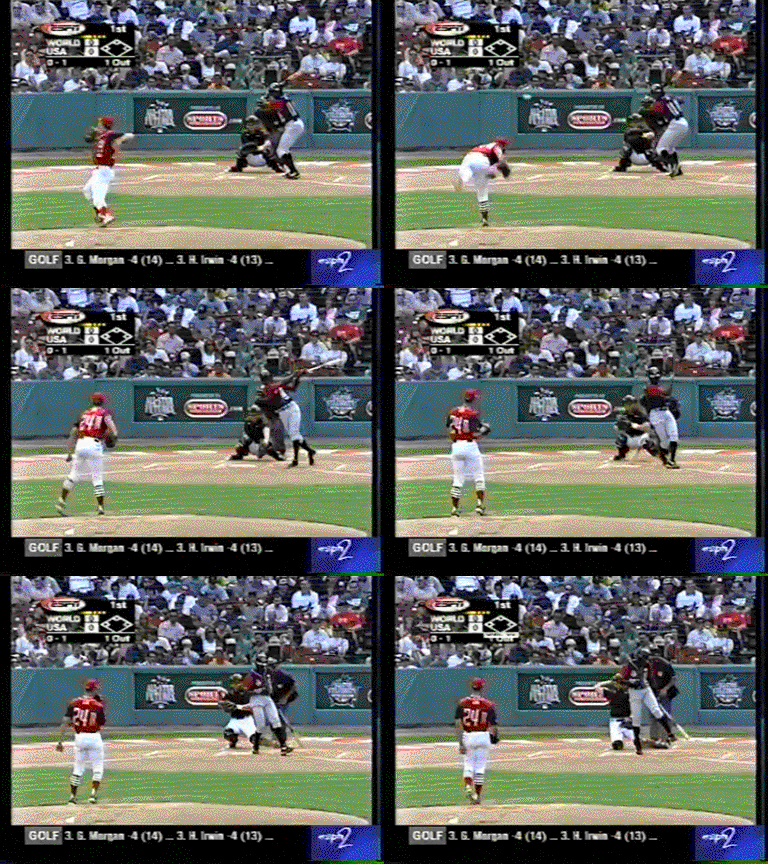
Brocail had never been a power pitcher, and the combined forces of age and repeated arm injury hadn’t done him any favors. On 2-1, he tried to sneak a backdoor breaking ball past Ankiel. The result:
Suddenly a meaningless game in an increasingly meaningless season became something bigger. For a few moments, the 2007 St. Louis Cardinals transcended the team that followed a stunning World Series victory with a Kip Wells/Braden Looper rotation.
Very few people thought that Rick Ankiel would ever see the Major Leagues after deciding to become an outfielder. In his one full season as a Major League pitcher, Ankiel hit only .250/.292/.382. He was 24 years old when he made his conversion official, and he was generally seen as a finished player. The idea that he could turn his entire career around in his mid-20s, improve his batting skills in the minors, and fight his way back to MLB was wishful thinking at best.
When he hit that home run, he proved something. He could have never taken another Major League at bat, and he would have done more than anything ever expected of him after he decided to end his pitching career. Everything else was just gravy.
A few days ago, Rick Ankiel was released by the Houston Astros. I’m not sure it was a good move, and I suspect there are several teams that could use an outfielder with an excellent arm capable of slugging .484. Nevertheless, being released by the worst team in the Major Leagues is a damning fate. This may be the end to Rick Ankiel’s career. He never became a star. He never even became a full-time starter. It’s easy to say that his career was a failure, but that would be incredibly short-sighted.
In 2000, Rick Ankiel pitched 175 innings with a 134 ERA+. In 2008, he had 463 plate appearances with a 120 OPS+. No one in the modern era has accomplished anything like that. Two separate seasons, two significantly above average stat lines, on both sides of the plate.
I don’t think Rick Ankiel should retire. He can still hit the ball a long way, which is a lot more than can be said for a number of players who still somehow inhabit a MLB roster. But if this is the end for Ankiel, it is not an ignoble end. His career is not one to be mourned, but rather celebrated. He didn’t fail. He didn’t falter. He persevered On August 9, 2007, he beat the odds. And he continued to beat the odds for over five years, seventy home runs, four hundred hits, and a few blistering outfield assists.
We will all be lucky to see another player like him.
At the beginning of every offseason, the United Cardinals Bloggers participate in a roundtable discussion about the past year and the future of the team. Thanks to the pleasant surprise of an extra month of Cardinals baseball, this discussion has continued into the winter. Last Friday was my turn to pose a question and in the wake of Albert Pujols’s defection to the Angels, I asked the following:
Should the Cardinals pursue Prince Fielder? Why or why not?
Albert Pujols is gone. Starting next season, he will no longer be a Cardinal.
Outside of a few hours yesterday, when the Marlins bowed out and the rumors were swirling that the Cardinals actually had the highest offer on the table, I was expecting this. We all should have expected this. Baseball players follow the money. Hell, people in general follow the money. Beyond family and (sometimes) country, loyalty is a fleeting and transient sentiment. Albert Pujols does not owe St. Louis anything. He does not owe Cardinals fans anything. He certainly does not owe Bill Dewitt Jr. anything. The Los Angeles Angels of Anaheim offered 254 million dollars. If reported figures are to be believed, that is at least 30 million more than what the Cardinals were willing to give him. It’s no surprise that he took it. It’s no surprise that anyone would take it.
I feel like anyone who is genuinely surprised by Pujols’s decision hasn’t been paying attention. When he demanded an extension rivaling Alex Rodriguez’s record-setting free agent contracts, he wasn’t doing it so he could reinvest the money in the city of St. Louis. When he refused to negotiate after spring training started, it wasn’t so that John Mozeliak had more time to worry about the amateur draft. And when he continued to retain Dan Lozano despite the controversy that emerged over the last two months, it wasn’t so that he could work out a deal favorable to the St. Louis Cardinals organization. This has been a long time coming. Pujols wanted to get paid.
That said, I don’t blame the Cardinals either. Matching the Angels’ offer would have been insane. The offer that the Cardinals made was probably insane. Emotionally, I wanted to see Pujols stay with the Cardinals and I would have been happy with any deal that made it possible. But logically, a ten year deal at 20MM+ is a huge risk for any player. Albert Pujols is going to be 32 when the deal begins. He will be 41 when it ends. Not many players–even elite players–age well into their late 30s and early 40s. There are freaks of nature and/or science like Barry Bonds, Hank Aaron, Mariano Rivera, and Roger Clemens that play well into their twilight years. But there are many players like Ken Griffey Jr., Alex Rodriguez, Miguel Tejada, Larry Walker, Mark McGwire, Pedro Martinez, and others who see their incredible talent ravaged by injury and time. There is no way to know what will happen to Pujols, but we all saw proof of his mortality in 2011. I don’t begrudge the Cardinals for not going higher.
I do, however, wish that the Cardinals had negotiated better. There’s no way to know the full story behind their plans and machinations. I can only see what the media shows me. But I saw a front office that, for whatever reason, was deceived by the same expectations as the fans who now lash out at Pujols. It looked like they expected him to sign, they expected him to be polite, and they expected him to want to return above all else. Pujols came into free agency looking for a battle. Mozeliak arrived looking for a handshake.
From the beginning of the offseason, the Cardinals gladly handed over every bit of leverage to Pujols and Lozano. They didn’t change their offer until late in the game. They never gave any deadlines. They outright denied any interest in free agents who could have competed with Pujols for the Cardinals money. Pujols knew that the Cardinals weren’t going anywhere. They weren’t going to snap up Jose Reyes or Prince Fielder and leave him with one less suitor. He could take his time and wait for some team to finally snap and offer him the mind-boggling sum he thought he could get. And if he didn’t get it? Unlike the Marlins offer, the Cards ~9/200MM wasn’t going anywhere.
Do I think anything would have happened differently if the Cardinals were aggressive? If they made a competitive offer to Fielder, or at least pretended that they were considering it? If they told Pujols that they needed a decision Tuesday night then pulled their offer? Probably not. Almost certainly not. But it would have been nice to see the Cardinals front office approach the negotiations with an attitude and tenacity that matched Pujols and Lozano. Like I said before, Pujols didn’t owe the Cardinals a hometown discount. But the Cardinals didn’t owe Pujols anything either. They didn’t have to announce to the world that they were not pursuing Fielder or Reyes before negotiations even began.
Now it’s over. The Cardinals will move on. Pujols will move on. I’ll probably cheer for the Angels in the AL now because Albert is still one of my favorite players. I hope he has a great career in Anaheim that proves all the doubters wrong. I hope he retires the home run champion and sails into the Hall of Fame with a Cardinal on his cap.
I also hope the Cardinals sign Prince Fielder or Carlos Beltran and crush the Angels in the World Series in 2012.
I don’t know if anyone noticed, but something’s been going on over in the sports section of STLtoday. It began a week ago, with reports that former Cardinals catcher Mike Matheny would be interviewed as a possible replacement for Tony La Russa.
Perhaps this didn’t come as a huge surprise to a lot of people. Matheny was a well-respected leader on the team many years ago. He was hard-nosed and competitive. Even then, there was talk that he would make a good coach or manager some day. But on closer examination, it was a little unusual.
Matheny hasn’t been a manager in the minors, like Ryne Sandberg, Chris Maloney, or even Joe McEwing. He hasn’t been a coach with the current Cards club like Jose Oquendo or Joe Pettini. And he certainly doesn’t have the big league pedigree of Terry Francona or Joe Maddon.
Matheny’s coaching experience, as far as I know, is limited to a few years as a spring training instructor and a series of videos for Protege Sports. Does that mean he’d be a bad manager? Of course not. I’m actually an advocate of signing an inexperienced manager because someone without a history is going to cost less. And I don’t think that the manager is terribly important. As long as he gets along with his players and doesn’t make too many horrible mistakes, he probably has less effect on the success of the team than the backup catcher or mopup reliever. There’s no reason to break the bank on a manager.
I’m in a pretty small minority with that viewpoint, however. So it was a bit unusual to me that the Cardinals, fresh off a WS victory, would consider replacing a high profile manager like La Russa with a complete rookie. I didn’t think too much about it, though. I honestly thought that they were interviewing Matheny as a courtesy or a curiosity. At that point, I assumed that Oquendo, Sandberg, and Francona were the real candidates.
Then STLtoday featured an article which detailed Matheny’s interview with the Cards. This piece highlighted his positive attributes, addressed his lack of experience, and was quick to point out Matheny’s bonds with Dave Duncan, Yadier Molina, and of course Albert Pujols.
If you’re as cynical as me, you realize that STLtoday might be floating a trial balloon. They might be preparing Cardinals fans for what they already know or suspect: Mike Matheny is the frontrunner to replace Tony La Russa. We’ve certainly seen it before. Rasmus’s departure came on the heels of various stories about his difficulty with the Cardinals coaching staff. McGwire was floated as a potential hitting coach in the news before he was hired. Are we seeing that same thing now? And why?
Why Matheny? Why would the Cardinals–who have spent the last 16 years demonstrating that they value the position of manager far too much–hire a completely inexperienced skipper?
Two possibilities come to mind:
1. This may be an unfortunate response to a crisis of leadership. The Cardinals have been Tony La Russa’s team for so long that they might not know how to live without him. Perhaps they hope to keep his reign alive as long as possible by hiring a figurehead manager, and allowing Duncan and McGwire to make the real calls. This isn’t a particularly flattering analysis for Matheny, but it is something that should be considered. Matheny is a blank slate, and perhaps the Cardinals want to shape his future with the help of La Russa’s old coaches.
Of course, if this was the goal, why not hire Joe Pettini? He’s filled in for La Russa numerous times. He probably knows La Russa’s style better than anyone but Duncan. He’d be the natural fit if you wanted to ensure maximum continuity. Which leaves me with…
2. This is Mozeliak’s power play. And it’s really goddamn interesting. When Walt Jocketty was dismissed following the 2007 season and replaced with Jon Mozeliak, I assumed the new GM was nothing but a puppet for Tony La Russa. Jocketty left over disputes with management. Mozeliak was an org team player. Throughout his time with the Cardinals, he’s been at La Russa’s beck and call. He traded Brendan Ryan and Colby Rasmus. He acquired Matt Holliday, Ryan Theriot and Lance Berkman. The media made no attempts to conceal where these moves truly originated. La Russa wanted these players (or he wanted them gone) and Mozeliak made it happen.
Now La Russa’s gone. There’s a power vacuum. And I think this is a surprising move from Mozeliak to come out of the shadows and establish that he’s no longer just an apparatus of a larger-than-life manager.
How do I figure this? A little tidbit that has come out into the public eye since this search began. Mike Matheny has been working for Mozeliak, in the GM’s office, for the last year or so. Think about this quote from the above-mentioned Miklasz article:
“He’s also served as an adviser to Mozeliak. An unofficial assistant GM, if you will.”
Interesting, right? Pettini and Oquendo are acolytes of La Russa. They worked on the field with him. McEwing and Sandberg are managerial prospects from the White Sox and Phillies, respectively. Terry Francona would bring his own people in. But Mike Matheny? He’s been working with Mozeliak.
There is still no predicting who will be the Cards’ manager in a few days. But I think that Matheny’s sudden ascension to front-runner shows that Mozeliak is ready to make the Cardinals his team. For better or worse.

 The Redbird Menace