Allen Craig is Fine. Probably.

NOTE: Allen Craig is out of the lineup tonight versus a left-handed starter, which is crazy because this season he’s been like the CIA in the 1980s: all he can do is hit lefties. Maybe he’s hurt and this is all a moot point. Or maybe Matheny is just going to Matheny and there’s no explanation.

I doubted Allen Craig for a long time. I thought his 2011 was a flash in the pan, a right-handed version of 2006 Chris Duncan, boosting a championship team up on his shoulders when they needed him, before the league could figure him out. Even after 2012, when put together an almost full season slash line of .307/.354/.522, I thought it was only a matter of time until the clock struck twelve and he turned into a couple of mice dragging a pumpkin around the basepaths.

Craig reminded me of so many other players before him. Some people call these guys “quad-A” talent, to indicate that they are too good for the minor leagues but not good enough to hack it in MLB. I’ll put a finer point on it, because there are several types of quad-A players. I’m not talking about the Brad Thompsons or Tyler Greenes but a specific species of player that has tormented fans ever since stats went mainstream.

I’m talking about minor league sluggers. They are usually a year or two older than the competition, either because they were drafted out of college or they’ve been in the organization longer than you remember. You don’t remember when they joined the organization because they weren’t drafted in the first couple rounds or they weren’t highly touted international signings or because they joined as minor league free agents. They don’t play any position very well so they usually end up at first base or right field, but somewhere on their Baseball Reference page they’ve got some minor league innings at 3b or CF because scouts claim their bat won’t carry them at a corner. But those scouts have to be crazy, because these guys are smashing AAA pitching and you just read Moneyball and we’re not here to sell jeans.

I’ll call these guys “Kilas”, after their patron saint and Platonic ideal Kila Ka’aihue, who spent years in the Royals’ Omaha affiliate doing his best Albert Pujols impersonation, seemingly ignored by a Major League team content to give at bats to Ross Gload, Scott Podsednik, and the death rattle of José Guillen. When he finally got his shot at the Majors, Kila struggled to a career .221/.305/.382 line over about 450 plate appearances.

Every team has a Kila at one point or another, and every fan base rallies around him. You can hear them on the radio, you can read them on the message boards, and if you’ve got a co-worker who read some of Baseball Between The Numbers, you’re probably never free of it. “Bring up Kila.” “Have you seen John Rodríguez’s slugging percentage?” “Can’t wait to see what Izzy Alcantera can do in Fenway.” “Cut Tino, bring up John Gall!”

So I thought Allen Craig was a Kila. He had all the warning signs. He was never considered a serious prospect, he didn’t have a position, he isn’t terribly athletic, and his tools were limited to the power/eye combo that doesn’t always translate from the minors. I was wrong. Craig had better plate coverage and contact skills than I expected, allowing him to overcome the problem that faces most Kilas, which is the inability to handle a league (mostly) full of pitchers who can locate their pitches on the corners of the zone. Even once I figured this out, I was stubborn and I kept expecting a crash that never came. By the middle of last season I finally accepted that Craig could be a Major League hitter. I stopped waiting for the crash and let myself enjoy the hits.

I’m not writing all this now, with Craig slumping harder than Nintendo’s marketing department, to say that I was right before. I’m not bragging about being right on Craig, because I’m a Cards fan and I always want to be wrong when I’m doubtful of a player. Rather, I just want to give some background for what I’m about to say:

Allen Craig is going to be fine. He may never be what he appeared to be in 2013, but that shouldn’t come off as a surprise. Anyone evaluating the Cardinals offense should probably treat 2013 like season four of Community and just assume what we think we experienced was just the result of fumes from a gas leak. We’re probably never going to see an entire team hit .330/.402/.463 with RISP again in our lifetime, and we’re certainly never going to see it from a team that hit .236/.297/.356 with the bases empty. Allen Craig was arguably the biggest beneficiary of the 2013 gas leak, putting up a line that looks more Ted Williams than Torty: .454/.500/.638

Craig probably won’t be the same hitter we saw in 2011-2012 either, as his home run power has seen a dramatic drop since his first full season. Whether this is the byproduct of nagging injuries or a conscious attempt to trade fly balls for line drives, I’ll leave up to your imagination. There is no way to know for sure, at least not until Peter Bourjos pulls an Edward Snowden and releases tapes from the batting cages before seeking asylum in Chicago.

So why am I optimistic about Craig? First, his BAbip is floating around .225, a hundred points below his career numbers. A big part of his slump has been terrible luck. So far this season he’s hit 64 balls on the ground and only 8 have squeaked through for hits. That’s only good for a .125 BAbip, when his career numbers on ground balls put him at .258. Twice as many hits on just grounders would go a long way to reversing the slump. Second, and on a related note, Craig is hitting way more grounders in total. His gb/fb rate in 2014 is 1.56, almost twice his career rate and high enough that even Ichiro Suzuki might give a respectful nod.

So Craig is hitting twice as many grounders as would be expected, and grounders are producing half as many hits as would be expected. Unless there is a hidden injury here or Craig suddenly has turned into the Kila I feared, unable to cover the inside corner of the plate, expect his numbers to bounce back. He might not make another All Star game, and it might not be enough to stave off Oscar Tavares, but don’t go writing him off based on a month and a half of bad luck just because it follows a year of the stupidest good luck.


Experiences in Old Sports Games: High Heat Baseball and Dogme 95

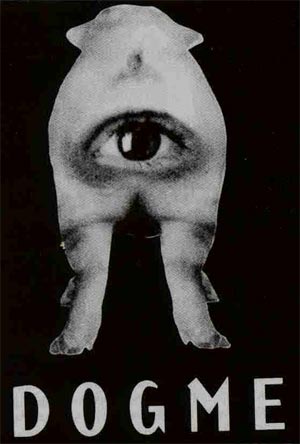
In 1995, two Danish filmmakers by the names of Lars von Trier and Thomas Vinterberg got together and decided to do the most Danish thing possible, which was to write a manifesto about film making.  The Dogme 95 Manifesto (which roughly translates to “The Manifesto of My Dog”) detailed a new philosophy of film, which wasn’t really all that new because it was largely just French New Wave on steroids.  Once the manifesto was complete, von Trier and Vinterberg followed up by doing the second most Danish  thing possible, which was to use government subsidies to fund films based on their manifesto.

This is the third most Danish thing possible.

This is the third most Danish thing possible.

Along with the manifesto, von Trier and Vinterberg developed a “Vow of Chastity”.  I am tempted to list the restrictions imposed by the Vow of Chastity but there are  10 or 11 of them, depending on how you read them, and they all work towards the same goal. Dogme 95 seeks to strip film down to the mere act of capturing light and sound on 35mm film, and remove all other trappings of cinema.  No period pieces. No genre films.  No special effects. No non-diagetic sound. No props. No fancy lenses, placed lighting, or even tripods.

Without tripods, the Dogme 95 adaptation of War of the Worlds told the story of a day-long picnic on the lawn of the Moesgård Museum.

Without tripods, the Dogme 95 adaptation of War of the Worlds told the story of a day-long picnic on the lawn of the Moesgård Museum.

I don’t know how in the mid-1990s a couple of talented filmmakers could have stumbled into the trap of Realism that other art forms had clawed their way out of decades, if not centuries, before.  A backlash against mainstream cinema was understandable, but Dogme 95 didn’t just throw out the baby with the bathwater.  It launched every other baby on Earth into the sun and boiled the oceans in the hopes that bathwater could never be created again.

If I let myself, I could probably write this entire post about Dogme 95.  As theory and thought experiment, it’s an interesting set of concepts.  But like raising a child for eighteen years without human contact to see how their mind develops in a vacuum of language, Dogme 95 is better left to theoretical discussions and never applied in the real world. It constricts a filmmaker from using the massive potential of film as an art in the name of achieving objective realism.  In the realm of video games, I’ve mentioned in my reviews for Brunswick Circuit Pro Bowling and Sensible Soccer that I don’t think that absolute objective realism is a noble goal.  The same is (mostly) true of film, and I think at least Lars von Trier has come around on this point of view based on the last decade or so of his films.  Just off the top of my head, the only part of the Vow of Chastity that Melancholia follows is that it is shot on 35mm film, and if Dogme 95 were written today I can almost guarantee that it would require the use of digital video rather than film.

Okay, let's face it, they were probably just doing the fourth most Danish thing possible: trolling the shit out of everyone.

Okay, let’s face it, they were probably just doing the fourth most Danish thing possible: trolling the shit out of everyone.

But what does any of this have to do with sports video games?

In 1998, 3DO released High Heat Baseball for the PC.  3DO is probably better known for their ill-fated console, the 3DO Interactive Multiplayer, rather than their later publishing efforts.  And there’s a good reason for this.  The 3DO console had all sorts of problems, but it was an interesting attempt to jumpstart the CD era of gaming, as well as an experiment in console funding that sought to undercut the licensing fees of Nintendo and Sega.  The games published by 3DO following the console’s failure were almost universally bad.  Remember Cubix?  Battletanx?  GoDai: Elemental Force?  So many Army Men games that the words “army” and “men” stopped having any meaning in the years between 1999-2002?  The only really good games that 3DO published were Might and Magic titles acquired from New World Computing and, of course, the High Heat series.

Sadly, in 1999 the naming conventions of video game websites and publications reached their zenith with GamerzEdge and we will never see those halcyon days again.

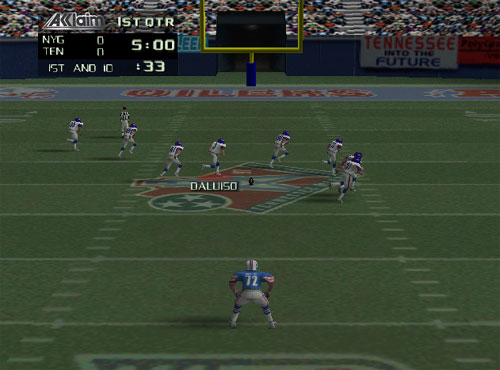
High Heat Baseball was a mixed bag upon its immediate release.  It had the unfortunate distinction of arriving in the wake of the early Triple Play games published by EA.  By the end of its life, the Triple Play series became something of a joke, but ’97 and ’98 were absolute revelations in sports game presentation and features.  They didn’t play the best, and they were plagued by Early Playstation Graphics Syndrome but at the time they were absolutely something special.  That wasn’t the only thing working against 3DO, though.  Just months before High Heat, Acclaim released All-Star Baseball 99 for the N64.  Like Triple Play, All-Star Baseball 99 looks so dated that it might as well be carrying a beeper.  But, again, at the time it was amazing.  You wouldn’t believe it from looking at it today, but the graphics outclassed anything on the market.  See also NFL Quarterback Club for the N64.

"The high resolution graphics of NFL Quarterback Club don't just move the chains...they're off the chain!" - GamerzEdge

“The high resolution graphics of NFL Quarterback Club don’t just move the chains…they’re off the chain!” – GamerzEdge

So the odds were stacked against High Heat Baseball and it honestly didn’t do itself any favors.  It didn’t have flash or glitz.  The learning curve was far more drastic than the pick-up-and-play Triple Play franchise.  It was missing the management aspects that were present in the Hardball series, and that’s without getting into the very early days of the Baseball Mogul franchise.  But High Heat did have one thing going with it: beyond the graphics, beyond the menus, and beyond the half-hearted presentation, it played a game of baseball better than anything on the market.  The variety of hits was unparalleled.  The AI was better than the competition. The interface was simple, but it produced results that felt like baseball.

Except I refuse to believe that Kyle Farnsworth ever threw a pitch slower than 90 mph.

Except I refuse to believe that Kyle Farnsworth ever threw a pitch slower than 90 mph.

The series diverged briefly in 1999 and 2000, with High Heat Baseball 2000 and Sammy Sosa High Heat Baseball 2001 respectively.  The PC game continued to evolve as a nuanced simulation while 3DO simultaneously released godawful arcade-style Playstation games under the same name.  The 2001 Playstation installment (of course named High Heat Baseball 2002) was the first decent console version of the series, and was followed up with a good PS2 port. For the next couple years, development was primarily focused on the PS2, with ports to the Xbox and Gamecube for the final installment, High Heat Baseball 2004.

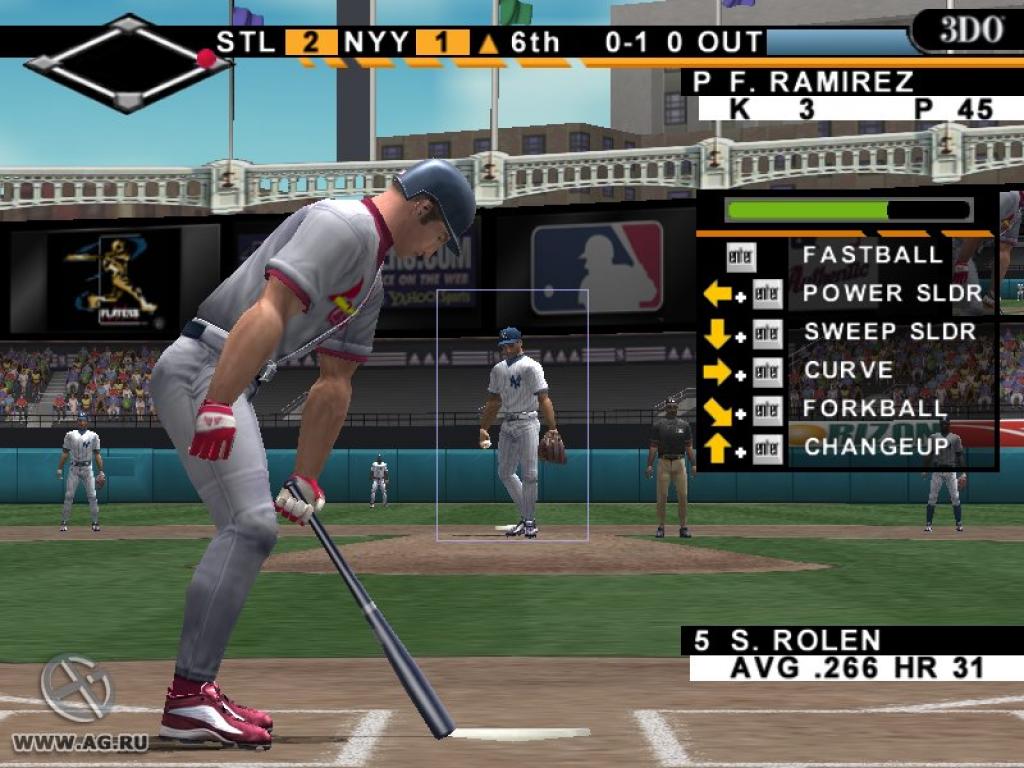
All of the good High Heat Games (read: not the early Playstation ones) had one thing in common: they played great and they looked terrible.

We have replaced Scott Rolen's forearms with tied-off socks full of oatmeal.  Let's see if anyone notices!

We have replaced Scott Rolen’s forearms with tied-off socks full of oatmeal. Let’s see if anyone notices!

This brings us full circle, back around to Lars von Trier, Thomas Vinterberg, and Dogme 95. Even fans of Dogme 95 would have to admit that it produces ugly cinema. 35mm film is finicky stuff and it doesn’t always play nice with natural sources of light. And that’s without even getting into capturing sound or lack of music or any number of restrictions that makes Dogme 95 films rather somewhat unpleasant.

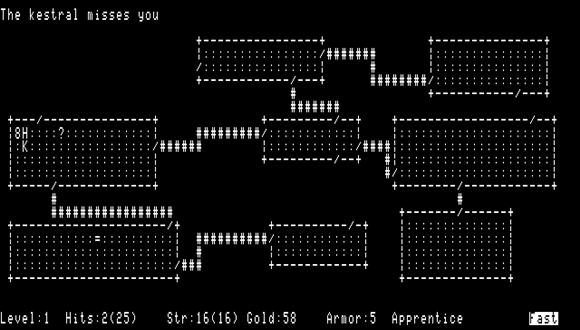
Now, I’m not about to claim that High Heat Baseball is the Dogme 95 of video games.  That’s ridiculous, as High Heat actually has graphics and sound, even if they’re terrible.  If there is any Dogme 95 of video games, it’s roguelikes without tilesets that use ASCII symbols for visual representations and PC speaker for all (if any) sound.

C'mon, let's be honest, you have to be a little autistic to understand this interface intuitively.

C’mon, let’s be honest, you have to be a little autistic to understand this interface intuitively.

Nevertheless, the High Heat philosophy comes from the same place as the Dogme 95 philosophy: strip out the extraneous production value, focus on the fundamentals.  The broadcast presentation of Triple Play or the “high resolution” of All-Star Baseball don’t lend anything to how their relative games actually play.  And, I suppose if you want to be reductive about everything, visual effects, props, lighting, and any number of other things don’t truly lend anything to the storytelling of a film.  If a stage play can convey a story, then a film can do the same without all the trappings of a film.   Rogue is playable on an ASCII terminal and a lot of people have spent a lot of time playing as an @ symbol in a field of punctuation.

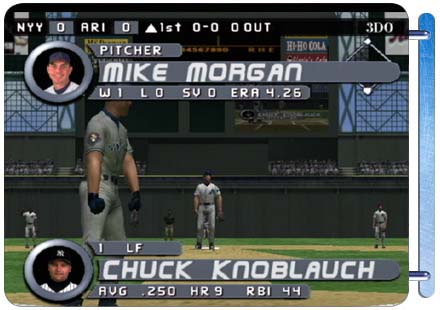
Well thanks to this game I just remembered Chuck Knoblauch's career and got really depressed.

Well thanks to this game I just remembered Chuck Knoblauch’s career and got really depressed.

Of course, like Dogme 95, High Heat Baseball didn’t last. This wasn’t the fault of the High Heat developers.  3DO went under, and if anyone is to blame it is the people behind those god damn Army Men games.  Even if High Heat was a huge fiscal success–and it wasn’t–it couldn’t possibly be enough to keep the entire publisher afloat.

But that’s not to say that High Heat and Dogme 95 didn’t leave their marks.  The echoes of Dogme 95 can, naturally, be seen in the later works of von Trier and Vinterberg.  But also in the later work of Harmony Korine, an American and one-time Dogme director himself, and mainstream/indie crossover master Steven Soderbergh.  The minimalism is tempered with the ridiculous rules falling by the wayside.  Meanwhile, Sony’s MLB: The Show has felt largely like a spiritual successor to High Heat, providing realistic scores, impressive hit variety, and a brutal learning curve.  But for The Show, good game play doesn’t come at the cost of  washed-out colors, marionette players, and presentation that never quite left the original Playstation era.  The Show has been a fantastic success, reviewing consistently well and selling better than a console-exclusive sports game should.   More than that, it’s become one of the best reasons for baseball fans to continue to buy Sony hardware.

Maybe the lesson is this: spectacle isn’t everything, but strip it away and you’ll see that it can be pretty important.

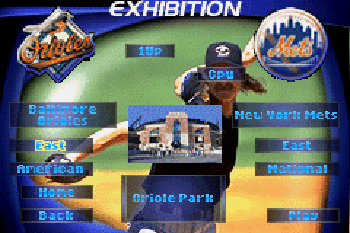
Oh dear god look at the graphic design on this menu.

Oh dear god look at the graphic design on this menu.  It’s like they’re trying to hide Randy Johnson’s identity with the word CPU but nothing can truly hide Randy Johnson’s identity.

The Beltran And The Sea

Carlos Beltran was and outfielder who hit from both sides of the plate with a Marucci maple bat and he had gone fifteen years now without taking a ring. This was not for lack of effort. In the first six years he been in Kansas City where he learned to regard their logo, a crown, with a certain sense of irony. But after six years he traveled to Houston then New York then St. Louis and he proved his worth every October. But each year he would come home with his fingers bare.

In his first years in baseball he was really very fast. He stole bases and went stood out in centerfield. He was so fast that he flattened Mike Cameron with just his running speed. But now he was an old outfielder. His knees were crooked and his arm ached when he pulled it back for a throw. Everything about him was old except the crack of his bat which was the same tenor as a thunderclap and was bold and undefeated.

“Carlos,” Miller said to him as they climbed the stairs of the dugout. “I could go out there with you. We’ve won some games.” Beltran had taught Miller about baseball and the boy loved him.

Beltran looked at him with confident eyes. “If you were my player, I’d take you,” he said. “But you are Matheny’s and there are match ups.”

“He hasn’t much faith.”

“I know,” Beltran said. “But haven’t we?”

They sat on the bench and many of the other players made fun of Beltran. Others looked at him and were sad. The successful players of Boston and St. Louis already won their rings and displayed them in glass cases with wooden plaques and now only looked to add to their glory.

“Carlos,” Miller said. “Can I get your batting gloves for you? If I cannot play with you, I would like to help in some way.”

“You brought us here,” Beltran said. “You are already a man.”

“This is your sixth post season series in St. Louis. Do you think that is a lucky number?”

“Six is a serious number,” Beltran said. “How would you like to see me bring in a ring dressed out with six hundred diamonds? Think perhaps I can?”

“Keep your bat warm, old man,” Miller said. “Remember we are in October.”

Keep my bat warm, Beltran thought. He hoisted the maple stick on his shoulder and, swinging it back and forth with a certain menace, he stepped onto the field. There were other players at other positions stretching and sprinting on the grass and Beltran could hear the roar of the crowd cheering for them but not for him. Beltran stopped in in the on deck circle and waited.

Beltran watched as Matt Carpenter faced the pitcher. Lester was left-handed but Beltran was ready.

This is the World Series. Beltran’s at-bat will be only one at-bat in all the at-bats that will ever be. But what will happen in all the other at-bats to come will depend on what Beltran does in this at-bat. It had been that way all year. All of baseball is that way.

He had no mysticism about baseball though he had played it for so many years.  Most players had superstitions. Beltran had facts. He did not wear a phiten necklace because of its magnetic properties but because its color gave his eyes a certain comforting warmth. He did not eat an entire chicken before each game for luck but to be strong in October for the truly important home runs. He did not tap his bat to hear its sound as a ritual. It was a science. The sound of a good bat is different than the sound of a bad bat. Beltran did not use a bad bat.

Carpenter fouled a pitch back towards the on deck circle. The ball rolled towards Beltran. He knelt down and picked it up.

“Baseball,” he said. “I love and respect you very much. But I will kill you dead before this day ends.”

Beltran  would have liked to come to the plate with a man aboard but the next pitch retired Carpenter. It was a cutter out over the plate and Carpenter should have taken hold of it for a drive but this was baseball. Baseball is a game of skill and a game of luck. The wind always blows harder in your face than at your back. Beltran knew that better than anyone. But he did not dwell on that.

After fifteen seasons without a ring Beltran knew he was not a lucky player. It was good to be lucky. Ryan Theriot was lucky. Pete Kozma was lucky. It was better to be exact. Every at-bat is a new at-bat. When the luck came Beltran ‘s way he would be ready for it.

Beltran stepped to the plate for the first time in a World Series game. He would not be defeated.

Experiences in Old Sports Games: Not Tony La Russa’s Ultimate Baseball

I’m late on making this post because I threw out what I wrote last night.  The subject of my post was going to be Tony La Russa’s Ultimate Baseball for the Commodore 64, both because I can’t stop picking baseball games and because I was using the post as an excuse to rant about Mike Matheny.

See, for a long time I disliked Tony La Russa.  In 2000, he started Rick Ankiel against the New York Mets in the NLCS, giving him a little-needed second chance to implode.  In 2001, he brought in Jeff Tabaka to face Lance Berkman and it arguably cost the Cardinals the division.  I realize it was foolish to get so hung up on a single bad move, but using Tabaka there may still be the single worse bullpen call I’ve ever seen (bringing in Boggs on May 30 of this year comes close).  So after 2001 I was done with La Russa and couldn’t wait for him to leave.  Of course, he didn’t leave, the Cardinals won a shit-ton, and my hatred of La Russa lessened all the way to the point that I finally want him back.

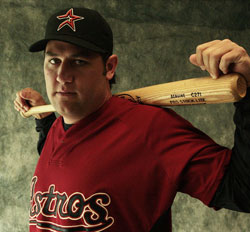
This is the 17th result for a google image search for "Jeff Tabaka", which says everything about his career and also the result of bringing him into that game.

This photo of Lance Berkman is the 17th result for a google image search for “Jeff Tabaka”, which says everything about his career and also the result of bringing him into that game.

Basically, the post I had written up Thursday night was only half about Tony La Russa’s Ultimate Baseball. I discussed how it innovated the presentation of fly balls within the game.  Rather than render every hit as a ground ball, or use a shadow texture to indicate the height of the ball, the interface marked the spot the ball would eventually land.  This made fielding much easier, and allowed for a greater variety of hit types.  This innovation and the fantasy draft, like the bullpen innovations of Tony La Russa himself, was imitated by everyone who came afterwards and is now a standard part of the genre.

Tony La Russa also innovated the use of the conga line on the basepaths.

Tony La Russa also innovated the use of the conga line on the basepaths.

The other half of my post was about how I missed La Russa, and how sick of Mike Matheny I was.  This was coming off games 4 and 5 of the NLCS, in which he put on a bad managing clinic.  It was like watching Denise Richards in The World is Not Enough: the performance was so terrible that if I wanted to teach someone how to be godawful, it would be shown in class on day one.  However, after last night I just couldn’t go through with the post.

Denise Richards could play a nuclear physicist in the same sense that Matt Adams could play shortstop.

Denise Richards could play a nuclear physicist in the same sense that Matt Adams could play shortstop.

It’s not because my mind has changed about Matheny.  I still think he’s lost out there and carried by a very talented team and front office.  Most managers are.  But it seemed light the pinnacle of Being A Spoiled Cardinals Fan to put down so many words about the manager’s mistakes on the same day that the team advanced to the World Series.  My team is about to appear in the fourth World Series out of the last ten, and I wasn’t about to write a post critical of the team while that was happening.

Yeah this looks like the face of a guy who would make the ~1,500 words I wrote on Thursday completely meaningless.

Yeah this looks like the face of a guy who would make the ~1,500 words I wrote on Thursday completely meaningless.

So in place of the post I was going to put up yesterday, I’m just going to end on a picture of Adam Wainwright and Carlos Beltran celebrating a World Series trip together, posted on twitter by Beltran’s wife, @ivanalenin.

wainbelt

Even if you hate the Cardinals, you should be cheering for Beltran to get a ring.  He’s arguably the best post-season hitter of all time, and while he shouldn’t need to bolster his Hall of Fame credentials, the truth is he’s going to need as much help as he can get.

A Modest Proposal: The Three-way Tie

Currently, the St. Louis Cardinals lead the National League Central by two games over the Pittsburgh Pirates and the Cincinnati Reds. Due to the latest turn in Uncle Bud’s Wildcard Ride, all three teams are guaranteed to make the playoffs, but only the division winner will automatically advance to the NLDS. The other two will play in a single Wildcard game to reach the division series. With the division coming down to the wire, everyone wants to talk about the worst-case scenario–or the best case scenario if you’re a Braves or Dodgers fan–a three-way tie that forces the NL Central teams into a brutal series of single game showdowns.

I have a better idea for resolving this potential problem. I think that everyone can agree that the Braves and the Dodgers are the real bad guys here, so how about we show some Central solidarity and solve this problem with some creativity.

One game. Three teams.

How is this possible? Well, to quote the classic 1997 film Air Bud, “Ain’t no rules say a dog can’t play basketball.” Each team will face both of their opponents in a single game. Each team will get a full nine innings on either side of the ball. It just won’t be at the same time.

Instead of halves, each inning will be divided into thirds. Home field and batting order will be determined by record against the other two teams. Best record plays at home, bats last. Second best record will bat in the middle third of the inning. Worst record will bat first.

Currently, the Cards have a .526 record against the Pirates and Reds, the Pirates have at .514 record against their opponents and the Reds have a .457 record. So the game would take place in St. Louis, Reds would bat first, then Pirates, then Cards. The Pirates pitchers would throw to the Reds batters in the first third of the inning, the Cardinals pitchers would throw to the Pirates batters in the middle of the inning, and finally the Reds pitchers would face the Cardinals batters. This way, each team faces one another. The team pitching would always bat in the following third of an inning, and then get a third of an inning to rest.

Winner of the three team game takes the division, then the team with the second most runs gets home field advantage for the play-in game. Given that each team has to outscore the other two to win the division, everyone will be equally motivated, even though each team’s batters are facing a different opponent than their pitchers. The only problem that could theoretically come up is if in the bottom of the ninth the Pirates are winning, the Cards are batting, and the Reds are pitching to preserve the Pirates lead with no interest in the outcome of the final third of the inning because they’ve already lost the division.

In this very unlikely situation, the Pirates will just have to hope that the Reds pitcher will be sufficiently motivated to become the first player to record a save for an opposing team because, hey, that’s pretty historic.

So let’s do it. Save some time. Three teams. One game. Twenty seven half innings. Baseball.

Experiences in Old Sports Games: RBI Baseball

We all know about the 1980s.  Even if we’re too young to remember them, there are countless Cracked and Buzzfeed lists flooding the periphery of our daily internet consumption to remind us of hair metal, Top Gun, and men wearing acid washed jeans.  Like every semi-recent era of human history throughout human history, the 1980s are simultaneously reviled and embraced throughout pop culture.

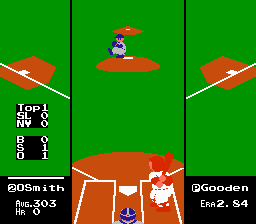
The first game I have chosen to examine for my ambitiously dumb project of reviewing old sports games is R.B.I. Baseball, released in early 1988 on the Nintendo Entertainment System. R.B.I. Baseball, which was essentially a re-worked and Americanized version of the Japanese Pro Yakyuu Family Stadium, was a revelation in baseball video games. It was the first console game to feature the names of real MLB players. And unlike the prior effort on the NES, titled simply Baseball, R.B.I. was actually playable and enjoyable. I don’t intend to focus on games as well-known as R.B.I. Baseball in the future, but I wanted to start with something familiar.

Just like we all know the 1980s, we have all heard or read Percy Bysshe Shelley’s 1818 sonnet “Ozymandias.” Perhaps it was forced upon you in high school English class, as your first introduction to romantic poetry beyond the creepy-in-retrospect couplet you passed to your freshman lab partner on the day you dissected a frog. Perhaps you clicked on the wrong link of the Watchmen wikia and accidentally read something that wasn’t illustrated. Or maybe you’re just really hyped about the last season of Breaking Bad.

“Ozymandias” tells of a fallen statue in a ruined land, erected by a tyrant who boasted that his material power would last forever. It didn’t, and the monument to his reign ended up as broken as his kingdom. Some believe that Ozymandias is based off of Ramesses II, who had no way of knowing any better, since he ruled a thousand years before the discovery of irony by Qin Shi Huang in 210 B.C.

While the kingdom of Ozymandias does not survive, the intent of the sculptor who created the statue lives on.  The tyrant is remembered by the artist who portrayed him, with “wrinkled lip, and sneer of cold command.”  What was commissioned as a monument was, in fact, a mockery of the tyrant.  He could not see it, because the flaws it portrayed were the truth.  Now, only the critique live on, while the statue has fallen to ruin along with the kingdom.

R.B.I. Baseball is, on the surface, a monument to the conservative movement that swept the United States in the 1980s.  But like the statute of Ozymandias, it speaks truth to power and reveals the flaws of an ideology that were beginning to emerge in the late years of the decade when the game was released.

The conservative victory in America during the 80s didn’t originate in America (or in the 80s, for that matter).  It was adapted from a successful product released overseas in the prior year.  Margaret Thatcher, who rose to power leading to her election to Prime Minister in 1979, was the Pro Yakyuu Family Stadium to the R.B.I. Baseball that was Ronald Reagan.  Reagan was elected in 1980, promising a new start for a country stuck in economic and geopolitical turmoil.  A former actor, Reagan was charismatic and charming.  He endeared himself to America, and in the process ushered in an era of deregulation, increased hostility to the Soviet Union, and the rollback of social programs that continues to this day.  He was known as The Gipper, probably because during his later years he was known to interject in cabinet meetings with a frantic yelp that sounded like “Gip!” to the untrained ear.

GIP GIP, MR. WEINBERGER

GIP GIP, MR. WEINBERGER

The dream of Reagan’s reforms can be seen at every level in R.B.I. Baseball, starting with the very circumstances of its release.  Reagan loved deregulation more than Jack Zduriencik loves baseball players who can nominally play a position but are probably career DHs.  Nintendo, however, was a different story.  Nintendo tightly regulated releases on its NES system.  Using a lockout chip, which required all NES games to go through an approval process it limited the number of games any publisher could release in a given year, and forced them into restrictive licenses.

Tengen, the manufacturer of R.B.I. Baseball, opted, Reagan-like, to pursue deregulation of the NES.  It acquiesced at first, licensing a number of games (including the first run of R.B.I. Baseball) through proper channels.  But once they had their hands on the NES lockout chip, they reverse engineered it and began releasing unlicensed games.  That’s why, if you owned a copy of R.B.I. Baseball, it probably looked like this:

It looks wrong. It's like walking in on your brother when he's nude and discovering that he is actually not a person but a well-coordinated pack of gray squirrels hiding in a trench coat.

It looks wrong. It’s like walking in on your brother when he’s nude and learning that he is actually not a person but a well-coordinated pack of gray squirrels hiding in a trench coat.

But the release history of R.B.I. Baseball wasn’t the only way in which the game reveled in the reforms of the Reagan era.  It strove to exemplify everything that the conservative movement achieved.  Baseball has always been a particularly individualistic sport–which is why player stats are so important.  But R.B.I. Baseball, like Ronald Reagan during his early years as a Cold War crusader, sought out all collectivism in baseball and stripped it from the batter vs. pitcher bones.

Fielding wasn’t rated, and was stripped down to a matter of only controlling the player closest to the ball.  It was by far the least important part of the game, which focused intently on the batter/pitcher matchup.  This was only exaggerated by the simplification of the pitching mechanics.  Since the NES controller had only two buttons–and one of them had to be used for pick-offs–the game “simulated” pitch movement by allowing the player to control the ball once it left the hand of the pitcher.

As such, it turned pitchers into ubermenschen, capable of abnormal and divine feats, violating the laws of physics.  It tore them down as human beings and recreated them as demigods with talents that could not be earned, only given from on high. As such, R.B.I. Baseball portrays baseball as less of a team sport and more of a clash of idols.

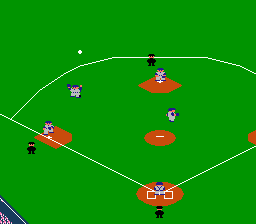
The pitcher looking away from the developing play represents the conservative fixation on restoring the glory of the past.

The pitcher looking away from the developing play represents the conservative fixation on restoring the glory of the past.

On top of this, R.B.I. Baseball doesn’t feature every team in the league. Only Boston, California, Detroit, Houston, New York (NL), St. Louis, Minnesota, and San Francisco are available, along with AL and NL All-Star teams. The eight teams represented in the game are the playoff teams from 1986-1987, an example of the social darwinism endemic to the title. Only winners are allowed to exist.  Everyone else was just the crud Michael Douglas scraped off the bottom of his shoe and fed to Charlie Sheen in my Wall Street follow-up that was apparently “too weird” for fanfiction.net.

Speaking of Wall Street, every single player in R.B.I. Baseball is white.  Color has been purged from the league.  Baseball is restored to an era in which anyone who didn’t pass a paper bag test was relegated to a different league that was much more awesome because it had Satchel Paige and Josh Gibson.  Sure, African-American players are in the game, but they’ve been whitewashed more than the cast of a high budget Hollywood adaptation.

Are you kidding me with this?

Are you kidding me with this?

So at this point, R.B.I. Baseball must seem like just another product of the conservative zeitgeist, like Red Dawn, Dallas, and the McRib.  As I alluded before, it’s not that simple.  As described in “Ozymandias” a work can both immortalize and critique the same subject matter.  R.B.I. Baseball was such a work.

To understand how R.B.I. Baseball is subversive of its subject material, one must understand that R.B.I. is a remarkably prescient game.  It was released in 1988, at the tail end of an era of baseball in which speed and contact ruled the day, and yet HR was clearly the most important rating given to players within the game and listed in the manual.

Manualsample

Making switch hitters into lefties is unsurprising. The view that one must either fully support the RIght or be a “lefty” is a remnant of Benito Mussolini’s “O con noi o contro di noi.”

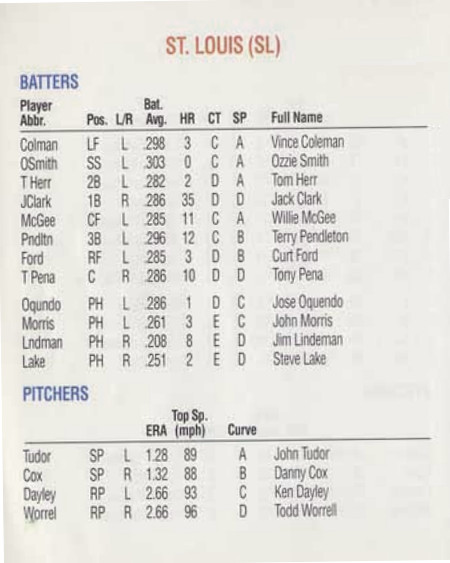
Power rules all.  Speed merely functions on the basepaths, and has little to do with success at the plate.  Contact rating, oddly enough, only modifies power in certain circumstances (See here for the best explanation I could find).

With this in mind, everything about R.B.I. Baseball falls into place.  It is not meant to be viewed by its contemporaries, but by those who come later and understand the chaos wrought by the values it satirically promotes.

RBIs are now known to be a terrible stat for measuring individual players.  They are incredibly team dependent, which runs counter to everything R.B.I. Baseball stands for.  RBIs are known to be basically useless, outside of a needless desire to conform to tradition.  The use of RBI in the title is a signpost to intelligent fans–remember, Bill James had been publishing his Baseball Abstract over ten years in 1988–that while the game might be fun, its philosophy is not to be taken seriously.

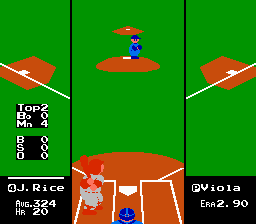
White Jim Rice is not amused by what I have to say about RBIs.

White Jim Rice is not amused by what I have to say about RBIs.

The strange Tengen cartridges pictured earlier are another example of how R.B.I. Baseball speaks out of both sides of its mouth.  On one hand, it is emblematic of the deregulation of the era.  Nintendo’s centralized licensing economy was bested by the invisible hand of the free market.  But the truth is far darker than such Randian fantasies.  Tengen agreed to work under Nintendo’s license, then used that opportunity to steal the design for the lock-out chip.  R.B.I., published both under the original licensing deal and later with Tengen’s illegitimate chip, stands for the proposition that deregulation is accomplished through theft.

Every element of R.B.I. Baseball is laced with such subtle irony.  The criteria for inclusion as a team–making the playoffs in 1986 or 1987–excludes the New York Yankees.  Can you imagine a game released today that didn’t feature the New York Yankees?  Granted, the 1980s were hardly the pinnacle of the  Yankee era, but they were still the team of Babe Ruth, Lou Gehrig, Yogi Berra, and so many championships that people occasionally had to take George Steinbrenner seriously.

As I noted before, the hitting ratings rely heavily on power, and far less on speed or contact.   In the years since the game’s release, and the advent of ROM hacking, people have broken open the RBI rating system to reveal the full picture of the ratings system.  All credit to the excellent Nightwulf R.B.I. Editor on this one:

Still a Cardinals fan, even if I'm blogging about "video" "games".

Still a Cardinals fan, even if I’m blogging about “video” “games”.

As you see, contact is represented by a two digit number in the late teens or early twenties.  Speed numbers are three digits, and there is only apparently a difference of 122-148 between Jack Clark, who once lost a foot race to the Stan Musial Statue in front of Busch, and Vince Coleman, who shot a man in Reno just to see if he could sprint to Vegas before he hit the ground.  Power, on the other hand, is rated in the 700s and 800s.  Baseball’s traditional scouting scale, from 20-80, is strange enough.  This is just madness.  Like the voodoo economics of the 80s, it seemed make everything work at the time but once we had some perspective, it was just throwing increasingly large numbers at a television screen and yelling loud enough that no one noticed when they didn’t add up.

R.B.I. Baseball is ultimately a paper tiger, and not the good kind like the life-sized cardboard cutout of Miguel Cabrera I use to scare away burglars and people who want to talk to me about advanced fielding statistics.  This is not a criticism of the game.  It was designed to be shallow, simple, and propped up by math that not only fails to check out but can’t even make it to the express lane without having a seizure.  It is a monument to the policies of its era, and yet also a scathing critique of their values.

My name is the Tax Reform Act of 1986, quoin of coins.
Look upon my works, ye Mighty, and default.

Take that, late stage capitalism.

Take that, late stage capitalism.

NSA Collecting 2013 MLB Draft Results

The National Security Agency has collected the results of the 2013 MLB draft hours before it was scheduled to begin, under a top secret court order issued by the Foreign Intelligence Surveillance Court. The order requires MLB to disclose the draft results whether or not the draft has occurred, forcing baseball executives across the country to piece together the details of an event that has not yet come to pass.

After the revelation of this secret, sweeping court order, the Obama administration has come under intense fire. Critics claim that the order, which allowed the government to obtain the upcoming draft results, violated federal law, state law, and the laws of nature.

“I’m not sure how any court could sign off on this order,” said intelligence committee member Mark Udall. “This information is protected for a reason, and that reason is clear: cause and effect is the dominant principal of classical physics.”

Dodging questions about the efficacy of time travel, a White House spokesman defended the legality of the order. “This type of information gathering is key in the war on terror. If the Chicago Cubs draft a superstar and go on to win the World Series, it could have a destabilizing effect on the entire region. That is the sort of crisis we have to be prepared for.”

The MLB order was made under a rather obscure provision of the Patriot Act, permitting the executive branch to direct the production of records pertaining to a specific, named sporting event. This subsection was added in 2003. Former President Bush pushed for the change after missing the Superbowl during a visit to Brazil due to confusion over the fact that January is a summer month in the Southern Hemisphere.

Several prominent senators have questioned the very existence of the provision permitting the subpoena of sporting records in the Patriot Act, but none have actually read the document to determine the validity of the order. “I guess that part is in there,” said Senator Tom Coburn. “I’m going to need a few more staffers to go through and verify. Fortunately, the NSA has already done the head hunting for me. By the end of the year, half these soft-tossers the Twins will drat will be out of baseball.”

The value of the documents received from MLB is undeniable. “You won’t believe what we learned,” said one operative, tasked with sorting out the details of the draft.  “For example, we’ve saved law enforcement hundreds of hours just by pre-emptively detaining every new member of the Rays organization.”

Meanwhile, as details about the disclosed documents leaked out, former Vice President Al Gore voiced his displeasure. “This is a complete over-reach,” he said emphatically. “The Mariners should have gotten more talent with the twelfth pick.”

Michael Wacha Poised To Make First Major League Start, Fix Struggling Economy

At 7:15 PM Central Time, Michael Wacha will take the mound at Busch Stadium for the first time as he looks to extend the St. Louis Cardinals’ winning streak to 5 and complete the intrastate sweep of the Kansas City Royals.  Expectations are high around St. Louis for the 2012 first round pick, with fans counting down the hours until his debut and a brutal trademark battle brewing on tumblr with a small but dedicated group claiming that hashtag #Wachamania dilutes the distinctive value of Final Fantasy X slash fan fiction hashtag #Wakkamania.

“I can’t wait to see what he can do,” said Cardinals fan Michael Wacha, who today legally changed his name in anticipation of the 21 year-old righthander’s first start. “I’m expecting to see nine, maybe ten strikeouts in the first three innings. I’d predict more, but Yadier doesn’t let enough pitches get away from him for The Big Train to really rack up the Ks in the opening third of the game.”

He later clarified that “The Big Train” was his preferred nickname for the Cardinals newest starting pitcher, after the legendary Walter Johnson.

Local businesses are also looking forward to the young pitcher’s debut. His presence is expected to create a surge in revenue, perhaps enough to make the final push for the region out of the current recession. “Tourists won’t be able to stay away,” said a representative from the office of Mayor Slay.  “This is going to be like opening a new ballpark, or even acquiring a Major League Soccer team.  People will come to the ballpark to see Wacha.  He’s something special.  I think he throws a change up.”

“This is the biggest thing to happen to this team since the Holliday trade,” one vendor told me, speaking on the condition of absolute anonymity. He is expected to get the first set of Wacha jerseys in an overnight shipment during the game tonight, and fears his competitors may target him for death if his name were to be made public. “The line is going to be around the block tonight. Everyone is going to want a #52 jersey.  There is nothing like acquiring a future Hall-of-Famer to boost sales.”

Others aren’t so quick to enshrine Wacha, who has yet to throw a pitch in the Major Leagues, among the all-time greats. “We’re decades ahead of ourselves with that conversation,” said one Cardinals scout. “I wouldn’t book your ticket to Cooperstown just yet.  By the time he’s eligible, I expect the Hall of Fame to be relocated to Iowa City, the birthplace of Michael Wacha.”

The End of the Tony La Russa Era

Tony La Russa retired today.  He decided to leave baseball on a high note, stepping down as the manager of the Cardinals after leading the team on a thrilling, improbable streak to a world championship.

This move leaves me with a lot of mixed feelings.  Sometimes I like La Russa.  Sometimes I hate him.  Even when he’s winning, he can be infuriating.  Even when he’s losing, he can be fascinating.  No other manager sticks Skip Schumaker at second base, then leaves him there even after he’s proven he can’t play the position.  But, then again, no other manager is willing to try batting the pitcher eighth.  I still think that’s a good idea.

No matter how I feel about La Russa at the moment, there is no denying that he shaped the face of the St. Louis Cardinals.  For better and for worse.

He took over as manager in 1996.  That was back when Bill Clinton was campaigning for a second term, the Macarena was a hit song, and Hailee Steinfeld–the actress who played Mattie in 2010’s “True Grit”–wasn’t even born.

La Russa took the team from the fading embers of the contact-and-speed Ozzie Smith era to the electrifying tape-measure Mark McGwire era.  It wasn’t a graceful transition, and ended up alienating Smith as well as a legion of Cardinals fans.  There are still those who, to this day, yearn for the slaps and steals of Whiteyball.

La Russa guided the team through the days of the MV3: Pujols, Edmonds, and Rolen.  But he also broke up the band.  His bizarre feud with Scott Rolen cast a dark shadow over what should have been a pleasant run at a title repeat in 2007.

The next few years were rough, but La Russa remained as the Cardinals built a new sort of team.  Pujols remained, but instead of being surrounded with elite hitters, he was paired with a couple of aces.  Chris Carpenter and Adam Wainwright were not always healthy at the same time.  But when they were, they made the Cardinals a team to be feared.

And now the Pujols years may be coming to an end.  It’s too soon to be sure, but there’s a fair chance that next season is an entirely new beginning.  If so, Tony La Russa took us all the way from the end of Whiteyball to the end of the Pujolsball.  That’s sixteen years.

It’s almost impossible to judge the skill of a manager.  There are too many factors.  If we want to be traditional–look to wins, postseason appearances, and titles–La Russa may be the best manager the Cardinals have ever had.  In his sixteen years, the Cardinals made the postseason nine times.  They went to three World Series.  They won two of them.  Only a Yankees fan could find those results unacceptable.

Of course, La Russa was gifted with incredibly talented players during his time with the Cardinals.  Lankford, McGwire, Drew, Edmonds, Pujols, Kile, Rolen, Carpenter, Wainwright, Holliday, Berkman…  Just to name the standouts.   La Russa also had the benefit of the best pitching coach in baseball.  I’m not sure Dave Duncan isn’t the one really responsible for La Russa’s success in St. Louis.  There is no one like him and I suspect he will be missed even more than Tony in 2012.

Considering the folks surrounding La Russa, it’s damn near impossible to give him full credit for everything he did for the Cardinals.  But he shouldn’t be overlooked.  Chances are, La Russa had a finger in acquiring many of the players I listed above.  He was more than just a manager.  He exerted control over the team far beyond the confines of the dugout.

That was part of the reason Walt Jocketty–another talented person who lent his skill to La Russa’s legacy–left in 2007.  The Cardinals weren’t his team.  They were Tony’s team.  And they were handed over to John Mozeliak.  Outside of the surprising Chris Duncan trade, Mozeliak has largely been seen as an apparatus of La Russa’s influence.

When La Russa wanted Matt Holliday, Mozeliak got Matt Holliday.  When La Russa wanted Brendan Ryan gone, Brendan Ryan was gone.  After Tony expressed a desire to improve the “character” of the clubhouse, Mozeliak brought in Ryan Theriot, Lance Berkman, and Nick Punto.  When Colby Rasmus wore out his welcome, he was shipped off for veteran pitching depth.

Things are going to change now.  Tony La Russa is no longer in charge.  What does that mean?  Is that good?  Is it bad?  I don’t have the answer for that.  When you look at the decisions La Russa made–and the fact that he was being paid millions to make them–it’s hard not to think the team is better off without him.  But when you look at his tenure in St. Louis–the years between 1996 and today– it was, overall, an amazing time to be a Cardinals fan.

I often disagreed with Tony La Russa.  I often hated his decisions. I often wanted him gone. But the Tony La Russa era was far more than the sum of its parts.  It’s very possible that I will never see a more prosperous stretch of Cardinal baseball.

So I want to thank Tony La Russa for the last sixteen years.  I don’t know if he’s responsible for any of it.  But I also don’t know if that matters anymore.

Elaboration on an Abomination

I wish that I could convince myself that what I am about to write is simply hyperbole.  I don’t want to feel this way.  I don’t want to be this reactionary and short-sighted.  But it’s impossible.  I can’t stop thinking it.  Tonight may have been the worst-managed baseball game I’ve ever watched.  Feel free to correct me.  Tell me about a game that was managed worse. It would make me feel better.

Tonight I watched the St. Louis Cardinals make a series of awful decisions that cost them the lead in the World Series.  And it sucked.

Earlier this evening, I made a very quick post about Mike Napoli’s stats versus righthanded and lefthanded pitchers.  It was brief, and I only made it because I couldn’t fit my point into a single tweet.  Basically, Napoli’s had a strong platoon split for his entire career.  He hits righthanders fine, but he crushes lefties.  This season especially, he’s been one of the best hitters in baseball against lefthanded pitching.  Leaving in noted lefty Marc Rzepczynski to face Napoli with the bases loaded was painfully foolish.  It’s reminiscent of allowing Lohse to face Howard in game 1 against the Phillies.  La Russa loves matchups, and he’s been manipulating them like crazy throughout the playoffs.  Here, he sat in the dugout and watched as a mediocre lefty faced a batter who eats lefties for breakfast.  The result was predictable.  4-2 Rangers.

If only that was all we saw tonight.  Instead, we also witnessed Ryan Theriot pinch-bunt.  Bunting isn’t a great move in general.  There are few situations where it improves the chances of scoring a run.  Most of those situations involve a pitcher at the plate.  There’s no reason to insert a player into the lineup specifically to bunt.  That’s insane.  I thought about citing statistics to prove how insane that is.  I don’t think that’s necessary.  The insanity is self-evident.  And I wish it was the most insane thing we saw.

No, the most insane move of the night was bringing Lance Lynn into the game to intentionally walk Ian Kinsler.  This was the calling card of the catastrophe.  It was how we all know that something was truly wrong.  There’s no explaining it.  Bringing in a pitcher, issuing an intentional walk, then pulling that pitcher should never happen.  Never.  I can contrive an elaborate situation to justify almost any managerial move–even the pinch bunt.  Not this one.  Clearly, the Cardinals management was lost in one of the most important games of the year.

Then to top it all off, in the top of the ninth the Cardinals send Allen Craig while Pujols (who can hit the ball a long way) is batting and Neftali Feliz (who can barely find the strike zone) is pitching.  It wasn’t just predictable that Albert would swing at a ball out of the zone and Craig, slow as his tortoise, would be thrown out at 2b.  It was damn near fated.  Craig can’t run.  Feliz is probably one of half a dozen pitchers in baseball  that Pujols can’t be trusted to make contact with.  Why?  Why hit and run there?  Craig crossing the plate doesn’t win the game for the Cards.  It doesn’t even tie the game.  The only reason to hit and run is to prevent the double play.  DPs have been a problem for the Cards, but consider this:

Albert Pujols has struck out 704 times in his career.  He’s only hit into 232 double plays.  That’s actually a lot of double plays and not that many strikeouts.  But the K is STILL far more likely than the GIDP.

Neftali Feliz has struck out 164 batters in his career.  He’s allowed 150 ground balls.  That’s right, Feliz is more likely to strike out a hitter than allow him to make contact and produce a ground ball.

There’s no reason to just expect a DP.  There’s no reason AT ALL to hit and run.

After the game, the excuses came fast and furious.  There was something wrong with the bullpen phone.  Albert himself put on the hit-and-run.  The speed at which this team covers for Tony La Russa is phenomenal.  If Allen Craig could run as fast as the Cards spin their failures, the team would be coming home up 3-2.

I really don’t know what else to say about what we saw in game 5.  It was atrocious.  It was like watching a car accident, except car accidents are usually over much quicker.

One week ago, the entirety of sports media was fawning over La Russa’s brilliance.  I wonder how many of those same writers dare question him after tonight?