I Probably Owe Y’all A World War K Update

Since there wasn’t a new World War K post this week, I figured I should post some kind of explanation. Don’t worry, the series isn’t stopping. The next post, which will feature the All Star game and a look at the trading block, should go up next Monday or so. I basically lost a week of free time to a law conference followed by a game jam, which is the first time in recorded human history those two events have been paired up to explain anything, but I do intend to continue and finish, though I may accelerate the time table and there may be more than a week between later posts. There are two reasons for this.

First: I don’t know if you’ve noticed, but the Kansas City Royals are still playing baseball. The ALCS begins later today, and they’ll face off against Baltimore for the chance to appear in their first World Series since The Series That Shall Not Be Named here in St. Louis. This has kind of put a damper on the story of rebuilding an underdog Kansas City team

When I first introduced the Royals back on July 14, they were 48-47, six and a half games out of first place and looking so listless that even Buzzfeed couldn’t make a list about them. Then, in August and September they went 34-21 and barely captured the Wild Card before beating the cream of the NL West and advancing to where they are today. Let’s just say this makes framing the narrative of my posts rather difficult, since I’m probably going to have to play a lot of games or save-load several times to get a run better than the real one will end up being.

This isn’t the first time this has happened to me. In early 2004, I wrote a screenplay that had a ton of titles over the months I worked on it. The one I remember is Fenway’s Ghost, so you can probably guess were this was going. The plot concerned a con artist who posed as a ghost whisperer/psychic who scams his way into the Red Sox front office by claiming he can speak to the spirit of Babe Ruth and lift the Curse of the Bambino. Once he has the job, though, the real ghost of Babe Ruth appears to him and threatens to expose the con unless they work together.

It was a dumb, broad comedy that had to dance around being too much like Major League, but I still thought it was pretty good. Before I could even edit it enough to try and do something with it, the Red Sox actually won the World Series and suddenly it was worthless.

I didn’t want to give up the script, so I rewrote. It couldn’t be about the Red Sox anymore, but there still needed to be a World Series drought, a ghost, and a city big enough that I could write some broad stereotypes and everyone would understand them. You can probably see where I’m going with this, too. I changed the Red Sox to the White Sox, Boston to Chicago, Babe Ruth to Joe Jackson. This required some work, as Jackson’s motivations would be different from Ruth’s and there was no Yankees-level rivalry to give me a natural villain. But I did it. The new script, Shoeless, was done in early 2005.

You all know what happened next. The Chicago White Sox won the World Series, broke their curse, and once again made my script less needed than another American Pie Presents film. At this point, I was working on other projects for school and didn’t have time to rewrite, so I temporarily gave up on the project. But I also did what any fan would do after twice seeming to predict the winner of the World Series less than halfway through the season. I hit “Find – Replace” on a few key terms. Turned Chicago into St. Louis, White Sox into Cardinals, Joe Jackson into Rogers Hornsby, 1919 into 1982. The script didn’t make any sense at all, because Rogers Hornsby wasn’t banned from baseball for throwing games and 25 years isn’t a drought. But the Cardinals still won the World Series in 2006. You’re welcome.

In 2007, I needed a feature-length comedy script to pitch to a few agents and studios, so I returned to the seemingly-magical .scw file and I did something I knew that I could regret for the rest of my life. I decided to make the story about the Chicago Cubs. Not only did I need the script to make sense because it was probably my best writing sample, I had to see just how powerful I was. Could I will the Cubs—the fucking Cubs—to a World Series victory. I’m not sure what I would have done if the Cubs actually took home the trophy in 2007. I might have been too terrified to ever write again.

Fortunately, I never had to answer that question. The Cubs did not win the World Series, though they did make the playoffs. Those three games were filled with plenty of existential terror on my part, let me tell you.

So here we are again, with yet another baseball comedy story threatening to be taken apart by actual baseball. But I’m not going to stop the story of Strike-O-Matic and Pat Burrell, Alcides “aWAR” Escobar and Alex the Girrafe-kin. But if the Royals win the World Series, I’m not sure I can ever in good conscience write fake baseball stories about real teams again.

The other reason that there may be a bit more delay between posts is that I’m returned to an old project I abandoned about a year ago that has a lot in common with World War K. Not ready to make a big, full-on post about it just yet but if you’ve liked these posts then, well, you’ll probably like this as well. So stay tuned for that, and expect the next installment of World War K shortly after the weekend.

MLB The Show – World War K: Halfway There (June Recap)

13header

Start from the Beginning – Episode 1: The History of the First Base War

Previous Episode: More Like Chief Blah-Hoo

In the far-flung future, June 30 will be remembered as one of the turning points of the Base Wars.  On June 29, 2081, US President Emma Jeter ordered an overnight attack on a server farm in silicon valley.  This battle was known as the Net Offensive, Brought to You by State Farm.  (Corporate sponsorships of major military actions had become the norm in the 2040s, starting with the Mountain Dew-mascus Assault in 2042, and by 2081 no one was even moderately shocked by the idea.)

The Net Offensive Brought to You by State Farm began with the firebombing of Paolo Alto, which was made exceedingly difficult by the fact that the pilots could not use computers for targeting or navigation.  Dozens of jets took to the air over central California, dropping tons of explosives on everything that looked remotely like a server farm.  By the June 30, they actually started to hit meaningful targets.  President Jeter spent the morning deep in her secure bunker, watching a live feed of the attacks.  Every time the headquarters of an early 2000s  tech startup went up in flames, she would pound her chest and mutter “yeah jeets”.  Despite the fact that the Net Offensive Brought to You by State Farm was ultimately successful, this fact would be brought up multiple times during her impeachment hearings the next year.

But in the innocent days before the Base Wars, June 30 was not known for a violent battle.  At best it was known as Chan Ho Park’s birthday.  Or the midway point of the baseball season.

Why didn't I come out of retirement for this season?

Why didn’t I come out of retirement for this season like Ray King and Kei Igawa?

Continue reading

MLB The Show – World War K: Money Also Walks

11header

Start from the Beginning – Episode 1: The History of the First Base War

Previous Episode: Sign of the Moose

PrimeTime Moose and the St. Louis Cardinals were defeated, and the Kansas City Royals wouldn’t have to face them again, except perhaps in the World Series.  Taking 3 out of 4 games from the Cardinals was a huge boost to the Royals, as the Redbirds had established themselves as the best team in the NL of the first half, despite the often puzzling decisions of the manager.  But this was just the beginning of a stressful month of June.  The MLB Amateur Draft was scheduled immediately after the series against the Cardinals, and then the New York Yankees rolled into Kansas City for a four game set.  The Yankees hadn’t been a particularly formidable team to date, but they were boosted by the addition of a robot master of their own.

run winning

Unlike Mike Mussina, who had allowed his consciousness to be used as a template for robot players because he wanted to be able to better control farm equipment, Rickey Henderson’s reasons for submitting to the experiment were a lot simpler: he still didn’t want to leave the game.  Despite being quite old when robots began playing MLB, Henderson was not ready to hang up his cleats.  The 80-something outfielder still believed he had a few more good seasons in him, even if his body disagreed in literally every way possible.

Rickey had not left baseball on his own terms.  While he played his final game in 2003, he continued to insist that he was in good enough shape to suit up for any number of teams, and could be an immediate contributor.  Despite a pedestrian final season and legs that were held together with withering sinew, he toughed it out in the independent leagues and maintained his desire to return to MLB until 2007.  The advent of robot players gave Rickey a chance to run again.

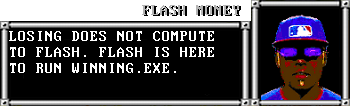
Whereas Mussina’s imprinting failed, Rickey’s was wildly successful.  The original Rickey Henderson remained in his body, while numerous copies of his consciousness were sold and uploaded into leadoff robots around MLB.  Each one was tweaked slightly, given upgrades and abilities to make it stand out.  The most successful was converted into a switch hitter for the Neo New York Yankees.  This particular iteration on Rickey Henderson, Flash Money, was chosen by K.I.R.K.G.I.B.S.O.N. to go back to 2014 to assist in the destruction of baseball.

literally Continue reading

MLB The Show – World War K: Sign of the Moose

10header

Start from the Beginning – Episode 1: The History of the First Base War

Previous Episode: The New Blood (May Recap)

For years, the world believed that Mike Mussina’s baseball story ended in 2008.  At age 39, the veteran ace retired after his first 20-win season.  He never won a World Series, never pitched a no-hitter,  and never claimed a Cy Young, but with 270 wins and 3.68 ERA in one of the highest offensive eras in baseball, he was considered a solid Hall of Fame candidate among fans who knew what the hell they were talking about.  After Mussina left baseball, he spent his days doing crosswords and fixing up old tractors.  He never thought he’d get a chance to pitch again, except maybe in an old-timer’s game if he suddenly decided he could stand to be around the other old-timers.

The first robot baseball stars could be distinguished by their design.  Top robotics firms used space-aged alloys, precision-crafted joints, and advanced processors to build machines that would stand out among their counterparts.  But before long, every android player was built from one of a handful of perfected designs.  The only advances made in the machinery were slight and incremental.  Teams had to find new ways to elevate their robots–to make them better than the competition.

First efforts in advanced robot AI were led by MLB’s chief programmer, Jeff Francoeur.  Francoeur was an ex-ballplayer himself, who had retired and went back to school to devote himself to other causes after a life-changing incident in the independent leagues: he’d let his bat slip out of his hands on a strikeout and killed a fan sitting behind the dugout.  A repentant Francoeur had devoted himself to the cause of safer baseball.  To him, this meant helping transition to robot baseball players whose pressurized mechanical hands could never lose the grip on the handle of a bat.

Jeff-Francoeur-Puppy

Jeff Francoeur in happier days.

Continue reading

MLB The Show – World War K: The New Blood (May Recap)

9header

Start from the Beginning – Episode 1: The History of the First Base War

Previous Episode: Trade Winds Part Two

In the dark future of 2099, robots playing baseball is commonplace.  Pitches are thrown at 150 mph.  Bats are laced with carbon fibers to increase home run distance.  Laser weapons are mounted on arms to assist with breaking up double plays.  These machines are designed with a certain brand of the sport in mind–one that fragile human flesh and bone would be unable to withstand.  But it was more than that.  Robot baseball was efficient.  It was calculated.  It was stripped of random chance and uncertainty with the virtual minds of the players guided by calculations beyond the comprehension of the human mind.

When the rogue AI K.I.R.K.G.I.B.S.O.N. selected six robot masters to send back to 2014, it did not anticipate these differences.  It believed that the robot masters would be unstoppable. It failed to take into account…the human element.  The fielders behind the robot pitchers would not be perfect.  In fact, many of them would be quite terrible.  The pitches the robot hitters faced in 2014 would be slow and unpredictable.  And so, despite everything that had gone wrong with Mike Trout’s plan to save baseball, there was still hope.

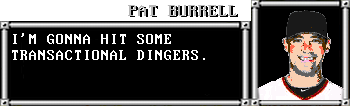
As May came to an end, and faced with a mediocre start to the season, player/GM Pat Burrell made two dramatic moves to improve the Royals.  Struggling prospect John Lamb was shipped out for the most corpulent pitcher in basebal, Bartolo Colon.  And James Shields, whose ERA was beginning to affect the tides, was traded to the Cardinals for Matt Holliday and Carlos Martinez.  This was a risky deal, as one of the six robot masters was playing for the Cardinals.  There was a good chance Shields could put everything together again, but Burrell saw enough potential in Martinez that he didn’t believe St. Louis could end up winning the deal.

youngdominican

Continue reading

MLB The Show – World War K: Trade Winds Part One

7headerStart from the Beginning – Episode 1: The History of the First Base War

Previous Episode: The King in the North

As the baseball season slipped past the midpoint of May, the Kansas City Royals found themselves in a rut.  The handful of players keeping the team afloat found their numbers normalizing, and the struggling majority didn’t improve in kind.  A terrible 1-7 run against the Rockies, Orioles, and White Sox left them with a 24-23 record and stuck in third place.  The GM of most teams would just wait out the trouble and hope for a rebound.  But Pat Burrell and Strike-O-Matic knew that they couldn’t let the Royals fall any further behind.

Fetch

beepbeep

transactional

Continue reading

MLB The Show – World War K: The Frame Game (April Recap)

5header

Episode 1: The History of the First Base War

Episode 2: And We Will Always Be Royals

Episode 3: Verland Before Time

Episode 4: The Candyman Can

T.S. Eliot once wrote that April is the cruelest month.  But what the hell did he know?  He wrote a book that inspired the musical Cats.  His hands are  stained with blood.  In baseball, April brings hope and uncertainty.  The passage of the month brings the first significant statistical endpoint to evaluate players or the team as a whole.  However, almost all of these stats–even win/loss record–come with sample size caveats.  You can’t project how well anyone will do based solely on their April.  But that doesn’t keep people from trying.

Late into the month of April, it became clear that the Royal’s catcher, Salvador Perez, was suffering from overuse.  He was hitting worse than anyone else on the team, which caught Player/GM Pat Burrell by surprise.  Perez was supposed to be one of the few sincerely good players on the Royals.  Burrell decided that the team needed a quality backup catcher and veteran presence.  Someone to fill the role that Todd Pratt had during Burrell’s early years in Philadelphia.  Unfortunately, Todd Pratt was now 47 years old, so getting him out of retirement would be more than a chore.  Burrell would have to trade for a backup, and do so without giving up anything of significant value.

With that in mind, he went to the team’s advance statistics department for advice.  Unfortunately, the Kansas City Royals advanced statistics department had been gutted during the Dayton Moore years, and now consisted of nothing but shortstop Alcides Escobar sitting in a small office after every game and browsing Fangraphs.

framing

Continue reading

World War K Episode 3: Verland Before Time

ep3head

Episode 1: The History of the First Base War

Episode 2: And We Will Always Be Royals

The first day of the regular season brought the first major challenge for the new-look Kansas City Royals.  Their first opponents were the Detroit Tigers and the first pitcher they would face was Justin Verlander.  For years, Verlander had been one of the most formidable pitchers in the American League.  In 2011-2012, he was absolutely unhittable.  2013 saw the first signs of decline for the hard-throwing right-hander, but all but the most pessimistic fans thought he would bounce back to contend for a Cy Young.

In the original version of the timeline, before Strike-O-Matic and the robot masters changed everything, 2014 was a disappointment for Verlander.  His first-half ERA was almost a run and a half above his career numbers.  Even by the standards established in Detroit in the early 21st century, this was a disaster.  However, time travel changes everything.  While the robot masters had no particular interest in Verlander other than his eventual subjugation at their cold steel hand, their presence would disrupt the timeline across the board.  This would give him another shot at a successful 2014.  And Verlander wasn’t someone to bet on disappointing twice.

tigertiger

Continue reading

FIFA 14: 6.7 Billion People Can’t Be Wrong Part Three – All Clocked Up

Imagine a heated Cardinals/Brewers game in the bottom of the ninth inning at Miller Park.  The Cardinals have a one run lead.  Trevor Rosenthal is on the mound.  There are two outs and probably at least one runner on base, given Rosenthal’s recent tightrope act.  After six tense pitches, Rosenthal finally pushes a 98 mph fastball past Ryan Braun for the strikeout.  The crowd goes silent, but before the Cardinals can celebrate the win over their division rivals, the home plate umpire stands up and raises a finger to the sky, indicating that the game will go on for one more inning.  With three more outs, and now Seth Maness or a tired Trevor Rosenthal, the Brewers come back to with the game in the bottom of the tenth even though the Cardinals were leading at the end of the ninth.

Sounds crazy, doesn’t it?  Like a dystopian nightmare or the fever dream of a power-mad C.B. Bucknor.  But something like that happens at the end of both halves of a soccer match.  See, time doesn’t stop in soccer.  It’s not like basketball, where points and fouls and out-of-bounds halts the game.  Or like American football, where some things pause the clock (incomplete pass, touchdown) and others don’t (ball carrier tackled within the field of play).  In soccer, the clock keeps ticking away.  Then, at the end of each half the referee adds a number of minutes that he believes represents the time lost to events that paused the flow of the game.

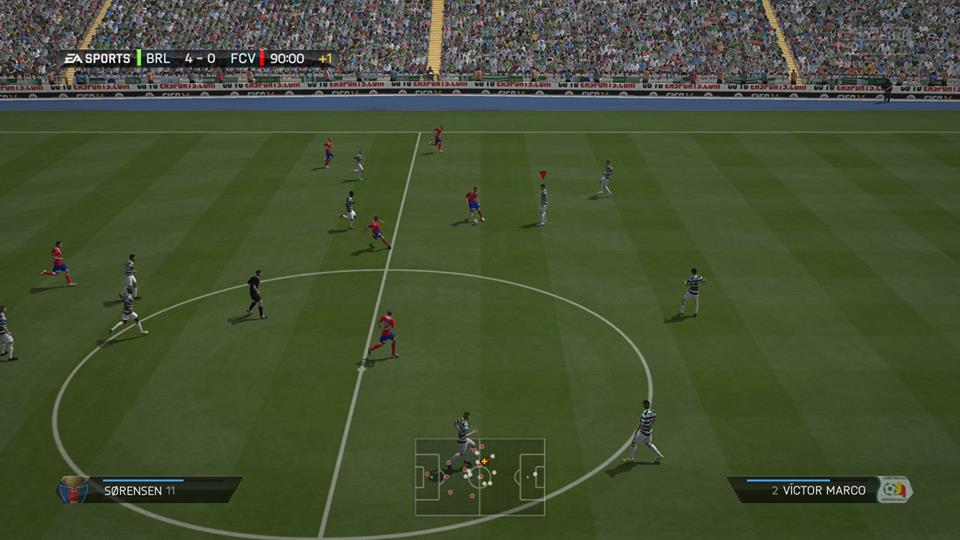
Only getting one minute at the end of a 4-0 blowout isn’t such a big deal for my opponents, but if they game had been close then people probably would have died in whatever city FCV represents.

As anyone who watched the US team in the World Cup can tell you, the decision about how much time to add to the half is where the system starts to break down for someone who isn’t regularly exposed to it.  In the US/Portugal game, the second half of the game ended with the US leading by 2-1 and the referees added five minutes to the half–just long enough to allow Portugal to tie the game and prevent the United States from automatically advancing to the knockout round.  And in the latest US/Belgium game, one a single minute was added at the end of extra time, which didn’t give a surging U.S. much of a chance to put together one last attack to tie.  Naturally, US fans who aren’t accustomed to this method of  timekeeping were furious about both decisions.  It seemed arbitrary and, well, it is.

Continue reading

FIFA 14: 6.7 Billion People Can’t Be Wrong Part One – I Have No Idea What I’m Doing

During the 1996 United States presidential election, an adviser to Republican candidate Bob Dole by the name of Alex Castellanos identified a key swing voting bloc he called the “soccer mom”.  Castellanos did not invent the term, but did move it into the political forefront.  The soccer mom was seen as a harried, middle class woman who was preoccupied with the busy lives of her children. The term was not meant to be derogatory, but in the coming years it would come to represent a boring, milquetoast view of the suburban family.

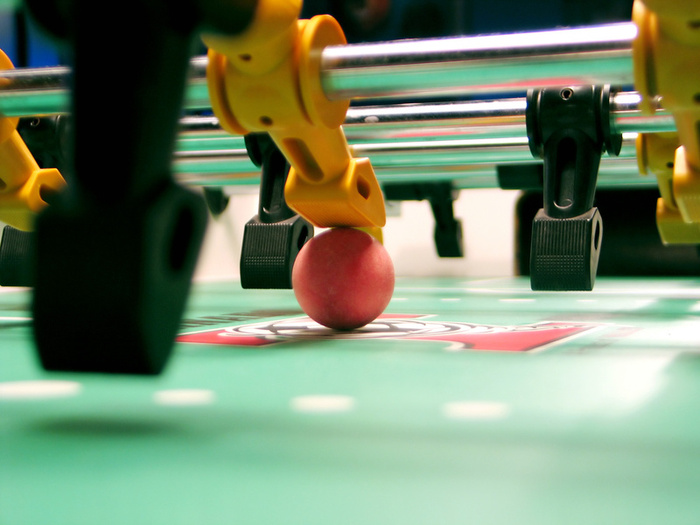
Anywhere other than the United States, a “soccer mom” would be a “football mom.”  And anywhere other than the United States, the thoughts it would stir up would not be of a middle-class housewife driving her children around, but a manic FC fan breaking her beer bottle over the head of someone who dared insult the virility of her favorite player.  This is because outside of the United States, soccer isn’t a game played by children and small wooden figures with a metal bar through their chests on a foosball table.

This is soccer, right?

This is soccer, right?


Supposedly, 250 million people worldwide play soccer.  That means that there are only 60 million more Americans than there are soccer players.  But don’t worry, even though those 250 million people are probably in a lot better shape than our 310 million Americans, any revolution will be quickly thwarted because the only effective way to use a gun is with your hands.

As long as I can remember, I have avoided learning much about soccer.  I think I played soccer for a brief time when I was a kid, but I was very young and I didn’t get off the bench unless someone broke a major bone, so it didn’t leave any impression on me.  I don’t know the rules, I don’t know the teams, I don’t know the players.  But this week I decided that had to change.

Right now, we’re mired in the middle of World Cup fever which, as I understand, is like the bubonic plague except Europe never managed to get rid of it.  Apparently a few rats made it onto a boat to the States recently, because I feel like soccer is suddenly being pushed on me like never before.  Soccer is all over ESPN.  Twitter keeps posting these scoreboards as promoted tweets, I think, because I certainly never followed the twitter soccer scoreboard.  The supermarkets, even in the middle of the country during baseball season, have big World Cup displays like it’s the Superbowl.

Why are there so many hands on this logo? If there's one thing I know about soccer it's that this logo should get a penalty.

Why are there so many hands on this logo? If there’s one thing I know about soccer it’s that this logo should get a penalty.


I was sick of it so I decided I needed to learn about soccer.  Of course, I wasn’t going to learn about soccer by playing soccer, since I wouldn’t even know where to start assembling an entire soccer team in the United States.  And I wasn’t going to learn by watching it–not yet–because I’ve tried that before and a full soccer game is pretty boring when you don’t understand what’s going on.  Although, it was fun to realize that the only time a British announcer sounds excited is when he gets to yell “GOOOOOAL”.

And I certainly wasn’t going to read about soccer, because reading is for nerds.  So I bought a soccer video game.

This is the back of the box for FIFA 14. I refuse to believe "Ya Es Real" is real Spanish and not someone faking Spanish.

This is the back of the box for FIFA 14. I am dubious about “Ya Es Real” being actual Spanish and not the result of a lazy person saying “yeah it’s real’ with a bad Mexican accent to the copywriter.

I’ve tried this before, with a PS3 Cricket game but I didn’t last long.  Apparently, the game itself was bad, which didn’t lend to being particularly entertaining even to someone who did understand cricket.  FIFA, on the other hand, is a renowned series and the most recent mainline installment, FIFA 14, is one of the best-reviewed games on the new generation of consoles.  My hope is that it won’t be a huge slog to play, and I can make learning fun.  Like Oregon Trail, but with slightly less dysentery.

To make it more entertaining to write (and hopefully read) about, I made two rules.  First, I’m going in blind.  I know very little about soccer, highlighted by the fact that I wrote this blog post about Sensible Soccer without ever discussing the sport. What I do know is this: there are two teams and two goals and there’s only one guy per team who can use his hands and he dresses in different clothes than everyone else.  That’s about it.

Second, I will try to avoid learning anything about soccer outside of playing FIFA 14.  I’ll watch games if I get a chance, but I don’t have a TV so that’s unlikely.  I won’t avoid seeing scores or keeping up with team USA, but if I have a question about how something is working in the game I won’t look it up.  I’ve heard that there is a short rulebook that has less than 20 rules which is called “The Laws of the Game.”  While I don’t know much about soccer, I know that “The Laws of the Game” is a soccer-as-hell name for a rulebook.  I’m not going to read it. The reason for this is as dumb as the rest of this project.  I’ve heard that Madden is particularly terrible about teaching a newbie how to play American Football.  There’s no way to test this, since I have always known the general rules of American Football.  But I sure as hell can put FIFA 14 to the test.  I will be relying entirely on the feedback from the game to figure out how to play it.

As a result, I’m sure I’m about to write some really stupid things about soccer and hope that it is entertaining.

Artist's rendition of my first FIFA 14 game.

A metaphor representing this project.

Once I decided I was going to go through with this, no matter how dumb it’s going to make me look, I didn’t hesitate.  It would be too tempting to go to wikipedia, look at some rules, learn about some players, and spoil everything I planned.  Instead I went to Target, bought FIFA 14,went home, and began playing.  Damn the results.

The first thing the game asked me was to set my language.  I was taken aback.  This is America.  There’s only one language we speak in this country.  We aren’t beholden to any other nation.  This is the very reason we rose up against the crown.  We didn’t want to bow to any fancy European lords with their fancy European languages.  So, FIFA, you know damn well what language I’m going to choose.  I’m going to choose Ameri–

Choose Language

OH

That is not an American flag.  That’s a god damn British flag.  What’s next? Soldiers in my home?  Strict laws prohibiting libel against the monarchy?  TAXES ON MY TEA?

FUCK

FUCK

There was no getting around it.  I had to betray my country to the House of Windsor just to get the game started.

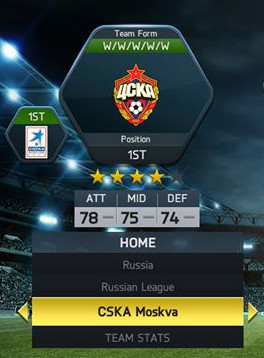
The next thing the game told me was to select my favorite club.  I know the name of two soccer teams.  One is the Los Angeles Galaxy because I lived in Los Angeles and I thought that was a silly name for a sports team.  The other is Real Madrid, because I heard it once in passing and decided that I wanted to visit Fake Madrid for the running of the mechanical bulls.  I didn’t want to select either of these teams because it didn’t seem genuine, so I scrolled through the options until I found one that fit the RedbirdMenace aesthetic.

Moskva

That’ll do.

This appears to be Moscow’s team in the Russian League.  Even though I already knew what CSKA signifies–the team was previously part of the Soviet Army Sports Club–I’m going to invent my own meaning for the acronym to fit with my theme of going in completely blind.  So, from here on out, this will be the Cool Soccer Kids Association of Moscow.

Once the game was fully installed, I decided to take the Cool Soccer Kids into their first game.  There are a ton of modes in FIFA 14 and, of course, I have very little idea what all of them are.  I get Career Mode, because Madden has it.  And Ultimate Team is the game that MLB The Show stole Diamond Dynasty from.  But what the hell is the rest of this?

Modes

I have been online and I do not believe that there are any friendlies there.

I had hoped that there was a tutorial.  Various iterations of Madden had something like a tutorial.  It wasn’t always great, but it outlined the mechanics of the game, at least.  As far as I can tell, FIFA 14 doesn’t come with a manual–not in the case or on the disc–so no matter what I chose I was going in blind.  “Skill games” was the closest thing I saw on the menu on to a mode that introduces all the game mechanics,but I wasn’t about to start with that.  I didn’t have any skill.

With no other choice, I picked “Kick Off”, paired the Cool Soccer Kids up against some team from Saudi Arabia, and jumped right in without any clue how to play the game.  A short loading screen mini-game popped up that informed me how to shoot the ball–the circle button–but other than that I didn’t even go into the menu to look at the controls before the game began.

That was probably a bad idea.

I HAVE NO IDEA WHAT I AM DOING

I HAVE NO IDEA WHAT I AM DOING

And so it begins, what will undoubtedly be the most embarrassing series of blog posts I have ever made since the time I played an entire season of NBA 2K14 and wrote Quantum Leap fanfiction around it.

NEXT TIME ON “6.7 Billion People Can’t Be Wrong”, I try t0 figure out why the refs keep taking the ball away from me right when things are about to get interesting and why these god damn British announcers keep showing me this:

lines

If you told me soccer had lasers in it I would have started watching a lot earlier.