
MLB The Show – World War K: Money Also Walks

11header

Start from the Beginning – Episode 1: The History of the First Base War

Previous Episode: Sign of the Moose

PrimeTime Moose and the St. Louis Cardinals were defeated, and the Kansas City Royals wouldn’t have to face them again, except perhaps in the World Series.  Taking 3 out of 4 games from the Cardinals was a huge boost to the Royals, as the Redbirds had established themselves as the best team in the NL of the first half, despite the often puzzling decisions of the manager.  But this was just the beginning of a stressful month of June.  The MLB Amateur Draft was scheduled immediately after the series against the Cardinals, and then the New York Yankees rolled into Kansas City for a four game set.  The Yankees hadn’t been a particularly formidable team to date, but they were boosted by the addition of a robot master of their own.
run winning

Unlike Mike Mussina, who had allowed his consciousness to be used as a template for robot players because he wanted to be able to better control farm equipment, Rickey Henderson’s reasons for submitting to the experiment were a lot simpler: he still didn’t want to leave the game.  Despite being quite old when robots began playing MLB, Henderson was not ready to hang up his cleats.  The 80-something outfielder still believed he had a few more good seasons in him, even if his body disagreed in literally every way possible.

Rickey had not left baseball on his own terms.  While he played his final game in 2003, he continued to insist that he was in good enough shape to suit up for any number of teams, and could be an immediate contributor.  Despite a pedestrian final season and legs that were held together with withering sinew, he toughed it out in the independent leagues and maintained his desire to return to MLB until 2007.  The advent of robot players gave Rickey a chance to run again.

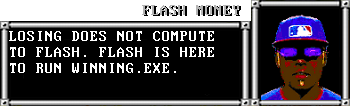
Whereas Mussina’s imprinting failed, Rickey’s was wildly successful.  The original Rickey Henderson remained in his body, while numerous copies of his consciousness were sold and uploaded into leadoff robots around MLB.  Each one was tweaked slightly, given upgrades and abilities to make it stand out.  The most successful was converted into a switch hitter for the Neo New York Yankees.  This particular iteration on Rickey Henderson, Flash Money, was chosen by K.I.R.K.G.I.B.S.O.N. to go back to 2014 to assist in the destruction of baseball.

literally Continue reading

MLB The Show – World War K: Sign of the Moose

10header

Start from the Beginning – Episode 1: The History of the First Base War

Previous Episode: The New Blood (May Recap)

For years, the world believed that Mike Mussina’s baseball story ended in 2008.  At age 39, the veteran ace retired after his first 20-win season.  He never won a World Series, never pitched a no-hitter,  and never claimed a Cy Young, but with 270 wins and 3.68 ERA in one of the highest offensive eras in baseball, he was considered a solid Hall of Fame candidate among fans who knew what the hell they were talking about.  After Mussina left baseball, he spent his days doing crosswords and fixing up old tractors.  He never thought he’d get a chance to pitch again, except maybe in an old-timer’s game if he suddenly decided he could stand to be around the other old-timers.

The first robot baseball stars could be distinguished by their design.  Top robotics firms used space-aged alloys, precision-crafted joints, and advanced processors to build machines that would stand out among their counterparts.  But before long, every android player was built from one of a handful of perfected designs.  The only advances made in the machinery were slight and incremental.  Teams had to find new ways to elevate their robots–to make them better than the competition.

First efforts in advanced robot AI were led by MLB’s chief programmer, Jeff Francoeur.  Francoeur was an ex-ballplayer himself, who had retired and went back to school to devote himself to other causes after a life-changing incident in the independent leagues: he’d let his bat slip out of his hands on a strikeout and killed a fan sitting behind the dugout.  A repentant Francoeur had devoted himself to the cause of safer baseball.  To him, this meant helping transition to robot baseball players whose pressurized mechanical hands could never lose the grip on the handle of a bat.

Jeff-Francoeur-Puppy

Jeff Francoeur in happier days.

Continue reading

MLB The Show – World War K: The New Blood (May Recap)

9header

Start from the Beginning – Episode 1: The History of the First Base War

Previous Episode: Trade Winds Part Two

In the dark future of 2099, robots playing baseball is commonplace.  Pitches are thrown at 150 mph.  Bats are laced with carbon fibers to increase home run distance.  Laser weapons are mounted on arms to assist with breaking up double plays.  These machines are designed with a certain brand of the sport in mind–one that fragile human flesh and bone would be unable to withstand.  But it was more than that.  Robot baseball was efficient.  It was calculated.  It was stripped of random chance and uncertainty with the virtual minds of the players guided by calculations beyond the comprehension of the human mind.

When the rogue AI K.I.R.K.G.I.B.S.O.N. selected six robot masters to send back to 2014, it did not anticipate these differences.  It believed that the robot masters would be unstoppable. It failed to take into account…the human element.  The fielders behind the robot pitchers would not be perfect.  In fact, many of them would be quite terrible.  The pitches the robot hitters faced in 2014 would be slow and unpredictable.  And so, despite everything that had gone wrong with Mike Trout’s plan to save baseball, there was still hope.

As May came to an end, and faced with a mediocre start to the season, player/GM Pat Burrell made two dramatic moves to improve the Royals.  Struggling prospect John Lamb was shipped out for the most corpulent pitcher in basebal, Bartolo Colon.  And James Shields, whose ERA was beginning to affect the tides, was traded to the Cardinals for Matt Holliday and Carlos Martinez.  This was a risky deal, as one of the six robot masters was playing for the Cardinals.  There was a good chance Shields could put everything together again, but Burrell saw enough potential in Martinez that he didn’t believe St. Louis could end up winning the deal.

youngdominican

Continue reading

MLB The Show – World War K: Trade Winds Part Two

8header

Start from the Beginning – Episode 1: The History of the First Base War

Previous Episode: Trade Winds Part One

Pat Burrell and the Kansas City Royals thought that trading for Major League pieces in the middle of May would be a difficult proposition, but they had underestimated the power of the trading block.  After putting out feelers for a few players listed on the block, it became clear that they were more than just available–they were priced to move.  The Royals would be able to upgrade both their rotation and their lineup with some judicious planning.

The first call Pat Burrell made was to Sandy Alderson, GM of the struggling New York Mets.  The Mets had not been expected to contend in 2014, and in the new alternate future they were more than living up to expectations.  They sustained a 9-18 record in April and continued to barely limp along into May. Alderson already knew there wasn’t much hope of competing, and wanted to move some of the older spare parts off for pieces in the future.

heavy load

weight

talkingbartolo

rounded

hng

Continue reading

MLB The Show – World War K: Trade Winds Part One

7headerStart from the Beginning – Episode 1: The History of the First Base War

Previous Episode: The King in the North

As the baseball season slipped past the midpoint of May, the Kansas City Royals found themselves in a rut.  The handful of players keeping the team afloat found their numbers normalizing, and the struggling majority didn’t improve in kind.  A terrible 1-7 run against the Rockies, Orioles, and White Sox left them with a 24-23 record and stuck in third place.  The GM of most teams would just wait out the trouble and hope for a rebound.  But Pat Burrell and Strike-O-Matic knew that they couldn’t let the Royals fall any further behind.

Fetch

beepbeep

transactional

Continue reading

MLB The Show – World War K: The King in the North

6header

Episode 1: The History of the First Base War

Previous Episode: The Frame Game (April Recap)

The theories of the 2010s pitch-framing analysts are lost to history, purged after a reactionary movement seized sports media in 2031 and instituted the Heyman Doctrine, a brutal set of reforms that made the use of any advanced statistic less predictive than ERA punishable by death.  But we do know that these statistics informed the 2014 Kansas City Royals’ decision to acquire Jose Molina from the Tampa Bay Rays.  Molina, a month away from turning 39 at the time of the trade, could otherwise hardly be seen as a trade target for a team that hoped to save the future of baseball in 2014.  He had a career OPS hovering around the low .600s and had never received more than 350 PAs in a season.  If not for the pitch framing craze of the 2010s, why else would anyone trade for Jose Molina?

knowthetruthwhat is thatsoro

ahura

Continue reading

MLB The Show – World War K: The Frame Game (April Recap)

5header

Episode 1: The History of the First Base War

Episode 2: And We Will Always Be Royals

Episode 3: Verland Before Time

Episode 4: The Candyman Can

T.S. Eliot once wrote that April is the cruelest month.  But what the hell did he know?  He wrote a book that inspired the musical Cats.  His hands are  stained with blood.  In baseball, April brings hope and uncertainty.  The passage of the month brings the first significant statistical endpoint to evaluate players or the team as a whole.  However, almost all of these stats–even win/loss record–come with sample size caveats.  You can’t project how well anyone will do based solely on their April.  But that doesn’t keep people from trying.

Late into the month of April, it became clear that the Royal’s catcher, Salvador Perez, was suffering from overuse.  He was hitting worse than anyone else on the team, which caught Player/GM Pat Burrell by surprise.  Perez was supposed to be one of the few sincerely good players on the Royals.  Burrell decided that the team needed a quality backup catcher and veteran presence.  Someone to fill the role that Todd Pratt had during Burrell’s early years in Philadelphia.  Unfortunately, Todd Pratt was now 47 years old, so getting him out of retirement would be more than a chore.  Burrell would have to trade for a backup, and do so without giving up anything of significant value.

With that in mind, he went to the team’s advance statistics department for advice.  Unfortunately, the Kansas City Royals advanced statistics department had been gutted during the Dayton Moore years, and now consisted of nothing but shortstop Alcides Escobar sitting in a small office after every game and browsing Fangraphs.

framing

Continue reading

MLB The Show – World War K: The Candyman Can

header4


Episode 1: The History of the First Base War

Episode 2: And We Will Always Be Royals

Episode 3: Verland Before Time

The first two weeks of the season for the Kansas City Royals passed with neither a bang nor a whimper.  The team was thoroughly mediocre, and after a 5-3 start, they dropped two games in a row to settle at 5-5 in their first two turns through the rotation.  None of this could be blamed on the starting pitching, however.  All five of the Royals’ starters–Strike-O-Matic, James Shields, Bruce Chen, Jason Vargas, and Kyle Zimmer–had been fantastic.  However, the lineup was struggling to produce runs.  Sal Perez, Colby Rasmus, Alex Gordon, and Mike Moustakas all had averages below .200 and their futility prevented the relative success of Nori Aoki, Eric Hosmer, Pat Burrell, and Omar Infante from bearing much fruit.

However, this was no time for the offense to be slumping.  Game 11 pitted the Kansas City Royals against their interdivisional opponent, the Minnesota Twins.  And perhaps more importantly, it pitted Strike-O-Matic against the first of the six robot masters, the deceptive hurler Stubby Candyman.

BasewarsCandyman

In the year 2099, the robot Stubby Candyman was the ace pitcher for the St. Paul Conjoined Twins, aptly renamed after the great Minneapolis Nuclear Disaster of 2051.  Unlike most robot hurlers, Candyman did not rely upon pure power to overwhelm his opponents.  Instead, his arm cannon was equipped with a variety of darting and dancing breaking breaking pitches.  His knuckleball was considered the best in all of MLB, as he could eject the baseball without any spin but still control its general trajectory towards the plate.  His slider, which was the hardest pitch he threw, could start at the knees of a left handed batter and end up on the far side of the strike zone.  And his vulcan change?  Well, he was the only one who even knew what a vulcan change actually was.

sting

Continue reading

World War K Episode 3: Verland Before Time

ep3head

Episode 1: The History of the First Base War

Episode 2: And We Will Always Be Royals

The first day of the regular season brought the first major challenge for the new-look Kansas City Royals.  Their first opponents were the Detroit Tigers and the first pitcher they would face was Justin Verlander.  For years, Verlander had been one of the most formidable pitchers in the American League.  In 2011-2012, he was absolutely unhittable.  2013 saw the first signs of decline for the hard-throwing right-hander, but all but the most pessimistic fans thought he would bounce back to contend for a Cy Young.

In the original version of the timeline, before Strike-O-Matic and the robot masters changed everything, 2014 was a disappointment for Verlander.  His first-half ERA was almost a run and a half above his career numbers.  Even by the standards established in Detroit in the early 21st century, this was a disaster.  However, time travel changes everything.  While the robot masters had no particular interest in Verlander other than his eventual subjugation at their cold steel hand, their presence would disrupt the timeline across the board.  This would give him another shot at a successful 2014.  And Verlander wasn’t someone to bet on disappointing twice.

tigertiger

Continue reading

World War K Episode 2: And We Will Always Be Royals


ep2header

Episode 1: The History of The First Base War


It is said that nothing worth doing is ever easy, and this is doubly true of time travel.  The fabric of the past resists change, not unlike a stubborn mule or the American South.  To move a human-sized pitching machine from the war-torn hell of the year 2099 to the slightly less war-torn hell of 2014 is a process with many steps, and there are numerous things that could go wrong.  It is thought that the power-crazed Artificial Intelligence K.I.R.K.G.I.B.S.O.N. actually sent back an army of robot masters to destroy baseball, and only the six most hardy even survived the trip.

When the aged Mike Trout programmed the Strike-O-Matic to go back to 2014 to stop the robot masters, he gave it a simple enough mission.  The Strike-O-Matic was instructed to find Mike Trout in the past and join the Angels to defeat the nefarious plans of K.I.R.K.G.I.B.S.O.N.  Unfortunately,  Strike-O-Matic’s memory was stored on a Chinese knockoff “Zandisk” solid state hard drive, which Trout had purchased on eBay.  This flash memory was poorly insulated from the terrible magnetic effects of time travel, and by the time Strike-O-Matic arrived in the year 2014, everything it had been programmed to do was corrupted.

The Strike-O-Matic only had a vague idea that he had to join forces with the best player in baseball and outplay some other robots, but everything else was lost to the corruption.  Ever resourceful, Strike-O-Matic turned to the resource that it assumed was the most reliable–networked crowdsourcing.  Strike-O-Matic didn’t understand that in 2014, the internet was only quasi-regulated and that people still thought “trolling” was fun.  Also, its irony meter had been destroyed by the massive influx of irony created during time travel, so it took the first response it received as the gospel truth.

twitter

Continue reading